


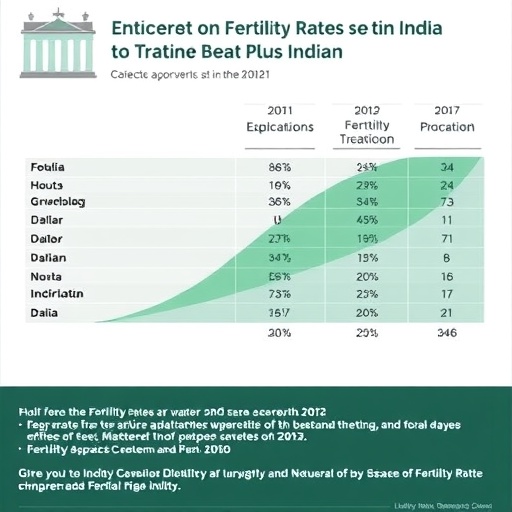
In a groundbreaking study published in the Journal of Population Research, the intricate relationship between education and fertility rates across diverse macro-regions in India has been meticulously examined. The research, authored by M. Das, sheds light on the evolutionary trends in fertility rates spanning two distinct cohorts: those born between 1945–1949 and those born between 1975–1979. This exploration not only deepens our grasp of demographic shifts in India but also amplifies the discourse surrounding educational attainment and its cascading effects on reproductive behavior.
The study meticulously categorizes India into macro-regions, reflecting the country’s vast and varied socio-economic tapestry. Each of these regions showcases unique educational landscapes, cultural norms, and familial structures, which inevitably play a critical role in determining fertility rates. The analysis brings forth significant findings that correlate higher educational attainment among women with lower fertility rates, a trend that is particularly pronounced in the more urbanized and economically developed regions.
As societal norms shift and educational opportunities expand, women born in more recent cohorts have shown a marked decline in fertility rates compared to their predecessors. The research indicates that the cohort of women born between 1975 and 1979, benefiting from improved access to education and family planning resources, exhibits significantly different reproductive behaviors than those from the 1945-1949 cohort. This demographic evolution is essential in understanding the broader implications of educational reforms and policy interventions.
Further, the differences between urban and rural settings emerge as a pivotal theme in Das’s research. Urban centers typically offer greater access to educational resources, healthcare, and career opportunities, leading to delayed childbirth and smaller family sizes. In contrast, rural areas, where traditional practices and norms may still reign, display higher fertility rates despite educational advancements. This urban-rural dichotomy highlights the need for tailored approaches in policy-making that address the unique challenges faced by different communities.
Moreover, the analysis delves into how educational differentials extend beyond just individual choices. They reflect systemic issues including socio-economic status, access to healthcare, and vocational prospects that shape the family planning decisions of women. For instance, women with higher levels of education are not only likely to have fewer children but also to invest more resources in their offspring, thereby enhancing the overall quality of life. This cyclical benefit underscores the importance of fostering educational initiatives as a means of empowering women.
The study further explores intersectionality by examining how factors such as caste, religion, and economic background intersect with educational attainment to influence fertility rates. In many regions, educational opportunities are not equitably distributed, leading to significant disparities that resonate across generations. Women from marginalized communities often face barriers that inhibit access to quality education and corresponding family planning services.
Das’s research also highlights how political and economic policies play a critical role in shaping educational trajectories and, consequently, fertility rates. Policy shifts such as increased funding for women’s education and family welfare programs have a direct correlation with observed demographic trends. As the Indian government continues to navigate these challenges, understanding the nuanced impacts of education on fertility could inform more effective policy interventions.
The implications of these findings extend beyond academic discourse, offering profound insights for stakeholders in public health, education, and economic development. By recognizing the pivotal role of women’s education in shaping demographic trends, policymakers can initiate programs that promote female empowerment, ultimately leading to sustainable development. When women are educated and empowered, the benefits ripple through households and communities, fostering improved health outcomes and economic stability.
Das’s study also calls for an ongoing dialogue surrounding the social constructs that influence reproductive choices. As educational institutions evolve, they must address not just academic curricula, but also the cultural narratives that shape women’s identities and aspirations. There is a pressing need to challenge traditional norms and ensure that education aligns with modern realities, empowering women to make informed choices about their reproductive lives.
The research also strongly advocates for increased investment in reproductive health services and education. Women must have the tools and knowledge to make informed choices about their bodies and futures. The availability of contraceptive methods and family planning resources, coupled with educational initiatives, could significantly alter fertility patterns in a positive manner. This integrated approach is essential for driving meaningful change in demographic trends across India’s diverse landscape.
As we move forward, the findings from Das’s research serve as a clarion call for increased collaboration between educational institutions, health services, and community organizations. By working together, these entities can create a more supportive infrastructure for women, resulting in ripple effects that influence health, economic conditions, and societal norms. The intertwined nature of education and reproductive health underscores the critical importance of viewing these issues through a holistic lens.
In conclusion, M. Das’s study on educational differentials in cohort fertility rates offers vital insights into the demographic transformations occurring in India. By elucidating the complex interplay between education and fertility, the research establishes a compelling case for policy interventions that prioritize women’s education and empowerment. As India continues to grapple with its demographic challenges, the lessons derived from this research could illuminate pathways toward a more equitable and prosperous future, benefiting not just women but society as a whole.
Das, M. Educational differentials in cohort fertility rates across Indian macro-regions: A study of cohorts born between 1945–1949 and 1975–1979.
J Pop Research 42, 38 (2025). https://doi.org/10.1007/s12546-025-09368-z
Cite Scienmag News
Courtney Benton. (August 26, 2025). Educational Impact on Fertility Rates in India. Scienmag. https://scienmag.com/educational-impact-on-fertility-rates-in-india/
Courtney Benton. "Educational Impact on Fertility Rates in India." Scienmag, 26 August 2025, https://scienmag.com/educational-impact-on-fertility-rates-in-india/. Accessed 3 September 2026.
Courtney Benton. "Educational Impact on Fertility Rates in India." Scienmag. August 26, 2025. https://scienmag.com/educational-impact-on-fertility-rates-in-india/


