


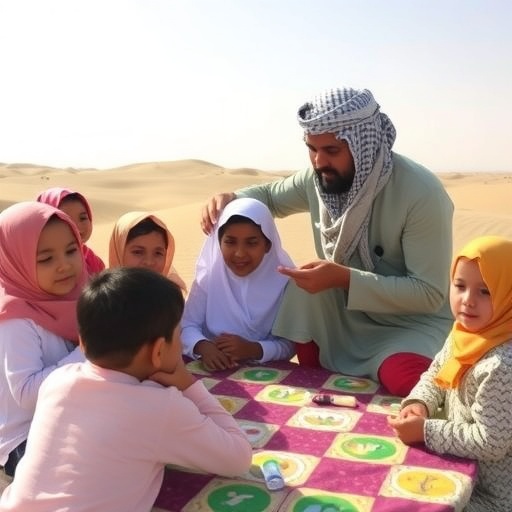
In classrooms across Israel’s Negev region, a quiet transformation is taking place. Arab-Bedouin children, many of whom arrive at school speaking Arabic at home and facing Hebrew as an imposing, often intimidating second language, are discovering that the fastest route to fluency may run through something they already love: play. A new study published in the International Journal of Early Childhood by Aref Abu-Gweder of Kaye Academic College of Education and Achva Academic College examines how didactic games, purpose-built educational games embedded in classroom instruction, can serve as a catalyst for second-language acquisition, social integration, and emotional empowerment among young learners from a minority community navigating two linguistic worlds at once.
The research focused on four core themes that emerged from classroom observation and qualitative analysis: active learning, peer communication, motivation and a sense of achievement, and parental involvement. Rather than treating Hebrew as a second language (HSL) as a subject to be drilled, the study positioned it as a living medium of interaction, one that children absorbed naturally while negotiating game rules, giving instructions to teammates, and solving tasks collaboratively. The games acted as what the author describes as a culturally responsive pedagogical tool, deliberately designed to be simple, accessible, and highly interactive, so that the linguistic demands of the classroom discourse matched the developmental capacities of the children while still stretching their vocabulary and oral fluency.
From a theoretical standpoint, the study draws on well-established principles of second language acquisition and sociocultural learning theory. Language, in this framing, is not acquired primarily through explicit grammatical instruction but through meaningful, repeated, and emotionally engaged use in authentic communicative contexts. Didactic games provide precisely this kind of context. When a child must ask a peer to hand over a card, describe a picture, or explain a move in Hebrew, the language ceases to be an abstract school subject and becomes a tool for achieving a goal the child genuinely cares about. This goal-directed communication lowers the affective filter, the psychological barrier of anxiety and self-consciousness that so often suppresses minority-language learners’ willingness to speak.
The findings document clear gains in oral fluency, vocabulary expansion, and, perhaps most strikingly, confidence in speaking Hebrew. The confidence gains were especially pronounced among students who typically hesitate to participate in conventional lessons, the quiet children at the back of the classroom who rarely raise their hands. Within the game framework, these children found low-stakes opportunities to produce Hebrew utterances: the rules of the game demand communication, but a mistake costs nothing more than a turn. The real-time, immediate feedback loop of play, where success or failure is visible within seconds, produced what the author calls a genuine sense of achievement, generating high emotional and physical engagement that reduced language anxiety and encouraged students to initiate Hebrew speech more freely than they otherwise would.
A second layer of the study concerns the adults in the room. The games did not operate in a vacuum; they were facilitated through a triangular interaction among the children, pre-service teachers, and mentoring teachers. This arrangement created what the study describes as a multi-layered learning ecology. The pre-service teachers, themselves often drawn from the Arab-Bedouin community and fully aware of the linguistic and cultural landscape their students inhabit, acted as linguistic mediators, scaffolding children’s understanding by reformulating instructions, modeling target vocabulary, and bridging the gap between the children’s home language and the target language. At the same time, the presence of mentoring teachers transformed the activity into a professional learning experience for the novice educators, linking academic teacher-training coursework to the everyday realities of classroom practice. Scaffolding, in the Vygotskian sense, flowed in multiple directions simultaneously: children were supported in their language learning, and novice teachers were supported in their professional development.
This dual function is significant in light of broader challenges documented in the literature on Arab-Bedouin education. Research cited in the study points to persistent gaps in Hebrew proficiency among Bedouin students at every educational level, from primary school through higher education, where Hebrew competency strongly predicts academic self-efficacy and success. Hebrew is not merely a school subject for these children; it is the language of Israeli higher education, employment, public administration, and civic life. Deficits in Hebrew acquisition therefore compound existing socioeconomic and educational disparities. By intervening early, at the age when language attitudes and confidence are formed, game-based pedagogy addresses the problem at one of its most tractable points.
The fourth theme, parental involvement, proved to be an unexpected amplifier of the intervention’s effects. When parents were drawn into the games, whether through take-home activities, school events, or shared play sessions, the boundary between home and school blurred. Hebrew words and game-based habits of learning traveled into households where Arabic is the exclusive language of daily life. Parents reported gaining a more positive attitude toward their children’s schooling, and children gained an audience beyond the classroom for their new linguistic skills. The study suggests that this home-school connection extended both Hebrew use and positive dispositions toward learning well beyond the school day, multiplying the intervention’s impact at minimal additional cost.
The methodological approach was qualitative, employing thematic analysis to distill the four core themes from extensive classroom data. Thematic analysis, as the study notes in its grounding literature, is a flexible but rigorous pattern-based approach suited to exploring how participants experience and make sense of educational interventions. The choice of a qualitative design reflects the study’s central question: not whether games raise test scores by some measurable increment, but how and why play transforms the social and emotional texture of language learning for this particular population. This emphasis on mechanism rather than measurement is increasingly common in educational research on minority populations, where standardized metrics often obscure the lived dynamics of classroom interaction.
The study also situates itself within a growing international body of research on game-based learning. Systematic reviews of serious games in fields ranging from medical education to organic chemistry have repeatedly found that well-designed games improve engagement, motivation, and retention, though the quality of evidence varies. Research on digital game interactions in second-language acquisition similarly suggests that game contexts create abundant opportunities for comprehensible input and negotiated meaning. What distinguishes the present study is its insistence on the non-digital, culturally embedded, face-to-face game as the vehicle, an important consideration for communities where access to technology may be uneven and where the social fabric of the classroom, the relationships among children, teachers, and families, is the most powerful available resource.
The implications for educational policy and teacher preparation are substantial. First, the findings argue for embedding didactic games systematically in HSL curricula for Arab-Bedouin children, rather than treating play as mere enrichment. Second, they highlight the value of community-based teacher education models, in which pre-service teachers from the minority community serve as linguistic and cultural bridges, simultaneously strengthening their own professional identities and their pupils’ learning. Third, the parental-involvement findings suggest that schools serving minority-language populations should invest in structured programs that bring families into the learning process, leveraging games as a shared, low-barrier medium that requires no literacy in the target language from the parents themselves.
More broadly, the study speaks to a universal question in education: how to teach a dominant language to minority children without diminishing their identity or their confidence. The answer emerging from the Negev classrooms is not to lower expectations or to separate language from meaning, but to make the dominant language the currency of joyful, cooperative, culturally familiar play. When a six-year-old laughs while racing a classmate to name picture cards in Hebrew, the language stops being the language of the other and becomes simply the language of the game. That shift, the study suggests, is where integration, academic, linguistic, and social, genuinely begins. As minority classrooms around the world grapple with similar dual-language challenges, the humble board game and its classroom cousins may prove to be among the most cost-effective and culturally sensitive tools available.
Cite Scienmag News
Courtney Benton. (September 6, 2026). Educational Games Boost Learning and Social Integration for Bedouin Children. Scienmag. https://scienmag.com/educational-games-boost-learning-and-social-integration-for-bedouin-children/
Courtney Benton. "Educational Games Boost Learning and Social Integration for Bedouin Children." Scienmag, 6 September 2026, https://scienmag.com/educational-games-boost-learning-and-social-integration-for-bedouin-children/. Accessed 6 September 2026.
Courtney Benton. "Educational Games Boost Learning and Social Integration for Bedouin Children." Scienmag. September 6, 2026. https://scienmag.com/educational-games-boost-learning-and-social-integration-for-bedouin-children/


