


In the flood-prone plains of North Bihar, one of India’s most densely populated and socially stratified rural regions, caste remains the organizing grammar of village life. A new study from Surajpur village offers an unusually granular portrait of how that grammar is being rewritten, and sometimes violently enforced, as subordinated groups rise. Researchers Md Abu Tarique, Md Abusaad and Salma Khatoon report in SN Social Sciences that caste conflict in the village is no longer primarily a story of upper-caste domination over everyone below. Instead, the sharpest fault line now runs between dominant Other Backward Classes, or OBCs, and Scheduled Castes, or SCs, a phenomenon the authors describe as intra-subaltern contestation. Their findings carry uncomfortable implications for how scholars and policymakers understand both caste inequality and the social consequences of education in rural India.
The study rests on an explanatory sequential mixed-methods design, a structure in which quantitative data are collected first and then interrogated through qualitative fieldwork. The researchers conducted structured household surveys with 100 respondents drawn from the village, embedding the survey in sustained ethnographic observation of everyday interactions across caste lines. They then used binary logistic regression to estimate which individual characteristics predicted the experience of caste-based violence, a statistical technique appropriate when the outcome of interest is dichotomous and the goal is to isolate the independent effect of each predictor. Thematic analysis, following the widely used Braun and Clarke framework, was applied to the ethnographic and interview material to identify recurring patterns of dominance, resistance and negotiation. The authors followed ethical guidelines from the Indian Council of Social Science Research, obtaining informed verbal consent from all participants and protecting confidentiality throughout.
The headline statistical result is striking. Scheduled Caste membership was associated with an odds ratio of 37.21, meaning that, after controlling for other factors, SC respondents were roughly thirty-seven times more likely to report experiencing caste-based violence than others in the sample, a relationship significant at p less than 0.001. Education, meanwhile, told a paradoxical story. Respondents with secondary or higher education faced odds of experiencing violence 7.18 times greater than those with less schooling, also highly significant. On its face, this seems perverse: schooling is conventionally understood as protective, empowering, and integrative. But the qualitative data, the authors argue, reveal why education can amplify exposure to violence even as it equips members of oppressed groups to resist it.
The explanation lies in what education changes about social behavior. For Scheduled Caste villagers, schooling builds what the authors call caste consciousness, an awareness of structural injustice and a vocabulary for naming it. Educated SC residents are more likely to question discriminatory practices, to refuse demeaning forms of address, to assert claims to public resources, and to participate in political mobilization. Each of these acts challenges the local status hierarchy that dominant OBC groups have long taken for granted. In a setting where everyday deference functions as a form of social insurance, its withdrawal is treated as provocation. Education, in other words, does not merely open doors; it also raises the visibility and perceived audacity of those walking through them, and dominant groups respond with intimidation and violence.
This is the study’s central empirical paradox: education simultaneously facilitates resistance among Scheduled Castes and increases their exposure to violent caste-based discrimination. The finding resonates with a long line of scholarship on the limits of schooling as an equalizer in caste societies. Research on Dalit children’s schooling in India has documented persistent discrimination inside classrooms and labor markets alike, and work on rural Uttar Pradesh has shown how education reproduces difference as often as it dissolves it. What the Bihar study adds is quantitative precision about the violent dimension of that reproduction. Education is not failing Scheduled Castes because it does nothing; it is implicated in violence precisely because it changes what SC villagers do and demand.
Theoretical framing matters to how the authors interpret these dynamics. They draw on James Scott’s account of domination and the arts of resistance, which distinguishes between public deference and the hidden transcripts of the subordinated. In Surajpur, the researchers suggest, education and political mobilization have begun to move hidden transcripts into public view, converting quiet resentment into open contestation. They also invoke Pierre Bourdieu’s concept of cultural capital to explain how credentials function as claims to dignity, and Nancy Fraser’s distinction between recognition and redistribution to frame caste conflict as a struggle over both material resources and social standing. Classical sociological treatments of caste, from Srinivas and Dumont to more recent work by Gopal Guru and Sukhadeo Thorat, supply the backdrop against which the intra-subaltern turn is measured.
That turn is the study’s chief contribution to caste sociology. Most existing research emphasizes upper-caste dominance, reflecting the historical architecture of the varna hierarchy and the classic village-studies tradition. But as land reforms, electoral reservations, and the political rise of backward castes documented by scholars such as Christophe Jaffrelot and Jeffrey Witsoe have redistributed power in the north Indian countryside, upper castes in many villages have receded from the front line of confrontation. Dominant OBC landholding groups now stand between the old elite and the Scheduled Castes, and conflicts over wages, water, land, honor and political representation increasingly play out between these two subordinated blocs. The Bihar study provides empirical evidence that this intra-subaltern conflict is not incidental but structured, measurable and severe.
The findings also speak to a broader debate about whether democratic institutions are softening caste. India’s constitutional framework formally abolishes untouchability and guarantees reserved political representation for Scheduled Castes, and Bihar has been a crucible of backward-caste political mobilization for decades. Yet the persistence of violence, concentrated so heavily on SC residents and on educated SC residents in particular, suggests that formal equality has not dismantled informal hierarchy. Instead, democratic openings appear to have intensified local contestation, as expanded rights collide with entrenched local power. The authors read their results as evidence that caste-based inequality persists within contemporary democratic and institutional structures, reshaped rather than erased by them. Political participation and education have given Scheduled Castes tools of resistance, but those tools have raised the stakes of every encounter.
Methodologically, the study illustrates both the power and the limits of village-level mixed-methods research. A single village survey of 100 households cannot by itself establish regional or national patterns, and the authors are careful to present Surajpur as a case study rather than a representative sample. The very large odds ratio for SC membership should be read in context: it reflects a social setting in which caste identity overwhelmingly organizes the risk of violence, not a laboratory-isolated causal effect. Still, the convergence between the regression results and the ethnographic record is the design’s strength. The numbers identify who is at risk; the fieldwork explains why schooling paradoxically deepens that risk while strengthening the capacity to resist it.
The broader implications are sobering and generative at once. For policy, the study suggests that educational expansion among historically oppressed groups must be paired with protections against the retaliation it can provoke, from effective enforcement of anti-atrocity legislation to vigilant local administration. For social science, it underscores that India’s caste order cannot be understood as a single vertical ladder; it is a shifting field of competing power blocs in which yesterday’s oppressors may be replaced by groups once counted among the oppressed. As education and political mobilization continue to reshape rural power relations, the experience of villages like Surajpur offers an early warning about the turbulent, contested path between inherited hierarchy and genuine equality.
Subject of Research: Intra-subaltern caste conflict and the paradoxical role of education in dominance, resistance and violence between OBC and Scheduled Caste communities in rural North Bihar
Article Title: Caste conflict in a village society: the study of dominance, resistance and conflict in North Bihar
Article References: Tarique, M. A., Abusaad, M., & Khatoon, S. (2026). Caste conflict in a village society: the study of dominance, resistance and conflict in North Bihar. SN Social Sciences, 6(9), Article 421. https://doi.org/10.1007/s43545-026-01702-3
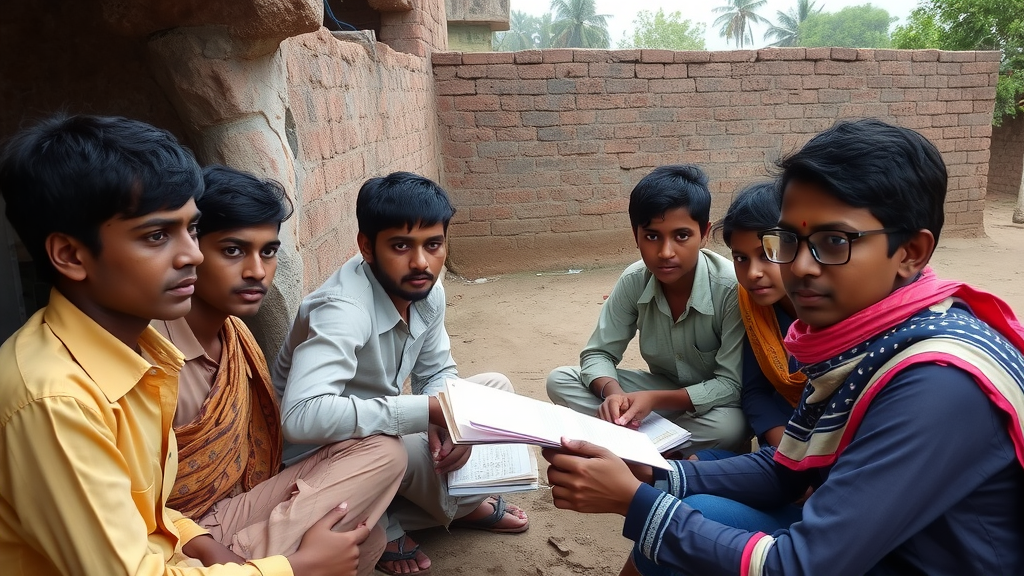
Image Credits: AI Generated
DOI: 10.1007/s43545-026-01702-3
Keywords: caste conflict, North Bihar, Scheduled Castes, Other Backward Classes, education paradox, logistic regression, rural India, Dalit resistance, political mobilisation, village society, mixed methods, social inequality
Cite Scienmag News
Courtney Benton. (September 12, 2026). Education Raises Caste Violence Risk for Dalits in Rural North Bihar. Scienmag. https://scienmag.com/education-raises-caste-violence-risk-for-dalits-in-rural-north-bihar/
Courtney Benton. "Education Raises Caste Violence Risk for Dalits in Rural North Bihar." Scienmag, 12 September 2026, https://scienmag.com/education-raises-caste-violence-risk-for-dalits-in-rural-north-bihar/. Accessed 4 October 2026.
Courtney Benton. "Education Raises Caste Violence Risk for Dalits in Rural North Bihar." Scienmag. September 12, 2026. https://scienmag.com/education-raises-caste-violence-risk-for-dalits-in-rural-north-bihar/


