


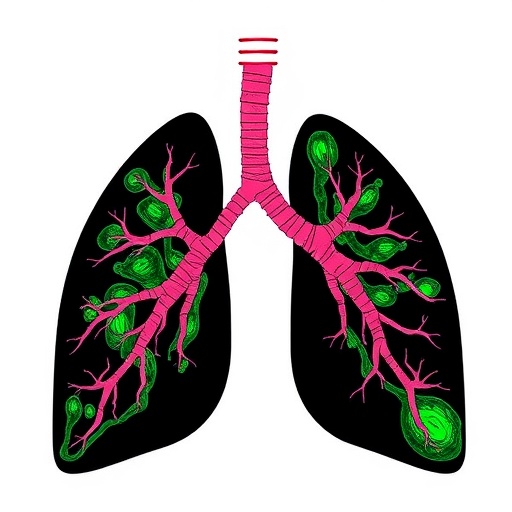
In an exciting breakthrough that deepens our understanding of developmental biology, researchers have unveiled the complex orchestration behind mesothelium formation and lung growth, spotlighting the critical roles played by extracellular matrix (ECM) organization, ROCK signaling, and cell polarity. This study, published in Nature Communications, opens new avenues for comprehending how functional lung architecture develops, providing far-reaching implications for regenerative medicine and tissue engineering.
At the heart of this investigation is the interplay between the cellular microenvironment and intracellular signaling pathways. The ECM, a complex scaffold of proteins surrounding cells, does more than offer structural support—it actively instructs cellular behavior. The research team discovered that meticulous organization of ECM components is essential for mesothelial cells, which form the lung’s outer lining, to coordinate and differentiate properly during embryonic development.
The study highlights ROCK signaling, a pathway known for regulating cytoskeletal dynamics and cellular contractility, as a pivotal conductor of this biological symphony. By modulating actomyosin tension within cells, ROCK signaling influences how cells sense their environment and orient themselves, orchestrating their polarity. This polarity, the asymmetric organization of cellular components, is fundamental for the collective behavior of mesothelial cells as they migrate and invade to form the protective mesothelium.
Utilizing advanced imaging techniques coupled with genetic and pharmacological manipulations, the researchers tracked how perturbations in ECM structure or ROCK activity resulted in dramatic lung developmental defects. Cells devoid of proper ECM signals failed to establish directed polarity, collapsing the mechanotransductive feedback necessary for shaping the lung’s expanding surface. Similarly, inhibiting ROCK activity disrupted cytoskeletal arrangements, impairing cell migration and mesothelial sheet stability.
An intriguing revelation was the reciprocal relationship between cell polarity and ECM remodeling. As cells align their polarity axis, they exert mechanical forces that reorganize the nearby ECM, which in turn refines signaling cues, creating a feedback loop essential for lung morphogenesis. This bidirectional communication underscores the dynamic reciprocity between cells and their extracellular milieu.
The team’s findings shed light on the mesothelium’s formative processes, which have been somewhat enigmatic until now. Previously regarded as passive barriers, mesothelial layers are now recognized as active participants in organ development. Their morphogenetic movements, dictated by intrinsic and extrinsic cues, play a role not only in lung expansion but potentially in reparative processes following injury.
From a broader perspective, these discoveries underscore the importance of mechanical and biochemical integration during organogenesis. The synergy among ECM organization, ROCK-mediated contractility, and established cell polarity pathways exemplifies how developmental systems integrate multiple signals to generate organized tissue structures. Such knowledge is pivotal for bioengineering functional lung tissue ex vivo, potentially benefiting patients suffering from respiratory failure.
Furthermore, aberrations in these pathways are implicated in various pathologies, including fibrosis and cancer. Understanding the normal mechanistic interplay in development could inform therapeutic strategies to mitigate disease progression or enhance tissue repair. For instance, targeted modulation of ROCK signaling might influence mesothelial dynamics in pathological states, opening new clinical interventions.
Intriguingly, the study also reveals temporal dynamics in signaling responses, as the maturation of ECM composition and cell polarity markers coincide with critical windows of lung morphogenesis. This temporal coordination ensures that cellular behaviors are tightly regulated, preventing premature or disorganized tissue formation.
The researchers employed state-of-the-art organoid models that recapitulate key aspects of lung development, allowing precise manipulation of molecular pathways and mechanical forces. These models serve as invaluable platforms to dissect cellular crosstalk in a controlled setting, bridging in vitro experiments with in vivo relevance.
At a molecular level, the signaling cascade initiated by integrin engagement with the ECM activates ROCK kinases, which phosphorylate downstream effectors governing cytoskeletal rearrangements. This cascade culminates in the spatial rearrangement of polarity complexes, positioning the cells appropriately to form a cohesive mesothelial layer.
The visualization of cell polarity markers alongside ECM components demonstrated spatial gradients that mirror mechanical stress distributions across the developing lung surface. These gradients likely inform cells about their positional identity and guide migratory trajectories, ensuring ordered mesothelial coverage.
This research marks a significant stride toward elucidating the biophysical principles underpinning organ development, emphasizing the convergent roles of structure, biochemical signaling, and polarity in shaping living tissues. As we decode these natural blueprints, the potential for innovative treatments and biofabrication strategies grows exponentially.
Ultimately, uncovering the mechanisms guiding mesothelium formation and lung growth advances not only basic science but also translational medicine. By harnessing the knowledge of how cells integrate mechanical and chemical cues to build organs, scientists edge closer to replicating these processes, paving the way for regenerative therapies that restore lung function in disease or injury.
Cite Scienmag News
Ophelia Keating. (October 30, 2025). ECM, ROCK, and Polarity Orchestrate Lung Growth. Scienmag. https://scienmag.com/ecm-rock-and-polarity-orchestrate-lung-growth/
Ophelia Keating. "ECM, ROCK, and Polarity Orchestrate Lung Growth." Scienmag, 30 October 2025, https://scienmag.com/ecm-rock-and-polarity-orchestrate-lung-growth/. Accessed 5 September 2026.
Ophelia Keating. "ECM, ROCK, and Polarity Orchestrate Lung Growth." Scienmag. October 30, 2025. https://scienmag.com/ecm-rock-and-polarity-orchestrate-lung-growth/


