

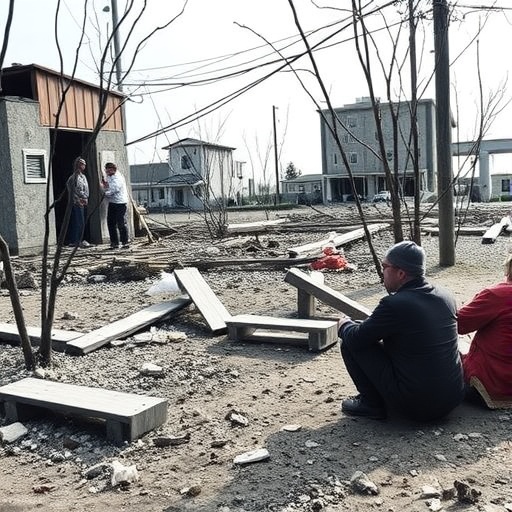
In the aftermath of devastating earthquakes, countless survivors find themselves trapped not only beneath the physical rubble but also within psychological landscapes characterized by confusion, despair, and an unsettling sense of loss. Recent research published in BMC Psychology by Keleş, Baloglu, Kesici, and colleagues offers profound insights into this liminal state described as “ambiguous loss,” a psychological phenomenon wherein survivors grapple with the uncertainty of whether loved ones are deceased or merely missing. This investigation explores the phenomenology of ambiguous loss through the lived experiences of earthquake survivors, revealing intricate emotional and cognitive responses that complicate traditional bereavement processes and demand innovative approaches to post-disaster mental health interventions.
Ambiguous loss, a term coined by psychologist Pauline Boss, traditionally refers to a grief that remains unresolved due to a lack of closure. The unique context of earthquake disasters intensifies this experience, as individuals face the physical disappearance of family members, friends, and communities amid the chaos of collapsed infrastructure and disrupted communication. The study conducted by Keleş et al. harnesses phenomenological methodologies to delve into the subjective realities of earthquake survivors, emphasizing how this state of liminality affects their capacity to process trauma and reconstruct meaning in their shattered worlds.
The authors employed in-depth qualitative interviews with survivors from multiple earthquake zones, capturing a wide array of narratives imbued with uncertainty and suspended hope. The phenomenological perspective prioritizes the survivors’ own interpretations, moving beyond quantitative measures of trauma or PTSD. By focusing on lived experience, the research reveals how ambiguous loss disrupts survivors’ temporal frameworks, leaving them trapped in a psychological holding pattern where normal grief progression is stalled indefinitely.
One of the key revelations from this study is the concept of “waiting on the rubble,” which encapsulates the physical and ephemeral suspension experienced by survivors. Waiting here is not simply a temporal gap; it is an embodied, sensory state wherein the survivor remains tethered to the disaster site, oscillating between hope for rescue and the grim recognition of potential loss. This state profoundly influences mental health outcomes, exacerbating anxiety, depression, and complicating resilience mechanisms that traditionally aid recovery.
Beyond the immediate psychological impacts, ambiguous loss also has far-reaching implications for social dynamics. The traditional roles and relationships within families and communities become destabilized when members are unaccounted for, but not confirmed dead. Survivors often face social isolation or stigmatization as they navigate communal grief where closure is absent. The phenomenological accounts documented by Keleş and colleagues demonstrate how community cohesion wavers under the weight of collective uncertainty, underscoring the need for social support systems tailored to ambiguous loss.
The neurobiological underpinnings of ambiguous loss also emerge as a critical area for future research. While this study focuses on phenomenological data, it raises poignant questions about how the brain processes grief without certainty. Neuroimaging studies on analogous conditions suggest that ambiguous or prolonged grief may activate neural circuits associated with reward anticipation and error monitoring, thus perpetuating a state of hypervigilance and emotional dysregulation. Integrating these biological insights with phenomenological findings could propel new, biologically informed interventions for survivors.
Another compelling dimension revealed by the research centers on the intersectionality of ambiguous loss with cultural, religious, and spiritual frameworks. Earthquake survivors interpret and assign meaning to ambiguous loss within their sociocultural contexts, shaping coping strategies and psychological trajectories. For example, certain cultural rituals designed to honor the dead cannot be fulfilled in cases of ambiguous loss, leading to compounded distress and existential frustration. The study’s detailed narratives provide a powerful lens into how cultural meaning-making processes mediate trauma responses.
Moreover, the role of technological interventions in mitigating ambiguous loss comes under scrutiny. In the digital era, the dissemination of information and potential for virtual communication could aid or hinder psychological processing. Survivors frequently rely on fragmented news feeds, social media reports, and unverified rescue claims, which can either falsely sustain hope or accelerate despair. Understanding these dynamics is crucial for designing digital tools that responsibly support mental health without exacerbating ambiguity.
From a clinical standpoint, the phenomenological insights gained by Keleş and colleagues highlight the inadequacy of conventional trauma therapies when addressing ambiguous loss. Treatments optimized for clear-cut grief or PTSD lack efficacy when confronted with a persistent absence of closure. The research advocates for therapeutic approaches emphasizing tolerance of uncertainty, narrative reconstruction, and community-based rebuilding of meaning, rather than premature resolution. These findings invite mental health professionals to incorporate nuanced understandings of ambiguous loss into disaster response protocols.
Furthermore, the study underscores the profound resilience embedded in survivor testimonies, despite the harrowing psychological conditions they endure. Many survivors developed adaptive strategies that involved reconfiguring connections with their environment and loved ones, even when physical reunification was impossible. This speaks to an inherent human capacity to find continuity through memory, ritual, and symbolic presence, which can be leveraged in recovery programs to foster hope amid ambiguity.
The implications of these findings extend beyond earthquake contexts. Other disasters—both natural and human-made—also produce ambiguous loss scenarios. Floods, conflicts, and pandemics all create conditions where loved ones may be unreachable or missing. Understanding how ambiguous loss operates phenomenologically can thus inform broader public health strategies, encouraging holistic psychosocial support systems capable of addressing the unique challenges posed by indeterminate grief.
In synthesizing the phenomenological insights, this research also challenges mainstream disaster management frameworks to integrate mental health considerations as integral rather than ancillary components of recovery. Ambiguous loss reframes survival as a protracted psychological ordeal, requiring sustained commitment from healthcare providers, policymakers, and community leaders. Addressing this invisible burden enhances both individual well-being and social cohesion, thereby aiding in the overall resilience of disaster-impacted societies.
On a methodological level, the research exemplifies the value of phenomenology in psychological science, especially for complex, understudied phenomena such as ambiguous loss. By privileging survivors’ lived experiences, Keleş and colleagues circumvent reductionist paradigms that often fail to capture the depth and nuance of psychological trauma induced by disaster. This approach provides a template for future interdisciplinary studies aimed at bridging subjective experience with empirical analysis.
Looking forward, the study calls for longitudinal investigations to track how ambiguous loss evolves over time and influences long-term mental health trajectories. Understanding recovery patterns will inform timing and content of interventions, optimizing resources for disaster-affected populations. Additionally, increasing attention to marginalized groups within survivor populations is necessary to ensure equity in psychological care and to acknowledge diverse phenomenological expressions of ambiguous loss.
In conclusion, “Awaiting on the rubble” is a seminal contribution to disaster psychology, unveiling the profound complexities of ambiguous loss experienced by earthquake survivors. By elucidating the phenomenological contours of this condition, the study provides a crucial foundation for transforming post-disaster mental health care, emphasizing the necessity of embracing uncertainty, fostering meaning-making, and reinforcing communal bonds. As earthquake frequency and intensity increase globally, such research is indispensable in guiding compassionate, effective, and culturally sensitive responses, ultimately aiming to alleviate the invisible wounds left by nature’s tremors.
Subject of Research: Psychological experiences of ambiguous loss in earthquake survivors.
Article Title: Awaiting on the rubble: phenomenological perspectives on ambiguous loss by earthquake survivors.
Article References:
Keleş, F.B., Baloglu, M., Kesici, Ş. et al. Awaiting on the rubble: phenomenological perspectives on ambiguous loss by earthquake survivors. BMC Psychol (2026). https://doi.org/10.1186/s40359-026-04086-4
Image Credits: AI Generated


