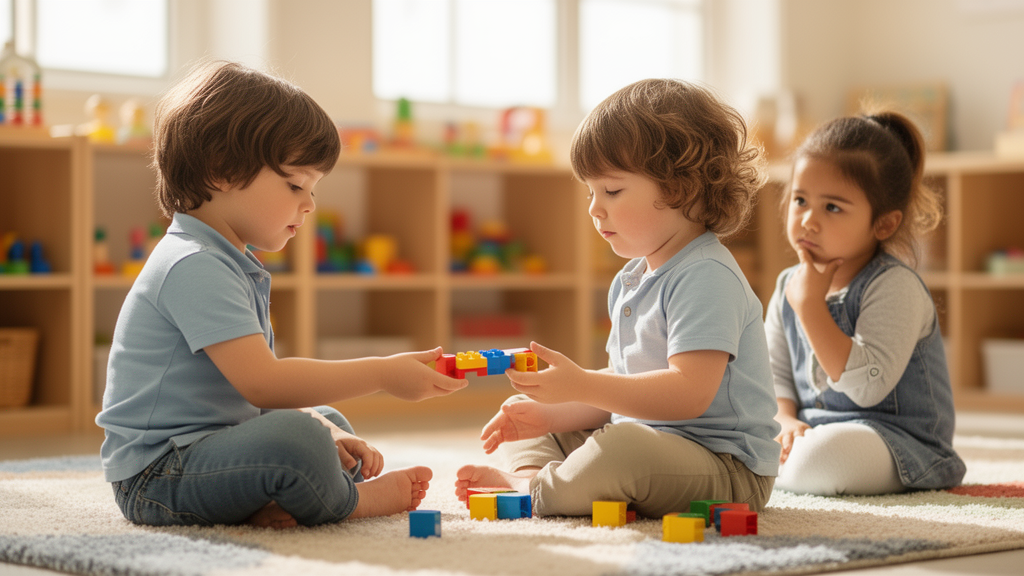
That is the central suggestion of a small longitudinal study conducted at a private nursery school in Japan, where researchers tracked 35 children from age 4–5 to age 5–6 to see whether earlier mental state knowledge conditioned the association between socially complex peer play and later prosocial judgment.
The study, a brief research report published in Frontiers in Developmental Psychology, was designed to test a specific conditional relationship rather than a simple one. The authors reasoned that socially complex peer play may provide opportunities for children to coordinate perspectives, negotiate roles, and respond to others’ needs, but that the association between such play and prosocial judgment may differ according to children’s social-cognitive resources.
A year later, at ages 5–6, the same children completed two judgment tasks, one probing helping and one probing sharing, while their naturally occurring free play was observed through repeated focal-child observations. Rather than relying on teacher reports or laboratory arrangements, the study indexed socially complex peer play as the combined proportion of associative and cooperative play recorded during these naturalistic observations, a measure intended to reflect how much of each child’s play involved peers interacting without adult structuring.
The key result came from hierarchical regression analyses. The interaction between earlier mental state knowledge and socially complex peer play significantly predicted sharing judgment at ages 5–6. In other words, the statistical association between the amount of complex peer play a child engaged in and their sharing judgment was not uniform across the sample; it depended on the level of mental state knowledge the child had shown a year earlier.
The parallel analysis for helping told a more cautious story. The corresponding interaction term was positive, pointing in the same direction as the sharing result, but it did not reach the conventional significance threshold. The authors therefore did not treat the helping finding as an established effect, and the report presents it as suggestive rather than confirmed.
Sensitivity analyses using heteroskedasticity-consistent standard errors supported the sharing result, indicating that the significant interaction was not an artifact of the homoskedasticity assumption in the main regression models.
The authors are explicit that the findings should be interpreted as preliminary given the modest sample size of 35 children drawn from a single private nursery school in Japan. A sample of this size limits statistical power and generalizability, and the study cannot establish that peer play causes changes in prosocial judgment, since the play measure and the judgment tasks were assessed concurrently at ages 5–6, with only the mental state knowledge measure taken earlier.
What the study does offer is a refined framing of a familiar question. Rather than asking simply whether complex peer play is good for children’s prosocial development, the report suggests that the association between socially complex peer play and prosocial judgment may differ according to children’s earlier social-cognitive resources. On this view, the same hours of associative and cooperative play may accompany different prosocial judgment outcomes depending on what a child already understands about others’ minds.
For researchers, the report points toward the value of studying interactions between children’s play environments and their cognitive capacities, rather than treating either factor in isolation. For practitioners in early childhood settings, the findings remain preliminary, and the authors’ own caution about the sample size applies to any classroom interpretation. The study’s contribution lies in its longitudinal design, its naturalistic observation of free play, and its demonstration that a conditional model of play and prosocial judgment can be tested, and in this case partially supported, in a small sample of preschool children.
Subject of Research: How peer play and mental state knowledge relate to prosocial judgment in preschool children
Article Title: Socially complex peer play and preschoolers' prosocial judgment: the role of earlier mental state knowledge
Article References: Kato-Shimizu, M., & Harada, A. (2026). Socially complex peer play and preschoolers' prosocial judgment: the role of earlier mental state knowledge. Frontiers in Developmental Psychology, 4, Article 1986076. https://doi.org/10.3389/fdpys.2026.1986076
Image Credits: AI Generated
DOI: 10.3389/fdpys.2026.1986076
Keywords: peer play, prosocial judgment, mental state knowledge, theory of mind, preschool children, false-belief task, longitudinal study, sharing, helping, social development, Japan, developmental psychology
Cite Scienmag News
Glenn Wilkins. (October 28, 2026). Early mental state knowledge may shape how peer play relates to preschoolers’ sharing judgments. Scienmag. https://scienmag.com/early-mental-state-knowledge-may-shape-how-peer-play-relates-to-preschoolers-sharing-judgments/
Glenn Wilkins. "Early mental state knowledge may shape how peer play relates to preschoolers’ sharing judgments." Scienmag, 28 October 2026, https://scienmag.com/early-mental-state-knowledge-may-shape-how-peer-play-relates-to-preschoolers-sharing-judgments/. Accessed 29 October 2026.
Glenn Wilkins. "Early mental state knowledge may shape how peer play relates to preschoolers’ sharing judgments." Scienmag. October 28, 2026. https://scienmag.com/early-mental-state-knowledge-may-shape-how-peer-play-relates-to-preschoolers-sharing-judgments/