


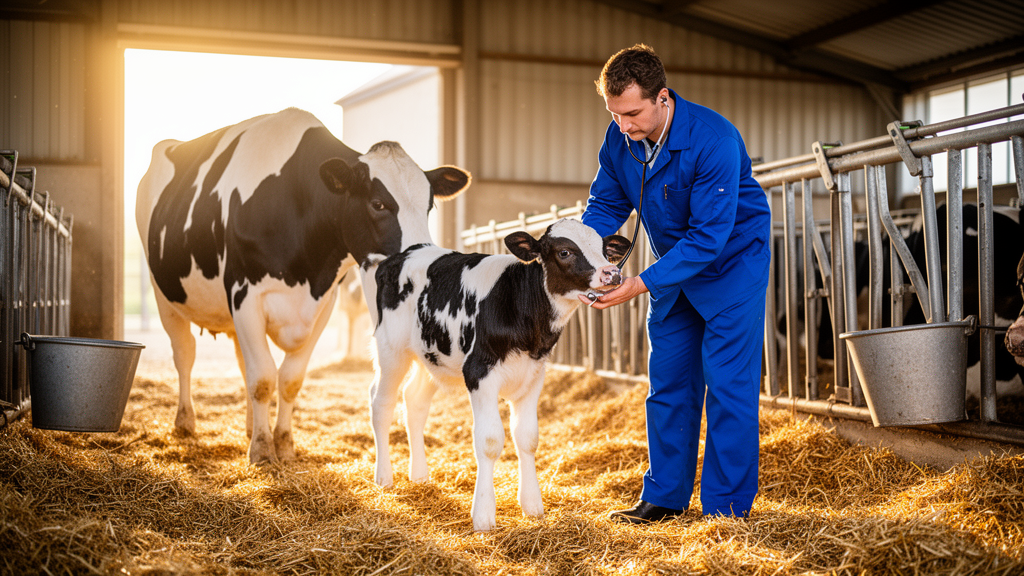
Bovine leukemia virus (BLV), a deltaretrovirus that integrates a DNA copy of its RNA genome into the chromosomes of cattle B-lymphocytes, is far more than a disease of lactating cows, according to a narrative review published in Frontiers in Veterinary Science by researchers at Michigan State University and Cornerstone Ag Management. The authors argue that heifer-rearing operations are quietly seeding dairy herds with new infections: youngstock, the female calves and heifers raised to enter the milking herd, face a series of distinct exposure windows from gestation through first calving, and any infection acquired during those windows undermines control programs aimed only at mature cows. In the United States, an estimated 94 percent of dairy herds harbor the virus, with an average within-herd prevalence of 46 percent, yet no national testing standards or eradication incentives exist.
BLV infection unfolds in four broadly recognized stages. After the virion targets a B-lymphocyte and reverse transcriptase converts its RNA into proviral DNA, the integrated genome replicates as the host cell divides, and proviral proteins begin activating cellular oncogenes and dysregulating immune function. This initial stage is asymptomatic. Most animals then enter a lengthy aleukemic phase in which they appear healthy and show no hematological abnormalities, yet the provirus expands through clonal proliferation and the animal remains infectious. Some progress to persistent lymphocytosis, an abnormal and sustained expansion of B-lymphocytes detectable by blood assays, which is associated with increased susceptibility to secondary infections and reduced vaccine efficacy. A minority ultimately develop lymphosarcoma, with solid tumors forming in the heart, abomasum, uterus, lymph nodes, eye socket, or spinal canal; clinical signs range from weight loss and reduced appetite to neurological dysfunction or sudden death, and the stage is ultimately fatal through culling or death.
Detection methods have evolved considerably since lymphomas themselves served as the first diagnostic tool. Early serological assays included radioimmunoassay, later abandoned because of radiation-safety requirements, and agar-gel immunodiffusion, which is labor-intensive because of antigen purification, gel preparation, and long processing times, and works only with serum. Enzyme-linked immunosorbent assays (ELISA) now dominate, running on serum, milk, or colostrum, and reporting a continuous optical density result with kit-specific thresholds for negative, suspect, and positive categories. Serum and milk ELISAs have shown agreement as high as 100 percent in some comparisons, although one more recent study reported milk ELISA at 86 percent agreement relative to serum. Molecular testing detects viral DNA directly: qualitative endpoint PCR can identify presence or absence in blood, milk, semen, or mucosal samples, but risks false negatives because BLV can persist at low levels and sequester in organs. Nested PCR improves sensitivity at the cost of specificity, increasing false positives. Quantitative PCR reports a proviral load, the ratio of BLV genome copies to copies of an endogenous gene such as beta-actin, which helps gauge an animal’s likely infectivity, although assay-to-assay variability in quantification remains a known limitation.
Transmission follows two broad routes. Horizontal spread occurs through direct contact with infected bodily fluids, including blood, milk, saliva, and nasal secretions containing infected lymphocytes. Vertical transfer moves virus from dam to calf in utero through the placenta, during birth, or afterward via colostrum and milk. Timing infections precisely is complicated by a diagnostic lag, estimated at 24 days post infection for qPCR and 36 days for ELISA, and by maternal antibodies in colostrum, which can confound serological results in young calves by reflecting passively derived immunity rather than the calf’s true status. Reported prevalence in youngstock varies enormously by life stage and method: fetal infections ranged from 0 to 18 percent in some studies, 6.4 to 8.1 percent by agar-gel immunodiffusion in another, and 20 percent by AGID in Japan; neonatal rates of 7.7 percent and 11.47 percent were reported by nested PCR; preweaning estimates spanned 0 to 32 percent by qPCR and up to 78 percent by AGID; and post-weaning figures ranged from 4 to 73.6 percent. The review cautions that these figures come from studies with differing designs and populations and should not be directly compared.
The fetal and neonatal periods present the first exposure risks. Intrauterine transfer was confirmed through cesarean deliveries of calves from BLV-positive dams, in which cord blood, placenta, and peripheral blood of both dam and calf tested positive by qPCR, and the env gene sequences shared 100 percent nucleotide identity, indicating identical strains. Intrauterine infection correlates positively with the dam’s proviral load, while dam age, breed, and parity showed no association, leading the authors to suggest prioritizing qPCR over ELISA when breeding decisions rest on a dam’s BLV status. Evidence on sires is sparse: in one study of 121 beef bulls from 39 herds, proviral DNA was detected in blood of 44.6 percent and smegma of 7.4 percent, but not in semen; a more recent study found a single positive seminal sample among 498, which reverted to negative at a 30-day follow-up. Given that roughly 89 percent of U.S. dairy operations use artificial insemination, semen is considered an unlikely significant infection source.
Parturition itself offers a second exposure point, since BLV can be present in blood during birth. One study, accounting for the diagnostic lag by testing calves at 30 days, estimated that 7.7 percent of youngstock acquired infection through the vaginal canal during natural births. The authors note that while nothing can be done to prevent exposure during delivery itself, removing the calf immediately after birth may limit contact with blood and birthing fluids such as cord blood. Colostrum and milk feeding is the best-studied neonatal risk, and also the most conflicted. Experimental work has demonstrated that neonates can be infected by ingesting colostrum or milk from positive cows, and proviral loads in milk correlate with those in the dam’s blood, suggesting higher-risk milk from heavily infected dams. Yet other studies, including sheep challenge experiments, indicate that anti-BLV antibodies in colostrum can confer temporary passive immunity lasting roughly four to six months, and one study found sheep fed antibody-rich colostrum resisted subsequent inoculation. Heat treatment can destroy immunoglobulin G if performed improperly, and freezing requires careful thawing to avoid IgG denaturation. The review concludes that colostrum and milk cannot be treated as a uniform risk and that this literature gap prevents definitive handling recommendations.
In the preweaning period, roughly four to eight weeks of age, mechanical transmission during dehorning becomes a central concern. Early work showed that failing to disinfect gouge dehorning equipment between animals produced significantly more infections, particularly when animals were dehorned after a known positive herdmate, and more recent risk-factor analyses associated gouge dehorning with significantly higher overall herd prevalence. Proper disinfection of equipment is therefore crucial, though the review notes that gouge dehorning is the least common method among U.S. dairy producers, used by only 13 percent, compared with hot iron at 70 percent and caustic paste at 16 percent, both of which minimize blood transfer between animals.
Post-weaning heifers encounter a different set of hazards dominated by needles and palpation gear. Vaccination and breeding synchronization injections create opportunities for needle reuse, which has repeatedly been shown to transmit BLV and to associate with higher herd prevalence; one estimate found infection risk eight times greater when blood sampling used a needle previously used on a positive herdmate, although other studies could not confirm transmission. Rectal palpation during artificial insemination and pregnancy diagnosis carries risk because palpation can cause bleeding: a controlled study found heifers were 8.3 times more likely to seroconvert when a shared obstetric sleeve was used instead of a fresh one, though another study detected no new infections, possibly reflecting differences in the extent of tissue damage, with first-palpation heifers more prone to hemorrhage. Biting insects add further uncertainty. Flies collected on dairy farms carry both cattle and BLV DNA, and one controlled experiment transmitted the virus by moving insects from positive to negative animals, but other studies found no infections despite months of insect exposure, and seasonal patterns are inconsistent, with some studies showing higher winter incidence indoors. The authors describe insect management as a reasonable, low-risk precaution rather than a proven control measure.
The economic logic of early-life control is substantial. On average, dairy cows break even on rearing costs only during their second lactation, an estimated 530 plus-or-minus 293 days after first calving, and BLV infection in cows is associated with losses of between $198.34 and $496.76 per cow per lactation. A heifer entering the milking herd already infected would likely reach profitability later, compounding the financial burden of replacement rearing. The review stops short of proposing a standardized testing algorithm for youngstock, acknowledging that age-specific test performance is poorly characterized and maternal antibodies confound serology in calves, so testing strategies must be tailored to herd goals, prevalence, and resources. Its central conclusion, however, is unambiguous: because infection can accumulate silently across fetal, neonatal, preweaning, and post-weaning stages, failure to manage transmission in youngstock may quietly defeat even the most diligent control programs focused exclusively on the milking herd.
Subject of Research: Early-life transmission of bovine leukemia virus in dairy youngstock and its implications for herd-level control
Article Title: Bovine leukemia virus and dairy youngstock: a narrative review of early-life transmission and its consequences for whole-herd control
Article References: Sokacz, M. E., Norby, B., Sporer, K. R. B., Buskirk, D. D., & Taxis, T. M. (2026). Bovine leukemia virus and dairy youngstock: a narrative review of early-life transmission and its consequences for whole-herd control. Frontiers in Veterinary Science, 13, Article 1911190. https://doi.org/10.3389/fvets.2026.1911190
Image Credits: AI Generated
DOI: 10.3389/fvets.2026.1911190
Keywords: bovine leukemia virus, dairy cattle, youngstock, vertical transmission, horizontal transmission, colostrum, proviral load, ELISA, qPCR, dehorning, needle reuse, herd control
Cite Scienmag News
Kristina Jarvis. (October 23, 2026). Early-Life Infections Sustain Bovine Leukemia Virus on Dairy Farms, Review Finds. Scienmag. https://scienmag.com/early-life-infections-sustain-bovine-leukemia-virus-on-dairy-farms-review-finds/
Kristina Jarvis. "Early-Life Infections Sustain Bovine Leukemia Virus on Dairy Farms, Review Finds." Scienmag, 23 October 2026, https://scienmag.com/early-life-infections-sustain-bovine-leukemia-virus-on-dairy-farms-review-finds/. Accessed 23 October 2026.
Kristina Jarvis. "Early-Life Infections Sustain Bovine Leukemia Virus on Dairy Farms, Review Finds." Scienmag. October 23, 2026. https://scienmag.com/early-life-infections-sustain-bovine-leukemia-virus-on-dairy-farms-review-finds/


