

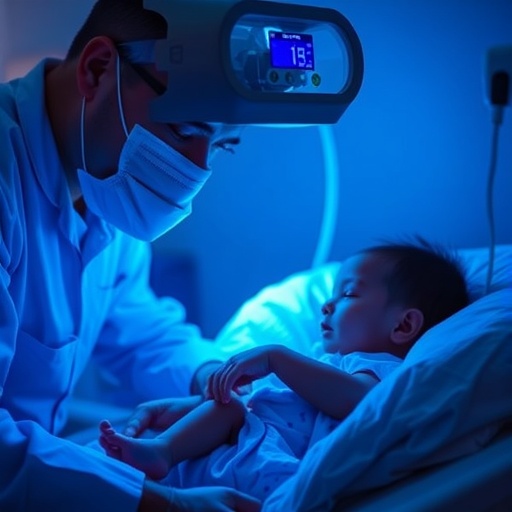
In a groundbreaking study published in BMC Pediatrics, researchers have shed light on a crucial aspect of neonatal care, specifically focusing on predicting the need for phototherapy in Chinese newborns through early postnatal assessments. This study, involving a collaborative effort by experts in the field, including Yang, G., Deng, L., and Zhang, K., seeks to optimize the management of jaundice in neonates, a common yet potentially serious condition that affects newborns shortly after birth. The researchers are now drawing from their findings to propose new guidelines for clinicians, emphasizing a proactive approach to the treatment of hyperbilirubinemia.
Jaundice in newborns is primarily caused by an excess of bilirubin, a yellow pigment produced during the breakdown of red blood cells. While jaundice often resolves on its own, severe cases can lead to significant complications, including kernicterus, which can cause permanent neurological damage. Therefore, timely assessment and intervention are critical. The authors of this study aim to develop a predictive model for determining which infants are at risk of requiring phototherapy, a common treatment that utilizes light to reduce bilirubin levels in the blood.
The study meticulously outlines the method used to gather and analyze data from neonates, focusing on early postnatal capillary blood samples to measure end-tidal carbon monoxide (ETCOc) levels. ETCOc is a promising biomarker, as it correlates with the level of bilirubin and can be indicative of hemolysis, the breakdown of red blood cells. By establishing a relationship between ETCOc levels and the progression of jaundice, the researchers present a pioneering approach to anticipating the need for treatment.
As part of their comprehensive analysis, the research team deployed a robust statistical framework to validate the predictive accuracy of ETCOc levels. They conducted a series of tests to assess how well ETCOc could serve as a precursor to elevated bilirubin levels that necessitate phototherapy intervention. Their findings revealed a striking correlation, suggesting that clinicians could significantly benefit from incorporating ETCOc measurements into standard practice.
This innovative predictive model offers a dual benefit: it enables healthcare providers to identify at-risk newborns early while also potentially reducing unnecessary treatments for those who may not require phototherapy. In a healthcare landscape that increasingly emphasizes personalized medicine, this approach aligns perfectly with the broader goal of tailoring interventions based on individual patient needs. With jaundice being a prevalent condition impacting a vast number of newborns globally, such advancements could have far-reaching implications.
The implications of this research extend beyond China, as the methodology could be adapted for use in diverse healthcare systems worldwide. This adaptability foreshadows a future wherein early detection methods for jaundice become standardized, ultimately improving outcomes and reducing the burden on healthcare facilities. By employing a more refined approach to identifying infants at risk, clinicians can focus resources on those who truly need them, thereby optimizing neonatal care.
The study’s outcomes highlight the importance of interdisciplinary collaboration in addressing neonatal health issues. Researchers from various backgrounds—including neonatology, biostatistics, and pediatrics—contributed their expertise toward refining the predictive model. This collaborative spirit serves as a testament to the progress that can be achieved when experts unite around a common goal, fostering innovation that enhances patient care.
Moreover, the research emphasizes the necessity for ongoing education among healthcare professionals regarding the latest advancements in neonatal care. As new evidence emerges, it becomes imperative for practitioners to stay informed and adapt their practices accordingly. The introduction of ETCOc as a predictive marker for phototherapy signifies an important shift in how clinicians can approach neonatal jaundice, ensuring that they provide optimal care while minimizing exposure to unnecessary interventions.
With continued research, the authors anticipate refining their predictive model, perhaps integrating additional biomarkers or clinical parameters that further enhance its reliability. Future studies could explore the potential of combining ETCOc with other variables, facilitating an even more comprehensive understanding of jaundice in newborns. This could lead to developments in clinical guidelines that reflect a nuanced approach to managing hyperbilirubinemia, paving the way for improved outcomes.
As the medical community begins to adopt these findings, the hope is that they will inspire a broader discussion around the importance of early detection and intervention across various neonatal conditions. The research team’s work serves as a powerful reminder of the impact that data-driven insights can have in clinical settings, particularly when it comes to safeguarding the health of our most vulnerable populations.
In summary, this research not only highlights the predictive potential of early postnatal ETCOc levels but also sets the stage for further investigation into improving strategies for managing jaundice in newborns. The promise of this study lies in its ability to usher in a new era of personalized pediatric care, where early interventions could dramatically transform the outcomes for countless infants facing this condition. The integration of innovative approaches, like the one proposed, may ultimately lead to advances in neonatal health that resonate across generations.
The significance of this work is compounded by the rising global interest in improving neonatal care frameworks, particularly in developing countries where access to phototherapy may be limited. By refining predictive measures, the study not only advocates for better health outcomes but also emphasizes the potential for cost-effectiveness in treatment paradigms. Consequently, this research lays a foundation for further exploration into how such innovative practices can be implemented universally, ensuring equity in healthcare for all newborns.
As healthcare continues to evolve, the findings from this pivotal study underscore the critical importance of understanding the biological underpinnings of common neonatal conditions. With the potential for establishing new standards in the clinical management of jaundice, this research has the capacity to inspire widespread change. As such, it opens the door for future inquiries that build upon this foundational work, allowing new generations of clinicians to adopt a more refined, data-driven approach to neonatal care.
In conclusion, the study represents a significant leap forward in the prediction and management of jaundice in newborns, emphasizing the role of scientific inquiry in enhancing pediatric healthcare. The detailed analysis and results provide a compelling case for integrating early ETCOc assessments into clinical practice, promising to improve patient outcomes and advance the field of neonatology. As the conversation surrounding neonatal healthcare continues to grow, this research will undoubtedly serve as a critical reference point for future innovations and advancements in the management of newborn conditions.
Subject of Research: Phototherapy prediction through early postnatal ETCOc assessments in Chinese newborns.
Article Title: The prediction of phototherapy by early postnatal ETCOc in Chinese newborns.
Article References: Yang, G., Deng, L., Zhang, K. et al. The prediction of phototherapy by early postnatal ETCOc in Chinese newborns. BMC Pediatr 25, 966 (2025). https://doi.org/10.1186/s12887-025-06073-x
Image Credits: AI Generated
DOI: https://doi.org/10.1186/s12887-025-06073-x
Keywords: jaundice, phototherapy, newborn care, ETCOc, predictive model, hyperbilirubinemia, neonatal health, pediatric care, early detection, bilirubin, hemolysis, clinical guidelines, personalized medicine, healthcare innovation.


