


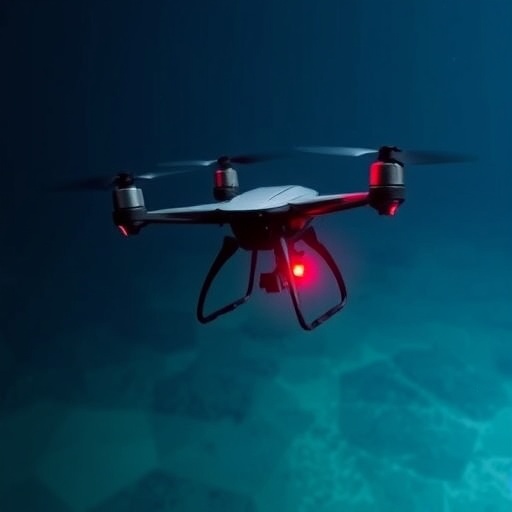
In a groundbreaking advance that could revolutionize the field of underwater robotics, a team of researchers has unveiled a novel dynamic hovering technique for uncrewed underwater vehicles (UUVs). This new method leverages an error-separation-based cooperative strategy that promises unparalleled stability and control in turbulent aquatic environments. The study, recently published in Communications Engineering, offers a comprehensive framework that transcends traditional positional control approaches and presents a leap forward in the precision and efficiency of underwater hovering operations.
Dynamic hovering—the ability of underwater vehicles to maintain a stable position in water currents—has long been a complex and technically challenging endeavor. This difficulty arises from the unpredictable nature of underwater currents, the vehicle’s interaction with fluid dynamics, and the limitations of onboard sensing and actuation systems. Traditional control methods, relying heavily on single-vehicle feedback loops, often fall short in compensating for these external disturbances. The novel cooperative strategy introduced by Luan, Yu, Wan, and colleagues answers this challenge by cleverly separating and managing error signals within a multi-agent framework.
At the heart of this innovation is a method called error separation, where the total error in vehicle positioning is dissected into distinct components that can be addressed more effectively. This approach allows the vehicles to differentiate between environmental disturbances and control inaccuracies, enabling more precise corrections. By coordinating multiple UUVs in a cooperative manner, the system harnesses collective sensing and actuation, enhancing stability beyond what is achievable by individual units.
The researchers developed an integrated control architecture that allows a fleet of underwater vehicles to execute dynamic hovering with remarkable accuracy. This system combines robust feedback mechanisms with predictive control models that anticipate disturbances before they propagate into significant positional deviations. The vehicles share error information in real time, dynamically adjusting their trajectories to maintain formation and counteract fluid forces collaboratively.
One of the most significant breakthroughs lies in the algorithmic design that supports this cooperation. The control algorithms employ advanced mathematical models rooted in control theory and fluid dynamics simulations. They adaptively tune control parameters based on the error components, ensuring robust performance across a wide range of operational scenarios, from calm waters to highly turbulent oceanic environments. This adaptability is essential for real-world deployment where conditions are rarely static or predictable.
Beyond the theoretical model, the team rigorously validated their strategy through simulations and experimental trials. Scaled-down prototypes equipped with the cooperative control system demonstrated consistent hovering stability, even under artificially induced water disturbances. These tests not only showed improvement over existing control schemes but also proved the scalability of the approach, suggesting applicability to various sizes and types of underwater vehicles.
The implications of this advancement extend beyond mere positional control. Precise hovering capability is crucial for numerous underwater tasks including environmental monitoring, scientific sampling, infrastructure inspection, and search-and-rescue missions. UUVs equipped with this cooperative dynamic hovering technology will be able to maintain station more reliably, operate in tighter formations, and carry out complex maneuvers with greater autonomy and lower energy consumption.
Energy efficiency is another critical benefit derived from the error-separation strategy. By minimizing unnecessary thruster engagement and reducing control oscillations, the team’s approach significantly lowers power consumption. This enhanced efficiency translates into longer mission endurance and greater operational range for underwater vehicle fleets, addressing one of the longstanding constraints in autonomous underwater exploration.
The research also emphasizes the importance of communication fidelity in cooperative control. Reliable, low-latency data exchange is vital to synchronize vehicle actions and facilitate the real-time error sharing that underpins the strategy. The team suggests future integration of advanced acoustic communication networks and edge computing to further refine the responsiveness and scalability of the system in expansive underwater environments.
Beyond technical benefits, this cooperative hovering methodology reflects a broader trend in robotics—moving from isolated autonomous agents to systems of interlinked machines collaborating as cohesive units. This paradigm shift heralds new possibilities for complex, decentralized tasks where collective intelligence and coordinated control can achieve outcomes unattainable by single-vehicle operations.
To propel this technology toward practical applications, further research is planned, focusing on enhancements in sensor integration, robustness to communication drops, and adaptive learning algorithms that can evolve with mission requirements. The researchers are particularly optimistic about integrating machine learning components that allow the system to refine its control policies based on accumulated operational data.
From a strategic perspective, the introduction of error-separation-based cooperative dynamic hovering could redefine how maritime industries approach underwater robotic deployment. Whether for offshore energy platforms, underwater archaeology, or marine biology studies, the ability to maintain stable, long-duration position holding will expand the scope and quality of underwater interventions.
In conclusion, the pioneering work by Luan and colleagues breaks new ground in underwater vehicle dynamics, marrying cutting-edge control strategies with multi-agent collaboration. The demonstrated ability to dynamically hover in challenging underwater conditions with collective precision opens fresh frontiers in robotic autonomy and operational effectiveness. This significant stride not only improves the reliability and efficiency of underwater vehicles but also paves the way for innovative mission profiles and expanded underwater exploration capabilities in the coming years.
Cite Scienmag News
Denise Maddox. (November 18, 2025). Dynamic Hovering for Underwater Drones: Cooperative Control. Scienmag. https://scienmag.com/dynamic-hovering-for-underwater-drones-cooperative-control/
Denise Maddox. "Dynamic Hovering for Underwater Drones: Cooperative Control." Scienmag, 18 November 2025, https://scienmag.com/dynamic-hovering-for-underwater-drones-cooperative-control/. Accessed 3 September 2026.
Denise Maddox. "Dynamic Hovering for Underwater Drones: Cooperative Control." Scienmag. November 18, 2025. https://scienmag.com/dynamic-hovering-for-underwater-drones-cooperative-control/


