

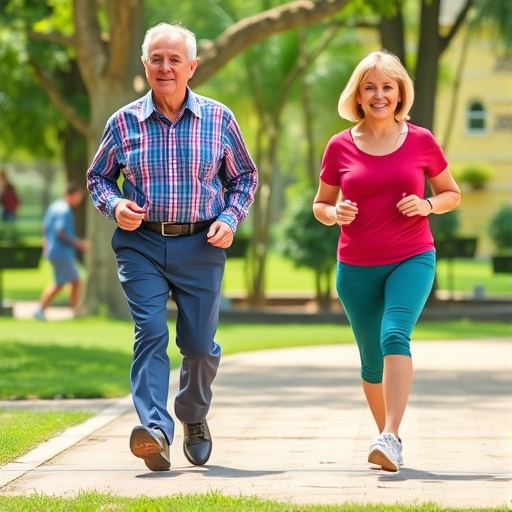
In the realm of aging research, mobility decline remains a profound concern, shaping the quality of life and independence among older adults. A groundbreaking study published recently in BMC Geriatrics explores an often-overlooked dimension of this issue by investigating how dual-task conditions—specifically cognitive-motor and motor-motor challenges—impact gait performance and dynamic stability in the elderly, with a spotlight on the presence or absence of sarcopenia. This revelation offers critical insights into the neurophysiological and biomechanical interplay influencing walking stability, potentially reshaping intervention strategies for this vulnerable population.
Sarcopenia, characterized by the age-related loss of skeletal muscle mass and strength, exacerbates frailty and diminishes physical function. It poses significant risks, including heightened fall propensity and reduced autonomy. While previous research has addressed gait impairments in sarcopenic populations, the nuanced effects of simultaneous task demands on locomotion dynamics have remained underexplored. Dual-task paradigms, involving concurrent motor or cognitive activities, mirror real-world scenarios where attention and motor control compete, providing a realistic lens to assess functional capacity.
The study utilizes a cross-sectional design, recruiting older adults stratified by sarcopenia status, thus enabling a comparative lens to discern differential impacts. Participants performed walking tasks under single and dual-task conditions, the latter comprising both cognitive-motor (e.g., walking while performing mental arithmetic) and motor-motor tasks (e.g., walking while carrying an object or engaging in a secondary physical task). The choice of these dual-task categories encapsulates the spectrum of attentional and motor control challenges faced daily.
Quantifying gait through advanced biomechanical analysis, the researchers meticulously examined parameters such as stride length, cadence, variability, and dynamic stability indices. Dynamic stability, a critical metric of balance control during ambulation, reveals how effectively an individual can maintain equilibrium amid perturbations. The team implemented state-of-the-art motion capture and force plate technology, ensuring high fidelity in data acquisition indispensable for accurate interpretation.
Findings were striking, revealing that dual-tasking universally degraded gait performance among older adults, yet those with sarcopenia exhibited disproportionately greater declines. Cognitive-motor dual tasks elicited marked reductions in stride length and increased gait variability, underscoring the cognitive load’s interference with motor planning and execution. Conversely, motor-motor dual tasks predominantly challenged balance control and dynamic stability, potentially reflecting muscular resource competition in sarcopenic individuals with compromised muscular reserves.
The neural substrates mediating these deficits likely involve shared pathways governing motor control and executive function. Aging-associated declines in prefrontal cortex activity, essential for attentional allocation and multitasking, may synergize adversely with peripheral muscular deterioration, culminating in impaired gait regulation. The study posits that dual-task walking tasks may serve as sensitive biomarkers for early detection of functional decline in sarcopenic elders, preceding overt clinical manifestations.
Moreover, the study emphasizes the intricate feedback loops between cognitive and motor domains, advocating for integrative therapeutic approaches. Rehabilitation strategies that concurrently target cognitive resilience and muscle strengthening could yield synergistic benefits, enhancing gait stability and reducing fall risk more effectively than unidimensional therapies. The findings invite a paradigm shift from isolated physical training to holistic multisystem interventions.
The implications for fall prevention programs are profound, suggesting that routine gait assessments under dual-task conditions may better stratify fall risk compared to traditional single-task evaluations. Early identification of dual-task gait impairments could trigger preemptive interventions, potentially mitigating the cascade leading to disability. This aligns with emerging geriatric care models prioritizing personalized medicine and proactive risk management.
Importantly, the research methodology exemplifies rigorous cross-sectional analytical frameworks, incorporating robust statistical controls to isolate the effects attributable to sarcopenia versus normal aging. The incorporation of well-defined diagnostic criteria for sarcopenia ensures replicability and relevance across diverse populations, enhancing the study’s translational potential globally.
The study also opens avenues for technology-driven solutions, such as wearable sensors capable of real-time dual-task gait assessment in community settings. Such innovations could facilitate continuous monitoring, empowering clinicians and patients with actionable feedback to adapt daily activities and therapeutic regimens dynamically.
Nevertheless, as a cross-sectional inquiry, causal inferences remain limited, prompting calls for longitudinal studies to unravel the progression trajectories of dual-task gait impairments and their interaction with sarcopenic progression. Future research may also explore neuroimaging correlates to delineate structural and functional brain changes accompanying these biomechanical alterations.
This investigation enriches the growing narrative on how aging interfaces intricately with cognitive-motor integration, underpinning mobility and safety in elder care. By elucidating the differential vulnerabilities under dual-task challenge, it lays the foundation for nuanced clinical assessments and innovative intervention frameworks aimed at preserving mobility, independence, and ultimately, quality of life in the aging population.
The intersection of muscle physiology, neurocognition, and motor control revealed by this study heralds a new frontier in gerontology. It challenges existing siloed approaches, inviting multidisciplinary collaboration among neuroscientists, physiotherapists, geriatricians, and engineers to decode the complex tapestry governing mobility decline.
In the face of global demographic shifts towards aging societies, such research assumes urgent public health significance. The potential to forestall disability through tailored dual-task assessment and intervention paradigms could alleviate healthcare burdens and elevate elder resilience.
In conclusion, this pioneering investigation offers compelling evidence that dual-task conditions significantly compromise gait and stability in older adults, disproportionately affecting those with sarcopenia. Through sophisticated biomechanical and clinical analyses, it underscores the critical need to integrate cognitive and motor assessments in routine elder evaluations, inspiring future innovations in preventative geriatrics.
Subject of Research: The investigation focuses on the impact of cognitive-motor and motor-motor dual tasking on gait performance and dynamic stability in older adults, emphasizing differences between individuals with and without sarcopenia.
Article Title: The effects of cognitive-motor and motor-motor dual tasks on gait performance and dynamic stability in older adults with and without sarcopenia: a cross-sectional study.
Article References:
Zhao, Y., Zhang, J., Yang, K. et al. The effects of cognitive-motor and motor-motor dual tasks on gait performance and dynamic stability in older adults with and without sarcopenia: a cross-sectional study. BMC Geriatr. (2026). https://doi.org/10.1186/s12877-026-07278-0
Image Credits: AI Generated


