


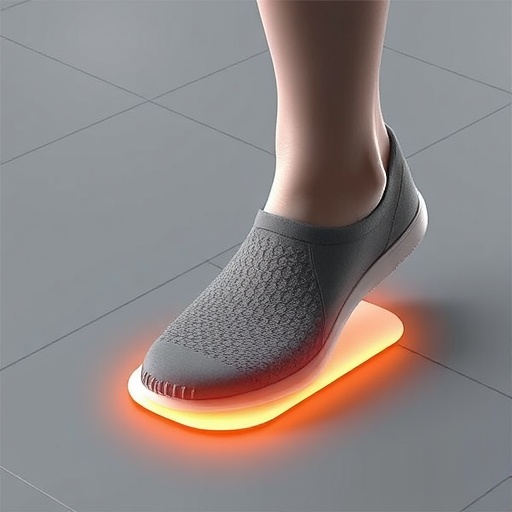
In the relentless pursuit of personalized comfort and enhanced performance in wearable technologies, recent advances have turned towards the intricacy of human gait and its interaction with pressure-distributing materials. A groundbreaking study led by Lu, Z., Li, X., and Sun, D., published in npj Advanced Manufacturing, pioneers a novel approach to engineering lattice pads that are computationally fine-tuned to adapt dynamically to the complex pressure patterns generated during walking. This work heralds a new era in the design of adaptive comfort systems, with implications spanning orthopedics, athletic performance, and everyday ergonomic support.
At the heart of this innovation lies the concept of dual-layer lattice structures, which serve as a sophisticated canvas for distributing mechanical stresses induced by human gait. Traditional cushioning systems often fail to accommodate the nuanced variability of pressure points encountered during the continuous phases of foot contact and lift-off. The researchers circumvent this limitation by harnessing advanced computational models that simulate gait-induced pressure distribution in unprecedented detail.
The dual-layer lattice pads are meticulously crafted through a synergistic combination of computational design and additive manufacturing techniques. The inner layer focuses primarily on compliance, designed to absorb and redistribute localized high pressures, while the outer layer manages stability and overall load distribution. By iteratively tuning the lattice architecture in response to simulated stress maps, the team achieves an optimized balance between softness and structural integrity tailored to individual walking dynamics.
This adaptive methodology hinges on integrating finite element analysis (FEA) with empirical gait data collected from motion capture systems and pressure sensors. Such data-driven modeling facilitates the identification of critical pressure hotspots and temporal variations during the gait cycle. By embedding these insights, the lattice geometry is computationally evolved, iterating through multiple design variants that progressively approach an idealized pressure mitigation profile.
A particularly compelling aspect of this research is the incorporation of heterogeneous lattice features within each layer, which deviates sharply from uniform foam or gel-based padding systems. Gradient porosity and localized stiffness modulation within the lattice allow the pads to morph their mechanical response in real-time, providing targeted cushioning precisely where and when it is needed. This gradation is meticulously engineered via computational optimization algorithms, enabling a level of personalization previously unattainable with conventional materials.
Importantly, the manufacturing of these complex lattices is enabled by the recent advancements in multi-material 3D printing technologies. The ability to precisely deposit polymers with varied mechanical properties in specific lattice regions ensures that the final product mirrors the digitally optimized design with high fidelity. This fusion between computation and fabrication embodies the essence of modern advanced manufacturing paradigms.
Testing and validation phases involved subjects performing controlled walking protocols while outfitted with instrumented insoles matched by these dual-layer lattice pads. The collected data demonstrated a significant reduction in peak plantar pressures compared to standard cushioning insoles, corroborating the efficacy of the computational design process. These empirical results highlight the real-world potential for preventing pressure-related discomfort and injury, particularly in populations vulnerable to foot ulcers or biomechanical abnormalities.
The broader implications extend into athletic wearables, where enhanced shock absorption and propulsion efficiency can translate to improved performance and reduced fatigue. By customizing the lattice structures not only to generic gait models but eventually to individual athlete biomechanics, these pads could revolutionize sport footwear design, merging comfort with performance enhancement.
From a biomechanical standpoint, this work sheds light on the intricate interplay between adaptive materials and human locomotion. It challenges conventional orthotic design philosophies by emphasizing a feedback-driven, iterative shaping of structural properties rather than static fabrication. The computational framework presents a blueprint for future explorations into dynamic wearable structures that evolve in harmony with human movement patterns.
Furthermore, the integration of artificial intelligence and machine learning in analyzing gait data sets a promising foundation for personalizing wearable solutions at scale. As these computational methodologies mature, the prospect of real-time adaptive cushioning that learns and adjusts to changing walking behaviors becomes increasingly tangible, promising unprecedented levels of user-specific comfort and injury prevention.
This research not only paves the way for smarter, more responsive cushioning systems but also catalyzes interdisciplinary collaborations across material science, biomechanics, and computational engineering. The advent of such integrative design strategies is poised to influence a spectrum of applications beyond footwear, including prosthetics, exoskeletons, and wearable robotics.
In conclusion, the study by Lu and colleagues exemplifies the transformative potential of computationally optimized dual-layer lattice pads, marking a significant stride towards truly adaptive, gait-aware wearable technologies. By finely tuning material microarchitecture to human biomechanics, this approach redefines the parameters of comfort and functionality, signaling a future where every step is supported by intelligent design.
Lu, Z., Li, X., Sun, D. et al. Computationally tuned dual-layer lattice pads adapted to gait-induced pressure distribution. npj Adv. Manuf. 2, 43 (2025). https://doi.org/10.1038/s44334-025-00055-8
Cite Scienmag News
Denise Maddox. (October 1, 2025). Dual-Layer Lattice Pads Optimized for Gait Pressure. Scienmag. https://scienmag.com/dual-layer-lattice-pads-optimized-for-gait-pressure/
Denise Maddox. "Dual-Layer Lattice Pads Optimized for Gait Pressure." Scienmag, 1 October 2025, https://scienmag.com/dual-layer-lattice-pads-optimized-for-gait-pressure/. Accessed 3 September 2026.
Denise Maddox. "Dual-Layer Lattice Pads Optimized for Gait Pressure." Scienmag. October 1, 2025. https://scienmag.com/dual-layer-lattice-pads-optimized-for-gait-pressure/


