


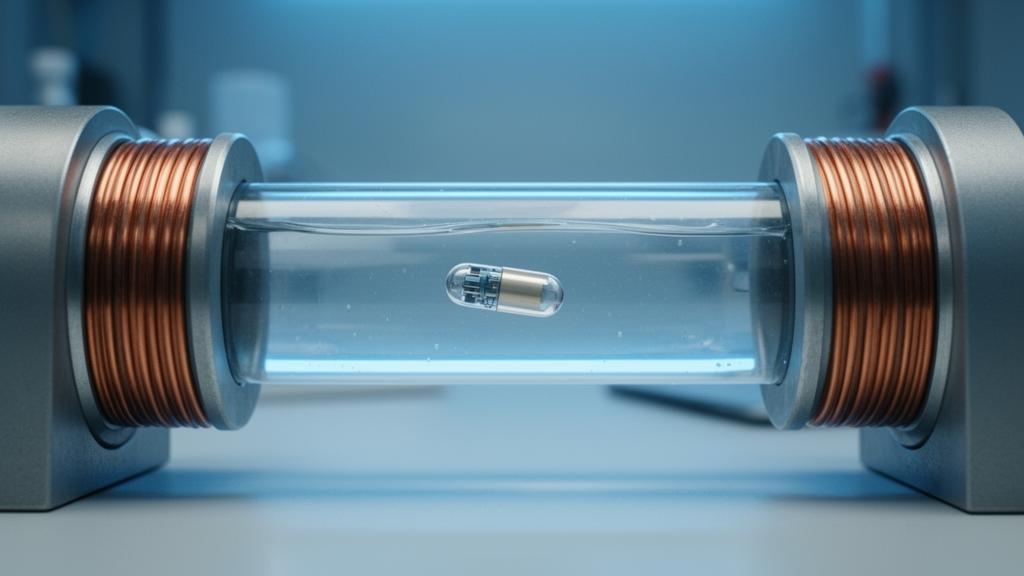
Imagine a tiny magnetic sphere floating motionless in the middle of a pipe filled with flowing liquid, holding its position against the current like an invisible hand were gripping it. That is precisely what a team of researchers at Nanjing University of Aeronautics and Astronautics has demonstrated. In a study published in the journal Mechanical Sciences, Zhanxiang Cui, Yonghua Lu, and Yun Zhu describe a magnetic-levitation drive system that uses two vertically arranged electromagnets to suspend and steer a small spherical robot inside a fluid-filled conduit. The work addresses a long-standing challenge in pipeline robotics: how to move a device through a narrow, liquid-filled channel without touching the walls, without wheels or tethers, and with enough precision to be useful in real applications ranging from industrial inspection to minimally invasive medicine.
The motivation is straightforward. Industrial pipelines that carry oil, gas, and water inevitably develop cracks, corrosion, and blockages that are difficult to detect from the outside. Conventional inspection robots rely on wheels, tracks, legs, or tow cables, and they must maintain continuous contact with the pipe wall, which limits their usefulness when debris or friction gets in the way. In medicine, the stakes are even higher: the human body is full of tubular organs such as blood vessels and the gastrointestinal tract, where traditional interventional tools suffer from poor controllability, invasiveness, and strict spatial constraints. Magnetic actuation has long been considered one of the most promising alternatives because it is wireless and non-invasive, but many existing approaches, such as rotating magnetic fields produced by Helmholtz coils, generate relatively weak torques, require complex equipment, and risk pushing the robot against the pipe wall as it spins.
The Chinese team’s solution borrows from magnetic-levitation technology, the same family of techniques that underpins high-precision positioning stages in semiconductor manufacturing and contactless manipulation in aerospace systems. Instead of spinning the robot, they levitate it. Two electromagnets, one above and one below a transparent pipe, generate a non-uniform gradient magnetic field that attracts a spherical permanent magnet made of neodymium-iron-boron. The ball, which serves as the robot, measures 13 millimeters in diameter, weighs 8.15 grams, and has a surface magnetic flux density of 677.3 millitesla. A spherical shape was chosen deliberately: compared with iron or steel balls, a permanent magnet of this kind produces a greater magnetic moment per unit volume, and a sphere experiences less fluid resistance and better directional stability as it moves through liquid.
One of the study’s more interesting engineering decisions involved the electromagnets themselves. Industrial electromagnets typically include an iron core, which concentrates the magnetic field along the coil’s axis and boosts the attractive force. But when the team simulated both designs in Ansys Electronics software, they found a trade-off. The core-equipped electromagnet needed less current to hold the ball at the same distance, but its controllable range was narrower: a one-milliampere change in current shifted the suspension distance by an average of 0.26 millimeters, compared with just 0.1 millimeters for the coreless design. Given that the current driver’s resolution is 0.001 amperes, the researchers chose the coreless configuration to achieve finer positional adjustment, a decision that highlights how actuator design details can dominate the ultimate precision of a levitation system.
Keeping the ball in place requires knowing exactly where it is. The system uses an industrial camera with a CMOS sensor capturing 30 frames per second at a resolution of 1296 by 964 pixels, processed with OpenCV to identify the ball’s elliptical outline, which appears distorted when viewed through the cylindrical pipe. A Hall sensor mounted on the end face of the electromagnet provides supplementary distance measurements and serves as a backup when visual measurement is unavailable. Together, these sensors feed a controller that continuously adjusts the currents in the upper and lower electromagnets, balancing electromagnetic attraction against gravity, buoyancy, and the drag forces exerted by the flowing liquid, which in the experiments was a glycerin-water mixture with a density of 1060 kilograms per cubic meter and a dynamic viscosity of 0.0035 pascal-seconds.
The experimental results reveal how strongly fluid flow shapes the behavior of a levitating object. With a single electromagnet driving the ball, fluid velocity proved to be the dominant factor determining horizontal position. At a flow velocity of 0.08 meters per second, the ball drifted only about 0.6 millimeters from the electromagnet’s axis, but at 0.16 meters per second the displacement grew to between 1 and 2.3 millimeters, and at 0.24 meters per second it reached between 1.4 and 4.3 millimeters. The ball also tended to drift further at lower suspension heights, where it sat farther from the single driving electromagnet and its stabilizing pull was weaker.
Adding the second electromagnet changed the picture dramatically. When both the upper and lower coils were energized, the horizontal component of the electromagnetic force grew large enough to counteract the push of the flowing fluid. At the highest flow velocity tested, the horizontal displacement of the ball at the bottom of the pipe dropped from 4.3 millimeters to 1.8 millimeters, a reduction of up to 58 percent. At the lower flow velocity of 0.08 meters per second, the reduction was around 21 percent. The benefit extended to stability as well: under single-electromagnet drive, the ball’s horizontal fluctuations during fixed-point suspension ranged from 0.25 to 0.35 millimeters, while vertical fluctuations ranged from 0.1 to 0.2 millimeters. With dual-electromagnet drive, horizontal fluctuations fell below 0.21 millimeters, with a minimum of 0.134 millimeters, and vertical fluctuations dropped below 0.11 millimeters, with a minimum of 0.063 millimeters. Notably, horizontal fluctuations consistently exceeded vertical ones by roughly a factor of two, confirming that fluid disturbances, rather than the electromagnetic control loop, were the primary source of instability.
Perhaps the most striking demonstration is the system’s ability to position the ball anywhere within a two-dimensional plane inside the pipe. By fitting polynomial models to the measured relationships between coil currents and the ball’s horizontal and vertical coordinates, achieving goodness-of-fit values of 0.996 and 0.997 respectively, the researchers could calculate the exact currents needed to reach any target point. They then commanded the ball to a series of twelve positions arranged in a rectangle, with horizontal coordinates spanning 2 to 3 millimeters and vertical coordinates spanning minus 2 to 2 millimeters, and photographed it suspended precisely at each location. By switching between suspension points at intervals of 2, 1, 0.5, and 0.2 seconds, the ball traced a rectangular path in stepwise motion, reaching average speeds of about 1 millimeter per second in the stable low-speed regime and up to 5 millimeters per second when speed was prioritized. At the fastest stepping rates, the ball no longer fully settled between switches, producing larger overshoots and deviations from the planned trajectory, with maximum horizontal overshoot of 0.463 millimeters recorded during the slower trials. Across all tested target points, position errors remained below 0.1 millimeters in both directions.
The authors are candid about the limits of the current work. The experiments were conducted in a straight, transparent pipe under idealized conditions, whereas real industrial pipelines, medical tubing, and biological lumens feature bends, diameter changes, and branches. They propose that future robots could adopt fish-like configurations with telescoping structures and steering mechanisms built into the permanent magnet, and they plan to employ multiphysics finite-element simulations to handle the mechanical modeling complexities of fluid environments, alongside optimized electromagnet structures, refined control strategies, and integrated multi-sensor feedback. Even so, the demonstration stands on its own: a contactless, friction-free robot that can hover in flowing liquid, resist disturbances from the current, and move on command with sub-millimeter accuracy. If the approach scales down and adapts to curved geometries, it could open the door to a new generation of pipeline robots that inspect infrastructure and navigate the body’s own fluid-filled passageways without ever touching the walls.
Subject of Research: Magnetic-levitation control of a spherical robot suspended by dual electromagnets inside a fluid-filled pipeline
Article Title: Two-dimensional point suspension characteristics of a magnetic robot driven by dual electromagnets within a fluid pipe
Article References: Cui, Z., Lu, Y., & Zhu, Y. (2026). Two-dimensional point suspension characteristics of a magnetic robot driven by dual electromagnets within a fluid pipe. Mechanical Sciences, 17(2), 825-838. https://doi.org/10.5194/ms-17-825-2026
Image Credits: AI Generated
Keywords: magnetic levitation, pipeline robot, electromagnets, fluid dynamics, position control, microrobotics, Hall sensors, machine vision, NdFeB magnet, industrial inspection, medical robotics, Mechanical Sciences
Cite Scienmag News
Denise Maddox. (October 9, 2026). Dual Electromagnets Steer a Levitating Robot Through Fluid-Filled Pipes With Sub-Millimeter Precision. Scienmag. https://scienmag.com/dual-electromagnets-steer-a-levitating-robot-through-fluid-filled-pipes-with-sub-millimeter-precision/
Denise Maddox. "Dual Electromagnets Steer a Levitating Robot Through Fluid-Filled Pipes With Sub-Millimeter Precision." Scienmag, 9 October 2026, https://scienmag.com/dual-electromagnets-steer-a-levitating-robot-through-fluid-filled-pipes-with-sub-millimeter-precision/. Accessed 9 October 2026.
Denise Maddox. "Dual Electromagnets Steer a Levitating Robot Through Fluid-Filled Pipes With Sub-Millimeter Precision." Scienmag. October 9, 2026. https://scienmag.com/dual-electromagnets-steer-a-levitating-robot-through-fluid-filled-pipes-with-sub-millimeter-precision/


