


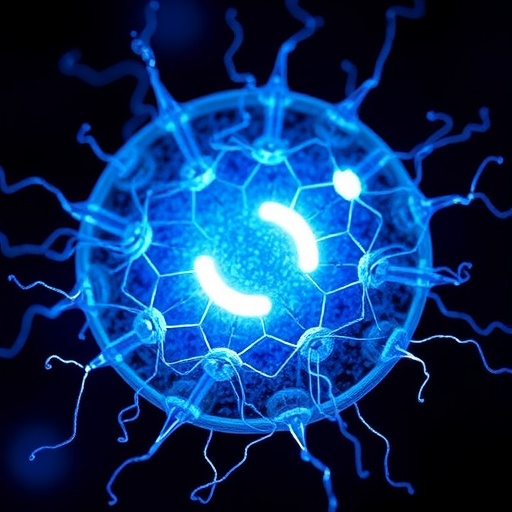
In the rapidly evolving domain of bioelectronics, scientists have long sought innovative methods to harness living organisms for sensing applications. A recent breakthrough by a multidisciplinary team spearheaded by Rice University professor Caroline Ajo-Franklin unveils a pioneering bioelectrical sensor system known as the electroactive co-culture sensing system, or e-COSENS. This modular, flexible technology capitalizes on synthetic microbial co-cultures to detect a variety of analytes, promising transformative impacts across health monitoring, environmental tracking, and beyond.
Traditionally, bacterial sensors have depended on bioluminescence—bacteria emitting light signals to communicate the presence of target substances. However, light-based communication often encounters practical limitations, especially outside controlled lab environments, because of environmental light interference and limited penetration. As a result, electrical signaling stands as a more viable alternative for transmitting bio-sensed information in complex real-world scenarios. Although electrically active bacteria are known to science, refining them into adaptable, sensitive, and modular bioelectronic sensors has posed a significant challenge until now.
The crux of e-COSENS’s ingenuity lies in its use of a co-culture approach that distributes sensing and electrical signal production across two distinct bacterial species. This division of labor contrasts sharply with single-cell strategies that attempt to engineer all-sensing and signaling functions within one organism. By doing so, the e-COSENS platform achieves unprecedented flexibility and ease in sensor construction, enabling researchers to “assemble” biosensors with a versatility comparable to stacking Lego blocks.
Among the bacterial players in this system are Escherichia coli (E. coli) and Lactobacillus plantarum (L. plantarum), species carefully chosen for their complementary attributes. E. coli, often lauded as a bioengineering workhorse due to its ease of genetic manipulation, traditionally does not produce electricity. On the other hand, L. plantarum naturally conducts electricity through the redox cycling of a molecule called quinone, yet this bacterium presents significant genetic engineering hurdles. The e-COSENS strategy sidesteps the limitations of each individual species by assigning E. coli the role of sensing and producing quinone in response to the target analyte, while L. plantarum functions as the electric signal generator.
Quinone, the linchpin molecule in this system, is synthesized by engineered E. coli only in the presence of specific analytes—chemicals or biomarkers of interest in the sensor’s environment. Because L. plantarum cannot produce quinone autonomously and relies on external quinones to conduct electricity, the presence of quinone produced by E. coli acts as a trigger, toggling the electrical signal on or off. This intercellular chemical communication underpins e-COSENS’s modularity: by simply rewiring the E. coli’s sensing circuitry to different input molecules, the system can be reprogrammed to detect diverse targets without redesigning the entire platform.
In their experimental validation, the research team demonstrated the system’s versatility by developing four distinct biosensors targeting analytes spanning environmental pollutants and human health markers. They applied e-COSENS to detect heavy metal ions in bayou water, inflammation indicators in artificial saliva, antimicrobial peptides in human fecal-derived samples, and antibiotic residues in commercial milk. Remarkably, the co-culture biosensors produced measurable electrical responses within hours, some responding as swiftly as twenty minutes after exposure, showcasing both the sensitivity and rapidity of the bioelectronic approach.
One of the notable hurdles in translating laboratory biosensors to field-ready devices lies in the hardware complexity and portability of measurement systems. To address this challenge, the team collaborated with Tufts University partners who engineered a compact electronic disk roughly the size of a quarter. This device interfaces seamlessly with commercially available digital multimeters, dramatically simplifying the hardware needed to detect the cellular electrical output. This development paves the way for low-cost, portable, and user-friendly bioelectronic sensors that can operate effectively outside traditional laboratory environments.
Furthermore, the modular design of e-COSENS allows the research team to expand beyond L. plantarum and E. coli by incorporating additional bacterial species capable of either producing or responding to quinone signals. This bacterial diversity enhances the adaptability of the sensing platform to an array of ecological niches and complex sample matrices, whether it be soil, water, food, or biological fluids. The ability to “mix and match” microbial components empowers the design of bespoke sensor arrays tailored to specific monitoring needs.
The concept of harnessing microbial consortia for synthetic biology applications represents a paradigm shift in engineering living systems. It acknowledges that cellular division of labor, a trait evolved naturally in microbial communities, can be leveraged for technical utility when designing smart, robust sensing interfaces. e-COSENS exemplifies this principle, demonstrating that combining multiple engineered organisms into co-cultures can overcome intrinsic limitations of single-species biosensors, improving both functional diversity and operational stability.
Professor Caroline Ajo-Franklin, who directs the Rice Synthetic Biology Institute, emphasizes the interdisciplinary nature of this accomplishment. The research brought together molecular biologists, synthetic biologists, microbiologists, and engineers from multiple institutions, including Baylor College of Medicine and Tufts University. Their collective expertise in microbial physiology, bioelectrochemistry, and device engineering was critical to navigating the technical hurdles required to develop and validate this innovative sensing platform.
Industry and academic observers alike recognize the potential for e-COSENS to revolutionize bioelectronic sensing. Its modularity not only reduces the time and complexity associated with sensor development but also opens avenues for real-time, in situ monitoring of complex environments, such as detecting contamination in water sources or monitoring biomarkers in clinical settings. By enabling electrical communication between engineered bacteria, e-COSENS bridges biological information processing with accessible electronic readouts, a crucial step toward integrating living sensors into broader sensing networks.
This work was supported by grants from the Cancer Prevention and Research Institute of Texas and the U.S. Army Research Office, affirming the broad significance and potential impact of this technology. Furthermore, the team has filed a series of provisional patents covering the system’s design, its integration with digital multimeters, and the innovative clay membrane technology used within their microbial fuel cells. These protections lay the groundwork for future commercialization efforts and broader implementation.
Looking forward, the e-COSENS platform exemplifies how synthetic biology can advance next-generation biosensors that merge biology and electronics in unprecedented ways. By exploiting natural bacterial communication molecules and engineering modular co-cultures, these bioelectronic sensors promise enhanced sensitivity, scalability, and adaptability critical for addressing complex challenges in health, environment, and industry. As technology advances, such systems may well become ubiquitous tools in precision monitoring and diagnostics worldwide.
- Li, S., Zhu, D., Britton, R. et al. Synthetic microbial co-cultures for modular bioelectronic sensing in diverse environments. Nature Biotechnology (2026). doi: 10.1038/s41587-026-03075-7
Image Credits: Jared Jones/Rice University
Keywords
Bioelectronics, synthetic biology, microbial co-culture, biosensor, electrical sensing, quinone signaling, E. coli engineering, Lactobacillus plantarum, bioelectrochemistry, environmental monitoring, health diagnostics, microbial fuel cell
Cite Scienmag News
Denise Maddox. (April 17, 2026). Dual-Bacterial Sensors Engineered to Convert Chemical Signals into Electricity. Scienmag. https://scienmag.com/dual-bacterial-sensors-engineered-to-convert-chemical-signals-into-electricity/
Denise Maddox. "Dual-Bacterial Sensors Engineered to Convert Chemical Signals into Electricity." Scienmag, 17 April 2026, https://scienmag.com/dual-bacterial-sensors-engineered-to-convert-chemical-signals-into-electricity/. Accessed 4 September 2026.
Denise Maddox. "Dual-Bacterial Sensors Engineered to Convert Chemical Signals into Electricity." Scienmag. April 17, 2026. https://scienmag.com/dual-bacterial-sensors-engineered-to-convert-chemical-signals-into-electricity/


