


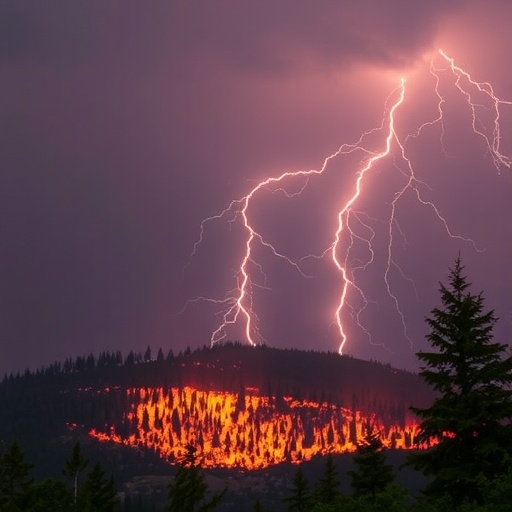
In recent years, the increasing frequency and severity of wildfires have captured global attention, prompting deeper investigations into their complex natural causes. Among these, lightning-induced wildfires pose a particularly formidable challenge due to their unpredictable nature and devastating impacts on ecosystems and human settlements. Despite longstanding scientific inquiry, the specific atmospheric conditions and characteristics of lightning that catalyze these fires remain incompletely understood. A groundbreaking study conducted by researchers at the University of Science and Technology of China and the University of Information Science and Technology has shed new light on this phenomenon by revealing surprising mechanisms of fire ignition during particular thunderstorm phases, challenging previous conventional wisdom.
Traditionally, it has been assumed that the most intense thunderstorms—and the lightning bolts they produce during peak maturity—are the primary culprits behind wildfire ignition. Such mature storm stages typically involve high-frequency lightning strikes accompanied by heavy precipitation. However, the latest research published in Atmospheric and Oceanic Science Letters overturns this belief by demonstrating that lightning occurring during the developing stages of thunderstorms, characterized by weaker discharge activity and fewer lightning flashes, can also be a potent source of wildfire ignition, particularly in forested mountainous regions.
To arrive at these conclusions, the researchers meticulously analyzed a lethal lightning-induced wildfire event that erupted on March 30, 2019, in southwestern China—a fire that tragically claimed 30 lives. By integrating a diverse range of multi-source data sets, including surface meteorological parameters such as precipitation levels, relative humidity, and wind velocity, alongside sophisticated satellite-derived cloud-top brightness temperature data from the Himawari-8 geostationary satellite, the team was able to reconstruct a highly detailed three-dimensional meteorological environment prevailing at the time and location of the fire’s outbreak.
The synthesis of this vast data repository revealed an unexpected temporal correlation between fire ignition and the developing phase of the thunderstorm rather than its mature phase. Although lightning frequency and intensity typically escalate as a storm matures, this investigation found ignition events aligned with the initial stages of storm development when lightning was relatively sparse and weaker. The atmospheric milieu during this early phase—characterized by drier air, lower precipitation, and sustained strong winds—was determined to be more conducive to igniting combustible forest materials despite the apparently subdued electrical activity.
A pivotal element of the study involved characterizing the electrical polarity of the lightning discharges responsible for initiating conflagrations. The data revealed that negative polarity lightning strikes dominated the ignition incidents. Negative cloud-to-ground lightning, known for its longer continuous current and broader stroke channels, poses a higher risk to forest fuels as it more effectively transfers energy capable of igniting dry vegetation. This observation held true even when comparing different fire cases in the same region under varying seasonal conditions, indicating a robust linkage between negative lightning and wildfire outbreaks.
Professor Yong Xue, the study’s corresponding author, elaborates on the implications of these findings, noting that the research fundamentally shifts long-held assumptions about the relationship between thunderstorm evolution and wildfire risk. “While lightning strikes during the mature thunderstorm stage are generally stronger and more frequent, it is the unique atmospheric conditions present during the developing stage that amplify the ignition potential of relatively weaker lightning discharges,” he explains. “Low humidity levels combined with minimal rainfall and vigorous winds create an environment where fires can establish and propagate rapidly from seemingly inconsequential electrical events.”
This nuanced understanding is critically important because existing wildfire risk models and early warning systems largely emphasize lightning characteristics during fully developed thunderstorms while potentially neglecting the insidious dangers posed during storm buildup. Enhancing predictive frameworks by incorporating this newfound insight could significantly improve the accuracy of wildfire hazard assessments and enable more targeted allocation of firefighting resources.
Moreover, the study’s findings have broad implications beyond the region in which the case study was conducted. Mountainous forest ecosystems worldwide share similar vulnerabilities to lightning-induced fires, particularly under changing climatic conditions where storm patterns and dry season lengths are evolving. Integrating advanced meteorological reconstructions with high-resolution satellite observations provides a powerful methodological blueprint for global monitoring programs aiming to preemptively identify and mitigate wildfire risks associated with lightning phenomena.
The researchers’ rigorous approach, bridging meteorology, atmospheric physics, and wildfire science, underscores the value of interdisciplinary collaboration in tackling environmental hazards. By elucidating the electrical and environmental factors that coalesce to ignite fires during thunderstorm development, this work opens new avenues for both fundamental atmospheric research and applied disaster management.
In summary, this pioneering study redefines our conceptual framework for lightning-induced wildfires by establishing that weaker lightning strikes in the developing phases of thunderstorms, under specific dry and windy meteorological conditions, are significant ignition sources. Negative polarity lightning emerges as a key contributor, emphasizing the need to refine lightning detection and risk modeling technologies. As climate change continues to impact thunderstorm behavior and wildfire dynamics, such enhanced understanding is vital for safeguarding vulnerable landscapes and human communities from the escalating threat of uncontrollable fires.
This research ultimately compels the scientific community and emergency response planners to reconsider fire ignition paradigms and adopt more holistic, phase-sensitive approaches to lightning wildfire prediction and prevention. The integration of satellite-based remote sensing with ground meteorological data exemplifies the cutting-edge tools now indispensable in this endeavor. Continued expansion of such studies across diverse geographies will be critical for building resilient strategies against the increasing global wildfire menace.
News Publication Date: (Not specified in the content)
Web References:
https://doi.org/10.1016/j.aosl.2025.100714
References:
The published article in Atmospheric and Oceanic Science Letters (DOI 10.1016/j.aosl.2025.100714)
Cite Scienmag News
Caitlin Barrett. (October 14, 2025). Dry lightning in developing thunderstorms sparks deadly wildfires, scientists warn. Scienmag. https://scienmag.com/dry-lightning-in-developing-thunderstorms-sparks-deadly-wildfires-scientists-warn/
Caitlin Barrett. "Dry lightning in developing thunderstorms sparks deadly wildfires, scientists warn." Scienmag, 14 October 2025, https://scienmag.com/dry-lightning-in-developing-thunderstorms-sparks-deadly-wildfires-scientists-warn/. Accessed 3 September 2026.
Caitlin Barrett. "Dry lightning in developing thunderstorms sparks deadly wildfires, scientists warn." Scienmag. October 14, 2025. https://scienmag.com/dry-lightning-in-developing-thunderstorms-sparks-deadly-wildfires-scientists-warn/


