

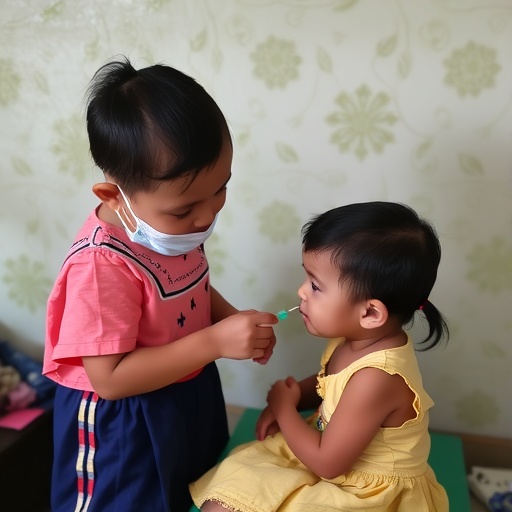
In the evolving landscape of global health, childhood immunization remains a cornerstone of preventive medicine, significantly reducing morbidity and mortality from vaccine-preventable diseases. Yet, in certain regions, especially those with socio-economic vulnerabilities, routine childhood immunization coverage remains persistently low. A groundbreaking study conducted by Dalisay, Landicho, Lota, and their colleagues sheds unprecedented light on the behavioral and social drivers underpinning these low coverage rates in selected areas of the Philippines, a developing nation grappling with complex health challenges.
The research delves deeply into the multifaceted barriers impacting childhood immunization uptake, moving beyond conventional biomedical models to explore the intricate interplay of cultural beliefs, social norms, and behavioral tendencies influencing parental decision-making. The investigators employed a comprehensive mixed-methods approach to unravel the nuanced factors that derail the achievement of optimal vaccine coverage in underserved communities.
One of the pivotal insights from the study centers on the significant role of trust—or a lack thereof—between healthcare providers and the communities they serve. Historical inconsistencies in vaccine communication, coupled with sporadic healthcare delivery, have eroded the confidence of many caregivers. This erosion of trust manifests as vaccine hesitancy, a phenomenon the research identifies as a major driver of suboptimal immunization rates. The study elucidates how ephemeral misinformation quickly permeates social networks, exponentially amplifying doubts about vaccine safety and efficacy.
Cultural paradigms and societal structures also reveal themselves as powerful determinants in vaccine uptake. The investigation illustrates that deeply entrenched beliefs around childhood health, often informed by traditional healing practices and religious doctrines, compete with modern medical advice. This clash inadvertently fosters skepticism towards routine immunizations, with some caregivers prioritizing alternative health modalities that ostensibly align better with their worldviews.
Additionally, logistical challenges inherent in the Philippine healthcare infrastructure play a non-trivial role in limiting immunization coverage. The study highlights obstacles such as geographical isolation, insufficient cold chain maintenance, and irregular immunization schedules that impede consistent vaccine availability. These deficiencies disproportionately affect remote communities where healthcare accessibility is already precarious, thereby exacerbating health inequities.
Behavioral economic theories provide a useful lens through which the researchers analyze decision-making processes within households. They note that risk perception, immediate versus delayed gratification, and cognitive biases collectively skew immunization behavior. Parents who do not witness immediate benefits of vaccination or who overestimate vaccine-related risks due to anecdotal adverse events are more likely to forego timely immunizations.
Social influence mechanisms are intricately mapped within the study’s scope, underscoring the power of community leaders and peer networks in shaping vaccination norms. The findings reveal that endorsement from respected figures within the community often catalyzes positive vaccination behaviors, while contrarian opinions can fuel widespread resistance. This observation signals the critical need for culturally nuanced engagement strategies that leverage trusted social intermediaries.
Importantly, the study does not only diagnose problems but also offers strategic policy recommendations to bolster routine childhood immunization. The authors advocate for integrated communication campaigns tailored to local contexts, aiming to counter misinformation and rebuild trust through transparency and empathy. Strengthening healthcare provider training to enhance interpersonal skills in vaccine counseling emerges as another essential intervention point.
Innovative technological solutions are also proposed as potential game-changers in immunization efforts. The application of mobile health platforms for appointment reminders, real-time vaccine stock monitoring, and community feedback channels could bridge existing gaps in the immunization cascade. Such digital health strategies, when culturally adapted, promise to enhance both efficiency and engagement.
The research explicitly calls attention to the importance of multisectoral collaboration, involving government entities, civil society, and international partners, to create resilient immunization programs. By adopting a holistic lens encompassing behavioral science, social anthropology, and health systems strengthening, the study sets a precedent for future interventions aiming at sustainable vaccine coverage improvements.
Moreover, the investigators emphasize the significance of ongoing surveillance and adaptive program design. Routine data collection on immunization attitudes and coverage trends enables timely responses to emerging challenges. This dynamic approach contrasts with static, one-size-fits-all strategies that often fail to address the mutable nature of behavioral and social determinants.
Beyond the immediate Philippine context, the study’s findings resonate with global health stakeholders grappling with similar immunization uptake issues in other low- and middle-income countries. The universal themes of trust, cultural congruence, and systemic barriers underscore the necessity for tailored, context-specific solutions rather than blanket policies.
In sum, this seminal work offers a comprehensive, empirically grounded analysis of the behavioral and social drivers that thwart routine childhood immunization efforts in vulnerable settings. By illuminating the intricate interdependencies among cognitive, social, and infrastructural factors, it charts a path towards more effective, equitable vaccination strategies capable of safeguarding future generations.
As childhood immunization policies continue to evolve in the face of emerging infectious threats and shifting societal landscapes, integrating behavioral and social insights will prove indispensable. The Philippines’ experience, as detailed in this study, serves as both a cautionary tale and a beacon, urging health practitioners and policymakers worldwide to harness multidisciplinary approaches to unlock the full potential of vaccines.
Indeed, the future of global health depends not only on scientific breakthroughs in vaccine development but equally on a profound understanding of the human factors that govern their adoption. This research stands as a clarion call to embrace complexity, empathy, and innovation in the quest for universal childhood immunization.
Subject of Research: Behavioral and social factors influencing routine childhood immunization in low coverage areas of the Philippines
Article Title: Behavioural and social drivers of routine childhood immunization in selected low coverage areas in the Philippines
Article References:
Dalisay, S.N., Landicho, M., Lota, M.M. et al. Behavioural and social drivers of routine childhood immunization in selected low coverage areas in the Philippines. Glob Health Res Policy 10, 48 (2025). https://doi.org/10.1186/s41256-025-00447-5
Image Credits: AI Generated


