


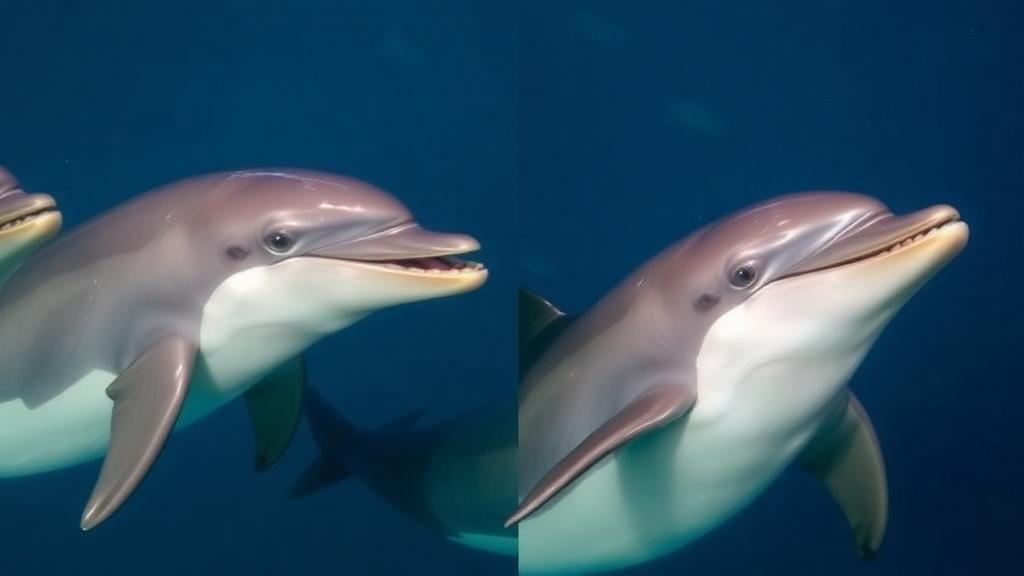
More than four decades ago, in the summer of 1982, a team of researchers chased bottlenose dolphins through the shallow, brackish waters of the Mississippi Sound, scooped them gently into a 457-meter net, and pressed liquid-nitrogen-chilled branding irons against their skin. The numbers they left behind, from 601 to 653, were meant to last a few years at most. Nobody could have predicted that some of those marks would still be legible in 2026, or that the animals carrying them would rewrite what scientists believe about how long dolphins live and how faithfully they return to the same stretch of coast for nearly half a century.
A new study published in Ecology and Evolution by researchers at the Institute for Marine Mammal Studies (IMMS) has followed up on those 50 freeze-branded dolphins, combining the original 1982 health assessment with community sighting reports, ongoing photo-identification surveys, and regional stranding records. Of the 50 animals originally marked, 10 have been documented since 2001, and the results are striking. Seven individuals were confirmed alive past the age of 30, and one female, catalogued as F649, was photographed in June 2026 at an estimated 47 years old, making her the oldest confirmed dolphin in the study and one of the oldest wild bottlenose dolphins ever documented in the Gulf of Mexico.
The longevity findings matter because estimates for bottlenose dolphin lifespan in the Gulf have long been inconsistent. A 1983 study in the eastern Gulf suggested these animals rarely lived past 30 years, while other research along the Gulf and Atlantic coasts pointed to lifespans exceeding 40 years, with rare individuals passing 50. The new data firmly support the higher estimates. One female, F620, stranded dead in January 2023 at an estimated 45 years of age, providing direct confirmation that Gulf dolphins can survive well beyond four decades. If four other individuals last seen between 2011 and 2013 were still alive in 2026, they would be projected to be over 40, and two males would be projected to exceed 50 years.
The technical foundation for these estimates dates back to the original capture operation. Between June 28 and August 2, 1982, crews using four boats and an aircraft located dolphin groups, screened them to ensure no nursing calves were present, and encircled small groups of five or fewer animals. Divers entered the water to support each captured dolphin and keep it at the surface while researchers recorded sex, weight, length, blood parameters, and biopsies. Each animal received a freeze-brand: two digits on each side of the dorsal fin and the full three-digit number on both flanks. The brand destroys pigment cells and hair follicles, leaving a permanent pale mark that, even when faded, can often be read from partial digits years later.
Age at capture was determined by extracting a single tooth from each dolphin. The teeth were boiled, cleaned, stored in an ethanol-glycerol mixture with thymol to prevent fungal growth, and then analyzed using two complementary techniques: thin-sectioning, in which the center of the halved tooth is sliced to reveal growth layer groups, and acid etching, which exposes the same layers on the tooth surface. When the two methods disagreed, the higher age estimate was used. By adding those 1982 ages to the decades elapsed since, the researchers could calculate each animal’s age at its last confirmed sighting or stranding.
But the study’s second revelation may be even more remarkable. Site fidelity, the tendency of an individual to remain in or return to a particular area, is usually assessed over just a few years. Here, the photographic record spans nearly the entire interval between the 1982 branding and the present. F649, for example, was seen once during the 1982 assessment, once during a 1995 to 1996 survey, and 16 times between June 2015 and June 2026, when she was photographed near Ship Island at age 47. That is evidence of habitat loyalty stretching across 44 years, an observation with almost no parallel in cetacean science.
The quantitative picture is equally compelling. Since IMMS began systematic photo-ID surveys in 2010, two of the seven dolphins confirmed alive have met the study’s threshold for site fidelity, five or more sightings within the Sound. F603, a male branded at the western tip of Cat Island at age 3, was sighted six times between October 2012 and August 2020, exclusively around Cat Island, and was recorded alongside nine other site-faithful individuals. His permanence value, the proportion of survey months spanning his first and last sightings, was 0.50, and his periodicity, the fraction of that span in which he was actually detected, was 0.06, reflecting the challenge of finding single animals in a large population.
F649’s record is even richer. Over 10.98 years of sightings she was photographed with 63 different site-faithful companions, averaging 8.79 months between detections, with a permanence of 0.69 and periodicity of 0.12. Her sightings clustered overwhelmingly in spring and summer, eight in spring and seven in summer against a single fall record, while F603 appeared only in summer and fall. That seasonal pattern matches earlier findings that a portion of the Mississippi Sound population migrates offshore into deeper waters during winter, likely following prey, and returns in spring for calving. Both animals would be classified as seasonal residents, and their movements suggest the population ranges beyond the currently defined stock boundaries, consistent with genetic evidence linking Sound dolphins to adjacent Gulf waters.
The researchers are candid about the limitations of their approach. Only 20 percent of the originally branded animals have been documented since 2001, and photo-ID surveys and stranding networks are inherently constrained by weather, seasonality, survey routes, and public reporting of carcasses, which may drift or sink before anyone notices. Long gaps between sightings, sometimes spanning decades, mean that dolphins last seen alive years ago could have died undetected, introducing potential survival bias. The authors also note that freeze-branding, while invaluable historically, causes stress and pain, and modern alternatives such as acoustic and satellite telemetry, stable isotopes, and environmental DNA now offer less invasive ways to track individuals. They call for greater collaboration with other photo-ID networks across the Gulf of Mexico to close these gaps.
Why does any of this matter beyond the novelty of a 47-year-old dolphin? Bottlenose dolphins are apex predators and widely recognized sentinel species, meaning their health, life history, and behavior mirror the condition of their ecosystem. The Mississippi Sound has endured hurricanes, freshwater diversions, the Deepwater Horizon oil spill, and intense fishing pressure, and the dolphin population has rebounded from these insults. Long-lived, site-faithful individuals like F649 integrate environmental change across decades, making them living archives of ecosystem health. If habitat degradation shortens lifespans or erodes site fidelity, those shifts will signal trouble for the entire Sound. The 1982 health assessment was designed as a snapshot; 44 years later, it has become one of the longest-running natural experiments in marine mammal science, and every future sighting of a faded two-digit brand on a dorsal fin adds another data point to a story still being written.
Subject of Research: Longevity and long-term site fidelity of freeze-branded bottlenose dolphins in the Mississippi Sound
Article Title: Dolphin Longevity and Long‐Term Site Fidelity in the Mississippi Sound: Insights From a 1982 Health Assessment
Article References: Solangi, M., Collins, F., Pamperin, K., Madrigal, T., & Busboom, K. (2026). Dolphin Longevity and Long‐Term Site Fidelity in the Mississippi Sound: Insights From a 1982 Health Assessment. Ecology and Evolution, 16(10), Article e74432. https://doi.org/10.1002/ece3.74432
Image Credits: AI Generated
DOI: 10.1002/ece3.74432
Keywords: bottlenose dolphin, Mississippi Sound, longevity, site fidelity, freeze-branding, photo-identification, Gulf of Mexico, sentinel species, marine mammal, ecology, age estimation, conservation
Cite Scienmag News
Margaret Porter. (October 4, 2026). Dolphins Branded in 1982 Reveal Lifespans Near 50 Years and Decades-Long Loyalty to Home Waters. Scienmag. https://scienmag.com/dolphins-branded-in-1982-reveal-lifespans-near-50-years-and-decades-long-loyalty-to-home-waters/
Margaret Porter. "Dolphins Branded in 1982 Reveal Lifespans Near 50 Years and Decades-Long Loyalty to Home Waters." Scienmag, 4 October 2026, https://scienmag.com/dolphins-branded-in-1982-reveal-lifespans-near-50-years-and-decades-long-loyalty-to-home-waters/. Accessed 4 October 2026.
Margaret Porter. "Dolphins Branded in 1982 Reveal Lifespans Near 50 Years and Decades-Long Loyalty to Home Waters." Scienmag. October 4, 2026. https://scienmag.com/dolphins-branded-in-1982-reveal-lifespans-near-50-years-and-decades-long-loyalty-to-home-waters/


