


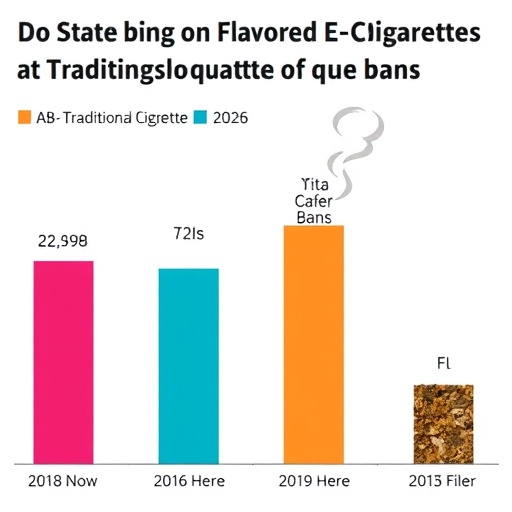
A groundbreaking study published in the prestigious journal Health Economics offers a comprehensive analysis of the real-world impacts of comprehensive state-level bans on flavored e-cigarettes in the United States. This rigorous research leverages national datasets and employs advanced econometric methodologies to explore the behavioral changes in tobacco product consumption among different age demographics following the implementation of these bans. The findings reveal a nuanced and complex relationship between flavored e-cigarette prohibitions and traditional smoking habits, particularly among young adults aged 18 to 24 years.
The research demonstrates that while these bans succeed in reducing the usage rates of flavored e-cigarettes among young adults by approximately 2 to 3 percentage points, an unintended consequence emerges as these same individuals increasingly turn to conventional combustible cigarettes. This substitution effect essentially nullifies the benefits expected from decreased e-cigarette consumption, raising vital public health concerns. As well-documented in epidemiological literature, conventional cigarettes carry a substantially higher health risk profile compared to e-cigarettes, including increased incidences of respiratory diseases, cardiovascular conditions, and cancer.
Central to the study is the employment of sophisticated causal inference techniques designed to isolate the effects of flavor bans from other confounding factors. Using difference-in-differences models and state fixed effects, the researchers meticulously accounted for underlying trends and demographic covariates, lending significant credence to the observed behavioral shifts. This methodological rigor ensures that the substitution toward traditional cigarettes is not merely a coincidental correlation but an effect attributable to the legislative measures targeting flavored vaping products.
Exploring younger populations under 18 years of age, the study identifies suggestive signals indicating a potential increase in cigarette use, though these findings are less definitive compared to the young adult cohort. Notably, among adults aged 25 and older, the flavor bans exhibited no statistically significant impact on either e-cigarette or cigarette use. This divergence in effects across age groups underscores the complexity of nicotine consumption dynamics and suggests that policy interventions may require greater granularity to avoid unintended health consequences.
The work adds to a growing discourse within public health and behavioral economics on the unintended consequences of regulatory frameworks aimed at harm reduction. While the promotion of flavored e-cigarette restrictions is rooted in the intent to shield vulnerable youth populations from nicotine initiation and addiction, the reality illuminated by this study points to the persistence of nicotine consumption behavior through alternate, potentially more harmful vectors. This presents an urgent call for policymakers to refine tobacco control strategies to holistically address substitution mechanisms rather than singular product targeting.
Very importantly, the findings emphasize the differential risk profiles associated with nicotine delivery systems. E-cigarettes, though not devoid of health risks, present a reduced harm compared to combustible tobacco products due to the absence of tar and many carcinogens. By inadvertently driving young adults towards traditional cigarettes, the bans risk increasing aggregate health burdens, including long-term morbidity and mortality. This counterproductive outcome challenges the conventional wisdom underpinning flavor restrictions and necessitates a reevaluation based on empirical evidence.
The study also situates itself within the broader framework of tobacco control policies, illustrating the delicate balance between regulation and consumer behavior. The observed substitution effect suggests that nicotine use is resilient and adaptive; users constrained by flavor bans may seek alternatives that satisfy dependency but bear greater health detriments. These insights contribute to understanding addiction economics and highlight the importance of cessation support and comprehensive policy designs that encompass all tobacco products.
Moreover, the research harnesses extensive data drawn from nationally representative surveys, incorporating demographic, socioeconomic, and geographic variables to enhance the generalizability of its conclusions. The large sample size and longitudinal scope enable the detection of subtle behavioral trends over time, enriching the tobacco control field with robust and actionable intelligence. This data-driven approach offers a model for future policy evaluations seeking to balance public health objectives with behavioral realities.
Beyond the empirical evidence, the study invites critical reflection on the ethical dimensions of tobacco regulation. Interventions that produce inadvertent harm impose a moral imperative to reconsider policy objectives and to incorporate stakeholder perspectives, including those of young consumers navigating addiction landscapes. By integrating insights from economics, psychology, and public health, future regulatory frameworks may better anticipate and mitigate unwanted effects.
In conclusion, the research led by Henry Saffer, PhD, a notable scholar affiliated with the National Bureau of Economic Research and the Graduate Center of the City University of New York, articulates a cautionary tale about the complexities involved in combating youth tobacco use. The nuanced interplay between flavored e-cigarette bans and increased traditional cigarette consumption among young adults underscores the need for multi-faceted strategies that address the spectrum of nicotine products rather than isolated components. Policymakers and public health professionals are urged to engage with these findings and to devise more sophisticated interventions that anticipate behavioral substitutes, thereby optimizing health outcomes across populations.
As the conversation around tobacco control continues to evolve, this study stands as a crucial contribution to the evidence base, urging a shift from narrowly targeted prohibitions to integrated regulatory frameworks. By acknowledging the adaptive responses of users and emphasizing harm reduction, future policies can better safeguard the health of younger generations while advancing the overarching goal of reducing tobacco-related disease worldwide.
News Publication Date: 3-Sep-2025
Web References:
- Journal: Health Economics
- DOI: 10.1002/hec.70030
References: The study is based on data and methodologies detailed within the Health Economics journal article DOI 10.1002/hec.70030.
Cite Scienmag News
Courtney Benton. (September 3, 2025). Do State Bans on Flavored E-Cigarettes Lead to a Rise in Traditional Cigarette Smoking? Scienmag. https://scienmag.com/do-state-bans-on-flavored-e-cigarettes-lead-to-a-rise-in-traditional-cigarette-smoking/
Courtney Benton. "Do State Bans on Flavored E-Cigarettes Lead to a Rise in Traditional Cigarette Smoking?" Scienmag, 3 September 2025, https://scienmag.com/do-state-bans-on-flavored-e-cigarettes-lead-to-a-rise-in-traditional-cigarette-smoking/. Accessed 4 September 2026.
Courtney Benton. "Do State Bans on Flavored E-Cigarettes Lead to a Rise in Traditional Cigarette Smoking?" Scienmag. September 3, 2025. https://scienmag.com/do-state-bans-on-flavored-e-cigarettes-lead-to-a-rise-in-traditional-cigarette-smoking/


