

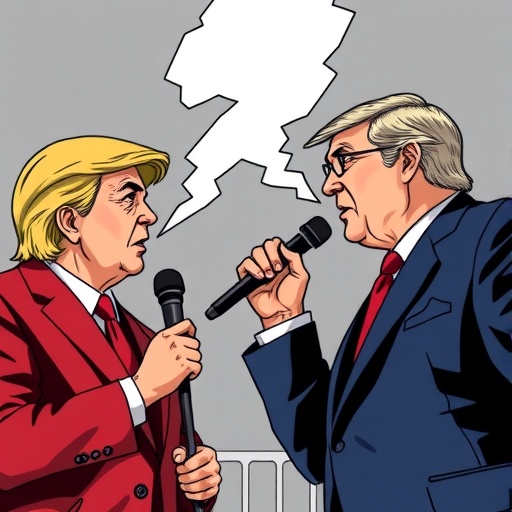
In recent years, American political discourse has alarmingly shifted away from substantive debate towards an escalating culture of personal attacks. This disturbing trend, marked by incivility and divisive rhetoric among elected officials, raises pressing questions about the underlying motivations driving political elites to abandon policy discussions in favor of conflict-laden communication. A groundbreaking study led by Marc Jacob, assistant professor of democracy and global affairs at the University of Notre Dame, offers a compelling explanation that attributes this behavior primarily to the dynamics of media attention.
Central to the study’s findings is the identification of what the authors term the “conflict entrepreneur” — a political figure who strategically employs personal attacks focused on the character, morality, or intellect of rivals rather than engaging on policy grounds. By examining the 118th United States Congress, convened from January 2023 to January 2025, the researchers analyzed an extensive database comprising over 2.2 million public statements, including floor speeches, press releases, newsletters, and social media communications. Leveraging advanced natural language processing via large language models, the team distinguished between legitimate policy critique and inflammatory personal invective, allowing for unprecedented granularity in understanding patterns of congressional rhetoric.
Intriguingly, the research reveals a pronounced asymmetry in the use of derogatory language between political parties. While both Democrats and Republicans engage in personal attacks to varying degrees, Republicans exhibit this behavior approximately 2.7 times more frequently. Furthermore, the incidence of such attacks is more prevalent in the House of Representatives as opposed to the Senate, with a 1.3-fold increase. These disparities point to systemic differences not only in partisan culture but also institutional norms that shape congressional interactions.
Perhaps the most striking insight from the study is the pronounced disjunction between conflict-driven communication styles and traditional markers of political success, such as fundraising prowess, electoral margins, legislative achievements, or personal wealth accumulation. Politicians dedicating a mere 5% of their discourse to personal attacks garner media attention on cable news networks comparable to peers whose discourse is overwhelmingly substantive. This disproportionate visibility is starkly evident in social media metrics: posts laced with insults enjoy nearly two and a half times more shares than those focusing on detailed policy discussions.
Nevertheless, this aggressive rhetorical style exacts tangible costs within the legislative domain. Lawmakers who habitually engage in personal invective tend to participate less in co-sponsoring legislation and receive fewer appointments to influential standing committees. This detachment from policymaking suggests that the pursuit of media attention may undermine traditional legislative roles and responsibilities, representing a strategic diversion from governance towards celebrity via conflict.
One of the study’s more unexpected findings challenges conventional wisdom linking incivility to the political leanings of legislators’ constituencies. The researchers found no statistically significant correlation between the extent of personal attacks and the level of partisan animus or polarization within electoral districts. In fact, many of the most vociferous conflict entrepreneurs represent electorates characterized by relative moderation. This decoupling implies that for a subset of political actors, objectives extend beyond traditional goals of reelection, legislative influence, or institutional power, gravitating instead towards maximizing media exposure.
The implications of these findings extend far beyond academic interest, illuminating the calibration of incentives in America’s burgeoning media ecosystem. The study underscores how the prevailing media attention economy rewards spectacle and conflict at the expense of deliberative policy debate, distorting political incentives toward incivility. Cable news and social platforms magnify the visibility of confrontational rhetoric, effectively incentivizing politicians to adopt aggressive communication tactics as a shortcut to national relevance.
Jacob and his colleagues caution that this burgeoning political communication strategy risks eroding foundational democratic norms by severing the link between visibility and accountability. As conflict entrepreneurs dominate airwaves and social feeds without corresponding legislative achievements or constituency representation, the integrity of democratic discourse faces unprecedented strain. The ascendancy of personal attacks threatens to normalize antagonism and reduce politics to entertainment spectacle.
The study’s sobering conclusion offers a dual mandate: political party leadership and media gatekeepers possess crucial agency in reshaping incentive structures. Leadership must champion policy-oriented discourse and curtail the tacit endorsement of incivility, while media organizations are called to critically evaluate what counts as newsworthy, prioritizing substantive governance over provocative personality clashes. Such corrective actions are essential to safeguarding the stability and health of American democracy in an era increasingly dominated by polarization and media saturation.
This research, conducted through the Polarization Research Lab, collaborates with scholars from Dartmouth College and the University of Pennsylvania, collectively advancing our understanding of political polarization and rhetorical strategies in contemporary governance. Their innovative integration of computational linguistic tools with large-scale political data establishes a new frontier in political science, blending empirical rigor with relevant real-world implications.
Ultimately, this study signals a critical inflection point in American political communication. The choices political actors make today, amplified by media platforms hungry for conflict, will shape democratic norms and citizen engagement for years to come. As Marc Jacob summarizes, the path forward demands deliberate cultural and institutional reforms that restore respect for policy debate as the cornerstone of representative democracy, resisting the alluring but corrosive temptation of personal attacks for fleeting attention.
Subject of Research: People
Article Title: Entrepreneurs of conflict: A descriptive analysis of when and how political elites use divisive rhetoric
News Publication Date: 17-Mar-2026
Web References:
References:
Jacob, M., Lelkes, Y., & Westwood, S. J. (2026). Entrepreneurs of conflict: A descriptive analysis of when and how political elites use divisive rhetoric. PNAS Nexus. https://doi.org/10.1093/pnasnexus/pgag038
Image Credits: University of Notre Dame
Keywords: Democracy, Political process, Sociopolitical systems, Mass media, News media, Social media, Rhetoric, Verbal communication


