


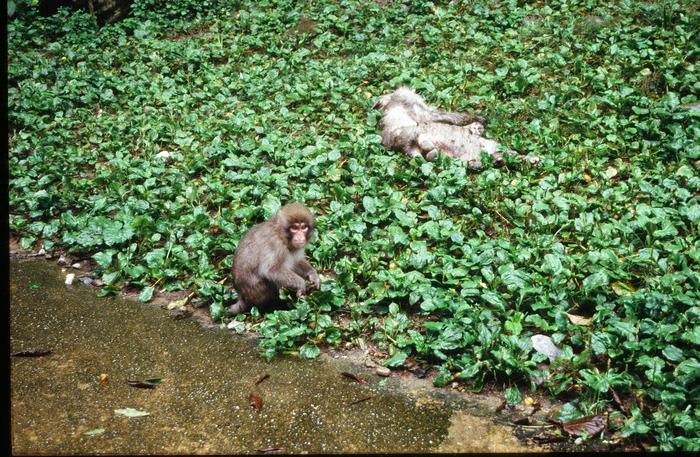
In a groundbreaking study challenging long-held assumptions about the uniqueness of human emotional capacities, researchers from The University of Osaka in Japan have documented strikingly human-like grieving behaviors among Japanese macaques (Macaca fuscata). Published in the journal Primates, this research offers unprecedented observational insights into how these nonhuman primates respond to the death of close social companions, shedding light on the complex emotional and social dynamics that extend beyond human experience.
Japanese macaques have long captivated primatologists due to their intricate social structures and varied behaviors. Living within expansive and highly organized troops, these primates exhibit a sophisticated array of social interactions that form the foundation of their community life. While maternal responses to infant death, such as carrying and grooming of deceased offspring, have been relatively well-noted, the specific reactions of macaques to the death of adult companions have remained elusive until now.
Utilizing meticulous observational methods, the research team was granted an extraordinary opportunity to witness the responses of individual macaques to dying and deceased adults within a provisioned, free-ranging group. Detailed behavioral tracking revealed that some macaques consistently remained in close proximity to the corpses of individuals with whom they had strong social bonds during life. Intriguingly, these interactions often included grooming behaviors directed at the deceased, indicating an emotional complexity and attachment that parallels human mourning.
Lead author Masayuki Nakamichi emphasizes the rarity and significance of these observations. "Documenting such behavior in wild settings is a formidable challenge," he explains. "Our approach, focusing on individual identification and continuous behavioral monitoring, allowed us to establish a clear link between social affiliation and post-mortem interaction behaviors." This finding suggests that the social fabric influencing macaque communities extends beyond life, affecting behavior even after death.
The team also identified variables influencing physical contact with the dying individuals and corpses. Evident injuries or severe infestations posed as deterrents, discouraging proximity and contact. Particularly noteworthy was the aversion displayed towards maggot infestations present on both dying and deceased macaques. However, the study highlighted exceptional cases where this natural aversion was overridden by the strength of social bonds; for instance, an alpha female was observed not only staying near her dying grooming partner but also removing and consuming maggots from his back, underscoring the powerful motivational role of social relationships.
Kazunori Yamada, co-author and primate behavior specialist, reflects on the implications of these findings for understanding nonhuman emotional capacities. "The behaviors we recorded reveal empathetic-like responses and social compassion, traits traditionally ascribed to humans," he comments. "Such findings challenge the anthropocentric view of grief, suggesting that the evolutionary roots of mourning may be deeper and more widespread across primate species."
These findings invite a reevaluation of grief as a biological and social phenomenon, suggesting it may have adaptive or social functions in nonhuman primates. Grief-related behaviors could facilitate social cohesion, aid in processing loss, or serve as mechanisms to reinforce social bonds—even in the face of death. The observation that some macaques maintained contact with deceased companions, sometimes at personal risk of disease or discomfort, implies that such behaviors are not merely instinctual but carry significant emotional weight.
Notably, this study also raises broader questions about how other primate species respond to death. The degree to which social relationships influence death-related behaviors across the primate lineage remains largely unexplored. With limited documentation existing, there is a compelling need for expanded ethological research focusing on death-related phenomena in diverse species, thus broadening understanding of the emotional lives of animals.
The researchers’ methodological approach relied extensively on continuous field observations and detailed individual identification, enabling the precise documentation of social interactions around death events. This scientific rigor is essential in a domain where such behaviors are notoriously ephemeral and difficult to record systematically. Their findings illuminate the deep-seated social awareness and emotional engagement of macaques with their conspecifics.
Furthermore, these observations contribute to the broader discourse regarding animal consciousness and emotional complexity. They suggest that behaviors associated with mourning, often regarded as uniquely human, may be part of an evolutionary continuum linking humans and other primates. Understanding these behaviors in nonhuman animals enriches scientific perspectives on the origins of empathy, grief, and social emotions.
The implications of this research extend beyond primatology into fields such as psychology, anthropology, and evolutionary biology. By unveiling the nuanced responses of Japanese macaques to dying and dead companions, this study contributes vital data that could inform models of social cognition and emotional processing in nonhuman species, as well as the evolutionary trajectories of these traits.
These discoveries also provoke ethical considerations concerning the treatment and welfare of primates, urging a reevaluation of how human beings perceive and interact with species possessing such complex emotional and social lives. Recognizing that primates experience grief-like states may influence conservation strategies and welfare policies.
Ultimately, this research from The University of Osaka enriches our understanding of nonhuman emotionality by illustrating that the experience of grief may not be the exclusive province of humans. The capacity to form lasting social bonds that impact behaviors even after death challenges the perception of a sharp emotional divide between humans and other animals, positioning Japanese macaques as compelling models for exploring the evolutionary underpinnings of social emotions.
The article titled “Responses to dying and dead adult companions in a free-ranging, provisioned group of Japanese macaques (Macaca fuscata)” is a landmark contribution to primatology and animal behavior research. Its detailed, observational approach and significant findings invite further inquiry into the social and emotional lives of nonhuman primates, ultimately deepening the scientific dialogue on what it means to grieve.
Cite Scienmag News
Courtney Benton. (June 26, 2025). Do Macaques Mourn Like Humans? Exploring the Echoes of Grief in Primates. Scienmag. https://scienmag.com/do-macaques-mourn-like-humans-exploring-the-echoes-of-grief-in-primates/
Courtney Benton. "Do Macaques Mourn Like Humans? Exploring the Echoes of Grief in Primates." Scienmag, 26 June 2025, https://scienmag.com/do-macaques-mourn-like-humans-exploring-the-echoes-of-grief-in-primates/. Accessed 5 September 2026.
Courtney Benton. "Do Macaques Mourn Like Humans? Exploring the Echoes of Grief in Primates." Scienmag. June 26, 2025. https://scienmag.com/do-macaques-mourn-like-humans-exploring-the-echoes-of-grief-in-primates/


