


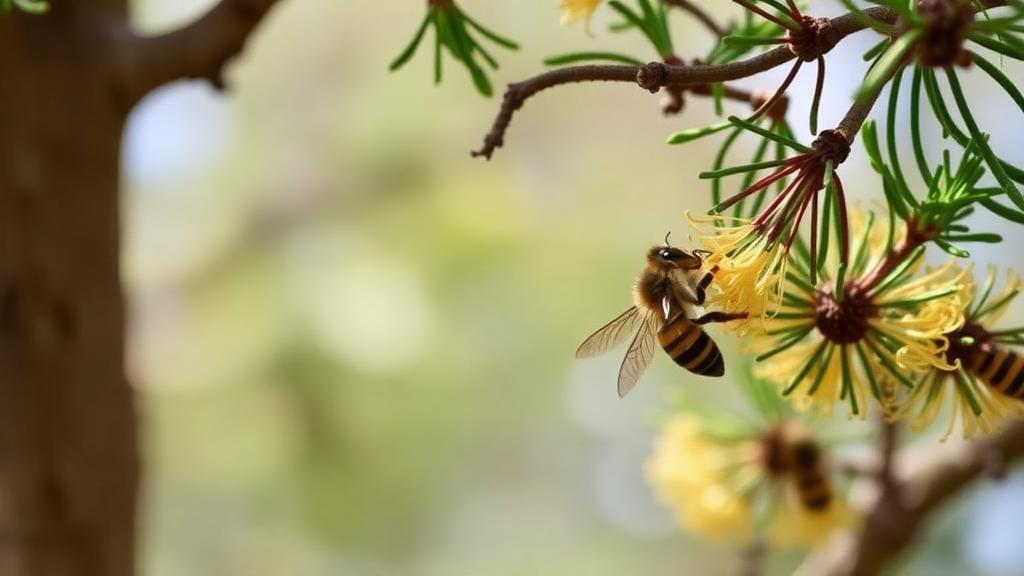
In the subtropical forests and macadamia orchards of south-east Queensland, a team of researchers has eavesdropped on the private lives of solitary bees in a way never done before at this scale. By sequencing DNA extracted from pollen bread, bee larvae, frass and the very materials bees use to build their nests, scientists have reconstructed the botanical world of seven cavity-nesting solitary bee species over two years. The findings, published in Frontiers in Bee Science, overturn several assumptions about what these important pollinators actually eat and how they build their homes, with implications for anyone trying to save bees in farmed landscapes.
Solitary bees make up the vast majority of the world’s roughly 20,500 known bee species. Unlike honey bees, they live without colonies, and many nest in hollow cavities, sealing brood cells with resin, cut leaves or cellophane-like glandular secretions. These bees are often equally effective or better pollinators than honey bees for many crops, yet they are acutely vulnerable when landscapes become simplified and flower-poor. Despite their ecological and economic importance, the specific plants that different solitary bee species rely on have remained largely unknown, particularly in tropical and subtropical regions where most resource-use research has been conspicuously absent.
To close this gap, researchers installed timber trap nests at three orchards and four forests in south-east Queensland, each unit containing drilled cavities lined with removable paper tubes. The sites, ranging across latitudes from Bundaberg in the north to the Sunshine Coast in the south, were classified as forest or orchard depending on canopy cover within a 500-meter radius. Over two years, from 2017 to 2018, the team recovered 590 occupied nests, dissected them, and collected samples of nest caps, pollen bread, larvae and frass. Emerging adult bees were identified to species using taxonomic literature and the Queensland Museum collections, allowing every nest to be linked to a known bee species.
The molecular workhorse of the study was DNA metabarcoding. The researchers amplified two plant DNA markers, rbcL and ITS2, using carefully controlled polymerase chain reactions, then sequenced the amplicons on an Illumina MiSeq platform. Reads were quality-filtered, denoised into amplicon sequence variants, and matched against a custom-built local reference database covering 93 percent of the plant species recorded in vegetation surveys at the study sites. Unmatched sequences were classified against broader Viridiplantae databases, and every assignment was cross-checked against the Atlas of Living Australia to confirm the taxon could plausibly occur in the region. The dual-marker approach was essential, because each barcode region carries different strengths in resolving plant identities.
The results were striking. Across all seven bee species, the team identified 118 plant taxa spanning 22 orders, 34 families and 67 genera. Yet the diet was far less diverse than that number suggests: just 20 plant species accounted for more than 70 percent of all resources used. Bees nesting in forests used roughly 5 to 13 plant species per nest, while those in orchards used only about 4 to 7, indicating that agricultural simplification narrows the botanical menu even for generalist foragers. Statistical analysis confirmed that bee species identity and land use, but not season, significantly shaped the composition of plants detected in nests.
Perhaps the most surprising discovery concerned plant form. Trees, not the wildflowers and herbaceous strips typically planted for pollinators, were the most frequently provisioned pollen source for every bee species studied, with 48 tree taxa detected. Metabarcoding allowed the researchers to quantify bee use of 43 tree species, half of which grow taller than 20 meters, including giants such as Eucalyptus pilularis, which can reach 70 meters, and Syncarpia glomulifera. Traditional observation of bee visits to tall canopies requires climbing ropes or flight-intercept traps, which is why this resource channel has been so badly underestimated. The study adds to emerging molecular evidence that a disproportionate share of bee-collected pollen comes from trees.
The nest materials told an equally unexpected story. Leafcutter bees, which line their brood cells with cut leaf pieces, sourced materials mostly from herbaceous plants, including the introduced annuals Modiola caroliniana and Passiflora foetida. Cellophane bees, which seal nests with glandular secretions, used vines and trees, and the detection of plant DNA in their nest caps suggests these bees mix their own secretions with plant-derived material, something never reported before for hylaeine bees. Most remarkably, resin bees relied heavily on parasitic plants, the mistletoes of the order Santalales, particularly species of Amyema. Mistletoe DNA appeared in roughly 87 percent median abundance in resin bee nest caps compared with only about 5 percent in pollen bread, indicating the collection was deliberate rather than accidental contamination. The researchers speculate that the glue-like secretions of mistletoe haustorial hairs or their waxy cuticles may make ideal nest-building materials.
Indigeneity mattered too. Introduced plants appeared in the resources of all seven bee species, even those nesting in natural forests, with the proportion ranging from as low as 1 to 16 percent for one resin bee species to as high as 39 to 86 percent for the cellophane bee Hyleoides concinna. This is the first record of exotic plant use by these species. Yet native plants still dominated, accounting for more than half of relative read abundance for six of the seven bee species, with the most heavily used native plants all belonging to the myrtle family, including Eucalyptus racemosa, Lophostemon confertus and Lophostemon suaveolens. The researchers suggest that fast-growing introduced annuals may fill temporal gaps in flowering when native plants are scarce, acting as ecological safety nets rather than preferred forage.
Several plants emerged as true multi-purpose resources. Modiola caroliniana and Passiflora foetida were detected in brood provisions and every type of nest material, while the myrtaceous trees Lophostemon suaveolens, Lophostemon confertus and Eucalyptus racemosa appeared in pollen, resin and cellophane samples alike. Notably, the plants used by bee species present in both forests and orchards were all tree and vine species, reinforcing the idea that landscapes retaining patches of structurally complex habitat sustain bee populations better than simplified farmland. The team also demonstrated that larvae and frass can serve as reliable proxies for pollen bread in metabarcoding diet studies, opening the door to analyzing nests even when pollen stores have been consumed.
The conservation implications are concrete. Current agri-environment schemes often focus on flower-strip plantings between crop rows, but this study suggests such approaches miss the most important pollen sources for solitary bees. The authors recommend retaining or planting patches of complex habitat with trees, shrubs and vines, and managing herbaceous weeds and mistletoes in ways that reduce their spread while preserving the forage and nest materials they provide during resource-scarce periods. Species such as Modiola caroliniana and Crotalaria lanceolata, both annual herbs that colonize disturbed sites, pose little invasion risk to undisturbed areas while offering valuable forage. As pollinator declines accelerate worldwide, this research makes clear that saving bees requires looking up into the canopy as well as down at the flower strip.
Subject of Research: Plant resource use by cavity-nesting solitary bees in Australia identified through DNA metabarcoding of pollen and nest materials
Article Title: Tall trees and exotic herbs identified in pollen and nest materials of seven cavity-nesting solitary bee species in Australia
Article References: Tall trees and exotic herbs identified in pollen and nest materials of seven cavity-nesting solitary bee species in Australia. (n.d.). https://doi.org/10.3389/frbee.2026.1744662
Image Credits: AI Generated
DOI: 10.3389/frbee.2026.1744662
Keywords: solitary bees, DNA metabarcoding, pollen diet, nest materials, mistletoe, eucalyptus, pollinator conservation, agri-environment schemes, Australia, Megachile, Hylaeus, tropical ecology
Cite Scienmag News
Julie Wynn. (October 16, 2026). DNA in Bee Nests Reveals Tall Trees and Mistletoes as Secret Lifelines for Australia’s Solitary Bees. Scienmag. https://scienmag.com/dna-in-bee-nests-reveals-tall-trees-and-mistletoes-as-secret-lifelines-for-australias-solitary-bees/
Julie Wynn. "DNA in Bee Nests Reveals Tall Trees and Mistletoes as Secret Lifelines for Australia’s Solitary Bees." Scienmag, 16 October 2026, https://scienmag.com/dna-in-bee-nests-reveals-tall-trees-and-mistletoes-as-secret-lifelines-for-australias-solitary-bees/. Accessed 16 October 2026.
Julie Wynn. "DNA in Bee Nests Reveals Tall Trees and Mistletoes as Secret Lifelines for Australia’s Solitary Bees." Scienmag. October 16, 2026. https://scienmag.com/dna-in-bee-nests-reveals-tall-trees-and-mistletoes-as-secret-lifelines-for-australias-solitary-bees/


