


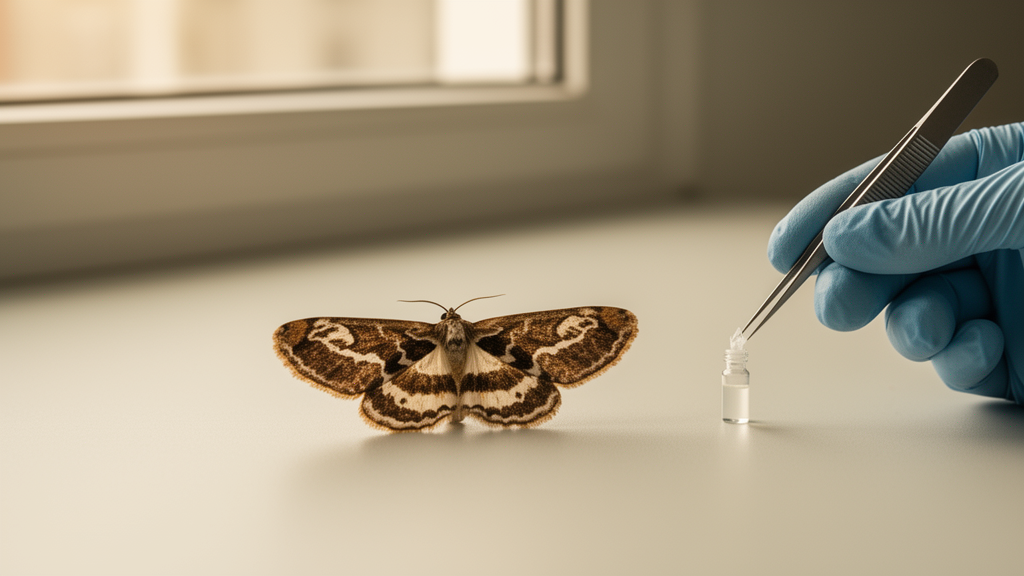
A moth long celebrated as one of the most striking members of the European snout-moth family Pyralidae has turned out to be hiding a secret. Using DNA barcodes, morphology and a sweeping survey of museum collections, researchers have shown that what was considered a single, trans-Palearctic species — the regal moth Pyralis regalis — is in fact a complex of several distinct species, and one of them is new to science. The new species, formally described as Pyralis cardinalis, was first recognized in Finland and is now known from Denmark and Sweden in the west all the way to Japan and South Korea in the east.
The study, published in the journal Nota Lepidopterologica, was carried out by a team of Finnish, Austrian and Swedish taxonomists who examined roughly 660 specimens of Pyralis drawn from more than a dozen European collections, including the Finnish Museum of Natural History, the Natural History Museum in London, the Zoological Museum in Copenhagen and the Museum für Naturkunde in Berlin. Their work combined classical taxonomy — careful study of wing patterns and genital structures — with modern molecular tools, sequencing a 658 base-pair segment of the mitochondrial COI gene from 91 of an attempted 104 specimens.
The DNA results were unambiguous. Rather than one widespread species, the barcodes divided the European material of P. regalis into four clusters: a northern, trans-Palearctic group; a central-southern European group; a south-western cluster; and a somewhat heterogeneous eastern Mediterranean cluster corresponding to the previously described species P. kacheticalis. The northern cluster, it turned out, was not P. regalis at all but an undescribed species — the moth that Finnish collectors had been pinning for decades under the wrong name.
The new species was named Pyralis cardinalis, a nod to the deep cardinal-purple tones of its hindwings. The holotype, a male, was collected on 16 July 2013 at Ramsholm in Jomala, in the Åland Islands of Finland, and deposited in the Finnish Museum of Natural History. The type series includes 56 males and 74 females, mostly from southern Finland, supplemented by material from China, Estonia, Japan, Latvia, Russia and South Korea. In total, the species is recorded from China, Denmark, Estonia, Finland, Japan, Latvia, Russia, South Korea and Sweden.
Externally, P. cardinalis is a showpiece. Its forewings combine purple, orange-brown and silvery-white markings, and its hindwing is divided by off-white stripes into three bands, with the outer third a deep purple — a feature that immediately separates it from its relatives, whose hindwings are dark brown, grey or pale yellowish grey but never purple. Under the microscope the differences are even sharper: in the male genitalia, P. cardinalis is unique among the focal species in bearing two cornuti, hook-like structures on the vesica of the phallus — one a narrow spine roughly half the length of the narrowed distal part of the phallus, the other a small, curved group of dense, partly fused coarse spines. In the female, the inception of the ductus seminalis is broadened and somewhat sclerotized, a trait that distinguishes it from all other species treated in the study.
The molecular data reinforce the separation. The intraspecific mean divergence of the barcode region in P. cardinalis is 0.21 percent, with a maximum of 0.70 percent among 21 specimens. The minimum distance to its nearest European neighbour, P. sagarrai, is 7.43 percent — a large gap by moth-barcode standards. Intriguingly, an unrevised species from China lies only 4.23 percent away, hinting that further diversity in East Asia still awaits formal description. The species was assigned Barcode Index Number BOLD:AAF5806 in the Barcode of Life Data System, where voucher data, images and sequences are publicly available in the dataset PYRAREGA.
Sorting out the taxonomy required more than describing a new species. The original type material of P. regalis, described by Denis and Schiffermüller in 1775, was deposited in the Hof-Naturalien-Kabinett in Vienna and was destroyed by fire during the Vienna Rebellion of 1848. After a personal search turned up no potential type material, the authors concluded the syntypes are lost and designated a neotype — a female collected in 2015 at Oberloiben in Lower Austria, the province where most of the original authors’ material was presumably collected. Lectotypes were also designated for Asopia kacheticalis Christoph, 1893, held in the Zoological Institute in St. Petersburg, and for Pyralis princeps Butler, 1889, from Dharamshala in India, based on a specimen already labelled as lectotype in the Natural History Museum in London.
The revision also changed the status of another taxon. Pyralis regalis ssp. sagarrai, described by Leraut in 2005 from south-western Europe, is now considered a valid species, P. sagarrai stat. nov., known from France, Portugal and Spain. Its barcode diverges from P. regalis by a minimum of 3.96 percent, and it differs in the pale, purple-free hindwing, the shape of the cornutus in the male genitalia and the long, evenly widening ductus bursae of the female. The study also clarified the identity of P. princeps, showing that the two specimens Butler described from “Yezo” — a region spanning northern Japan to Kamchatka — were misidentifications of P. cardinalis, an interpretation confirmed by examination of Japanese and South Korean material. A specimen illustrated as P. princeps by Leraut in 2005 was likewise shown to be P. cardinalis.
One of the most interesting threads in the paper concerns the recent history of P. cardinalis in northern Europe. The authors note that the species is expanding in the region; the earliest confirmed records from the Baltic countries and Fennoscandia probably date from the 1930s, and the first documented, still-existing specimen comes from Repino — then Kivennapa — in the Karelian Isthmus, collected in 1931. Records from Finland and apparently Latvia followed in the later 1930s, and since the 1970s the moth has become ever more abundant in the Baltic countries and Finland. It was first recorded in Denmark in 1996, under the name P. regalis, and is now established on the island of Bornholm. Its recent expansion in Sweden has also been documented, again under the old name. Where the contemporary population came from, however, remains a mystery: all barcodes examined throughout the species’ vast range are virtually identical, offering no geographic signal of origin.
The life history of P. cardinalis remains unknown. Adults have been observed at sugar bait as well as in light traps over a long season, from the end of June to the end of August, with the flight period peaking in July; there is no evidence of more than one generation per year. By contrast, collecting dates from late May to October suggest that P. regalis, its southern relative, likely has at least two generations in southern Europe. The authors also flag unresolved questions: female genitalia of P. regalis, P. kacheticalis and P. sagarrai show large intraspecific variation and cannot yet be identified unambiguously, and barcode clusters within P. kacheticalis from Cyprus, Lebanon and Ukraine-Greece do not correlate with the external or genital variation observed, so the authors refrained from taxonomic conclusions there. An endemic Cretan population close to P. kacheticalis, with a strongly divergent unpublished barcode, may even deserve species status, but too little material exists to decide. For now, the study stands as a reminder that even a flagship species of European moths — one whose taxonomy had gone unchallenged for more than a century — can conceal a charismatic new relative, waiting for a few hundred barcodes and a drawer full of old specimens to bring it into the light.
Subject of Research: Taxonomic revision of the Pyralis regalis species complex of moths using DNA barcoding and morphology, including description of the new species Pyralis cardinalis.
Article Title: Pyralis cardinalis , a charismatic new species related to P. regalis [Denis & Schiffermüller], 1775, first recognized in Finland ( Lepidoptera , Pyralidae )
Article References: Wikström, B., Huemer, P., Mutanen, M., Tyllinen, J., & Kaila, L. (2020). Pyralis cardinalis, a charismatic new species related to P. regalis [Denis & Schiffermüller], 1775, first recognized in Finland (Lepidoptera, Pyralidae). Nota Lepidopterologica, 43, 337-364. https://doi.org/10.3897/nl.43.54916
Image Credits: AI Generated
DOI: 10.3897/nl.43.54916
Keywords: Pyralis cardinalis, Pyralis regalis, Pyralidae, DNA barcoding, new species, taxonomy, Lepidoptera, neotype, lectotype, Finland, BOLD, species delimitation
Cite Scienmag News
Juliet Wilcox. (October 27, 2026). DNA barcoding reveals a striking new moth species hiding in plain sight across Europe. Scienmag. https://scienmag.com/dna-barcoding-reveals-a-striking-new-moth-species-hiding-in-plain-sight-across-europe/
Juliet Wilcox. "DNA barcoding reveals a striking new moth species hiding in plain sight across Europe." Scienmag, 27 October 2026, https://scienmag.com/dna-barcoding-reveals-a-striking-new-moth-species-hiding-in-plain-sight-across-europe/. Accessed 27 October 2026.
Juliet Wilcox. "DNA barcoding reveals a striking new moth species hiding in plain sight across Europe." Scienmag. October 27, 2026. https://scienmag.com/dna-barcoding-reveals-a-striking-new-moth-species-hiding-in-plain-sight-across-europe/


