


By Jade Boyd
Special Rice News

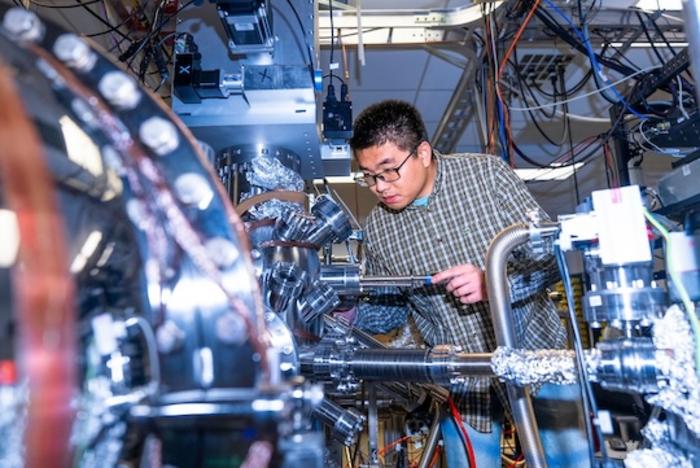
Credit: Photo by Gustavo Raskosky/Rice University.
By Jade Boyd
Special Rice News
Rice University physicists have discovered a phase-changing quantum material — and a method for finding more like it — that could potentially be used to create flash-like memory capable of storing quantum bits of information, or qubits, even when a quantum computer is powered down.
Phase-changing materials have been used in commercially available non-volatile digital memory . In rewritable DVDs, for example, a laser is used to heat minute bits of material that cools to form either crystals or amorphous clumps. Two phases of the material, which have very different optical properties, are used to store the ones and zeros of digital bits of information.
In an open-access study published recently in Nature Communications , Rice physicist Ming Yi and more than three dozen co-authors from a dozen institutions similarly showed they could use heat to toggle a crystal of iron, germanium and tellurium between two electronic phases. In each of these, the restricted movement of electrons produces topologically protected quantum states . Ultimately, storing qubits in topologically protected states could potentially reduce decoherence-related errors that have plagued quantum computing.
“This came completely as a surprise,” Yi said of the discovery. “We were initially interested in this material because of its magnetic properties. But then we would conduct a measurement and see this one phase, and then for another measurement we would see the other. Nominally it was the same material, but the results were very different.”
It took more than two years and collaborative work with dozens of colleagues to decipher what was happening in the experiments. The researchers found some of the crystal samples had cooled faster than others when they were heated prior to the experiments.
Unlike the materials used in most phase-changing memory technology, Yi and colleagues found the iron-germanium-tellurium alloy did not need to be melted and recrystallized to change phases. Rather, they found that empty atomic sites in the crystal’s lattice, known as vacancies, were arranged in differently ordered patterns depending on how quickly the crystal cooled. To switch from one patterned phase to the other, they showed they could simply reheat the crystal and cool it for either the longer or shorter period of time.
“If you want to change the vacancy order in a material, that typically happens at much lower temperatures than you’d need to melt everything,” Yi said.
She said few studies have explored how the topological properties of quantum materials change in response to changes in vacancy order.
“That’s the key finding,” she said of the material’s switchable vacancy order. “The idea of using vacancy order to control topology is the important thing. That just hasn’t really been explored. People have generally only been looking at materials from a fully stoichiometric perspective, meaning everything’s occupied with a fixed set of symmetries that lead to one kind of electronic topology. Changes in vacancy order change the lattice symmetry. This work shows how that can change the electronic topology. And it seems likely that vacancy order could be used to induce topological changes in other materials as well.”
Rice theoretical physicist Qimiao Si, a co-author of the study, said, “I find it amazing that my experimentalist colleagues can arrange a change of crystalline symmetry on the fly. It enables a completely unexpected and yet fully welcoming switching capacity for theory as well as we seek to design and control new forms of topology through the cooperation of strong correlations and space group symmetry .”
The study’s lead authors are Han Wu and Lei Chen, both of Rice. Additional Rice co-authors include Jianwei Huang, Xiaokun Teng, Yucheng Guo, Mason Klemm, Chuqiao Shi, Chandan Setty, Yaofeng Xie, Bin Gao, Junichiro Kono , Pengcheng Dai , Yimo Han and Si . Yi, Dai, Han, Kono and Si are each members of the Rice Quantum Initiative and the Rice Center for Quantum Materials .
The study was co-authored by researchers from the University of Washington, Los Alamos National Laboratory, South Korea’s Kyung Hee University, the University of Pennsylvania, Yale University, the University of California Davis, Cornell University, the University of California Berkeley, the Stanford Linear Accelerator Center National Accelerator Laboratory, Brookhaven National Laboratory and Lawrence Berkeley National Laboratory.
This research was supported by the Department of Energy (DOE) Office of Science User Facilities (DE-AC02-05CH11231, DE-AC02-76SF00515, DE-SC0012704), the DOE Office of Basic Energy Sciences (DE-SC0021421, DE-SC0018197, DE-SC0019443, DE-AC02-05-CH11231, DE-AC02-76SF00515), the Gordon and Betty Moore Foundation’s EPiQS Initiative (GBMF9470), the Robert A. Welch Foundation (C-2175, C-1411, C-1839, C-2065-20210327), the Air Force Office of Scientific Research (FA9550-21-1-0356, FA9550-22-1-0449, FA9550-22-1-0410), a Vannevar Bush Faculty Fellowship managed by the Office of Naval Research on behalf of the Department of Defense Basic Research Office (ONR-VB N00014-23-1-2870), the DOE National Nuclear Security Administration (89233218CNA000001), the DOE Laboratory Directed Research and Development Program (FR-20-653926), the Army Research Office (W911NF-19-1-0342), the National Science Foundation (2213891, 1829070, 2100741, 2034345), the Alfred P. Sloan Foundation’s Sloan Research Fellows Program and Rice’s Electron Microscopy Center.
Cite Scienmag News
Reid Dalton. (April 5, 2024). Discovery points path to flash-like memory for storing qubits. Scienmag. https://scienmag.com/discovery-points-path-to-flash-like-memory-for-storing-qubits/
Reid Dalton. "Discovery points path to flash-like memory for storing qubits." Scienmag, 5 April 2024, https://scienmag.com/discovery-points-path-to-flash-like-memory-for-storing-qubits/. Accessed 3 September 2026.
Reid Dalton. "Discovery points path to flash-like memory for storing qubits." Scienmag. April 5, 2024. https://scienmag.com/discovery-points-path-to-flash-like-memory-for-storing-qubits/

