

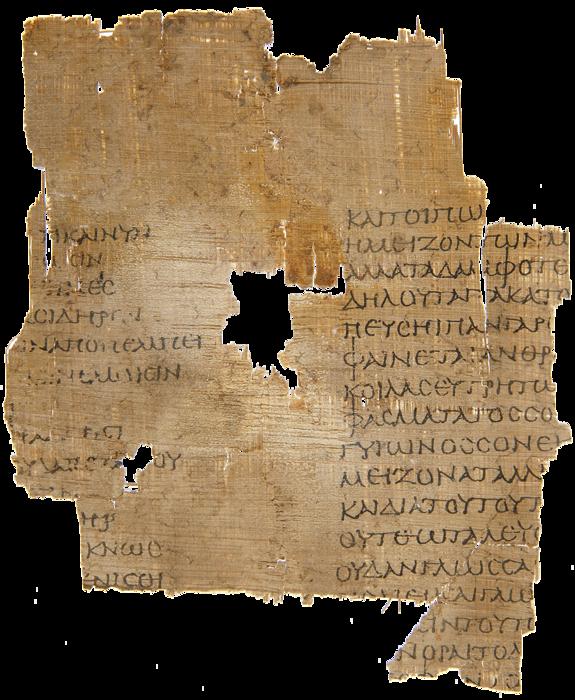
A Remarkable Discovery: Two-Thousand-Year-Old Papyrus Fragment Unveils New Verses by Pre-Socratic Philosopher Empedocles
In a groundbreaking discovery that has electrified the world of ancient philosophy and papyrology, researchers have uncovered a two-thousand-year-old papyrus fragment that contains thirty previously unpublished verses attributed to Empedocles, a seminal pre-Socratic philosopher from the 5th century BCE. This rare find, housed in the archives of the French Institute of Oriental Archaeology in Cairo, offers experts a direct glimpse into Empedocles’ original thought, hitherto accessible only through later authors’ often incomplete or biased quotations.
The papyrus, denominated P.Fouad inv. 218, was identified by Nathan Carlig, a distinguished papyrologist affiliated with the University of Liège. Carlig’s meticulous work revealed that this fragment belongs to the poem Physica—an extensive philosophical poem by Empedocles on natural philosophy. Until now, all extant knowledge about Empedocles’ work rested upon indirect, often fragmentary sources quoted or summarized by subsequent thinkers like Plato, Aristotle, and Plutarch. The exceptional nature of P.Fouad inv. 218 lies in its status as the sole known manuscript copy of this important treatise. Related fragments from the same original scroll also survive in Strasbourg, corroborating the fragment’s provenance.
The text found in this fragment elucidates Empedocles’ complex theory of particle effluvia and sensory perception, most notably vision. This theory posits that objects emit minute particles or effluvia which interact with sensory organs to generate perception—a concept that predates and arguably informs later atomic theories. The analysis of the fragment has illuminated previously obscured intellectual connections. For instance, its contents likely served as a direct source for a passage by Plutarch dating to the 2nd century CE. Moreover, the verses resonate with ideas found in dialogues by Plato and texts by Theophrastus, the latter being a student of Aristotle, thus stretching the impact of Empedocles’ doctrines across a broad swath of classical philosophy.
The rediscovered verses also echo in the works of figures as varied as Aristophanes, the comic playwright, and Lucretius, the Roman philosopher and poet, underscoring the fragment’s wide-reaching influence. Particularly compelling is the suggestion that Empedocles anticipated key elements of atomist philosophy, an intellectual lineage culminating in thinkers like Democritus. This positions Empedocles as not simply an isolated thinker but as a foundational figure in the development of theories concerning the fundamental nature of matter and perception.
To truly appreciate the significance of such a discovery, one might imagine a hypothetical scenario in the distant future where only scattered excerpts of Victor Hugo’s works survive in textbooks and performances. The sudden unearthing of original manuscripts would constitute a momentous cultural and literary event. Similarly, the discovery of these papyrus fragments constitutes a transformative moment for specialists in Empedocles, who until now have labored with incomplete texts and secondhand accounts. This find provides an unprecedented opportunity to engage with the philosopher’s work in a fresh, authentic manner.
The uncovering of P.Fouad inv. 218 epitomizes the rigorous quest undertaken by papyrologists since the late 19th century. Much like Renaissance humanists who scoured European repositories to recover lost classical texts, contemporary scholars comb papyrus archives to resurrect ancient voices long thought lost. Nathan Carlig frames this work as a “second Renaissance” of ancient literature, highlighting the cultural and scholarly revival engendered by such discoveries.
Publication of the first edition, translation, and commentary on these newly identified verses has materialized in the scholarly volume L’Empédocle du Caire, edited by Nathan Carlig, Alain Martin, and Olivier Primavesi. This comprehensive work offers not only a philological reconstruction of the verses but also critical insights into their philosophical import and historical context, thereby advancing the understanding of Empedocles within the broader landscape of ancient Greek philosophy.
Beyond textual analysis, the fragment reveals technical aspects of ancient papyrus scroll preservation and the fragility of transmitting philosophical heritage. The survival of P.Fouad inv. 218 is a testament to the careful archival practices of institutions like the French Institute of Oriental Archaeology, whose collections continue to bear rich, untapped intellectual treasures.
The discovery also prompts a reevaluation of the intertextual relationships among pre-Socratic philosophers and their successors. It challenges longstanding assumptions regarding the originality and influence of Empedocles’ thought, inviting scholars to reconsider the transmission and evolution of key philosophical ideas about nature, perception, and the cosmos.
From a methodological standpoint, this breakthrough underscores the importance of integrating philological expertise, ancient history, and philosophical inquiry. It illustrates how papyrological discoveries can dramatically alter the intellectual map of antiquity, enhancing not only historical knowledge but also contemporary philosophical appreciation.
Ultimately, this revelation reshapes the narrative concerning Empedocles’ legacy, situating him more prominently among the progenitors of scientific and philosophical inquiry. The verses captured in P.Fouad inv. 218 will undoubtedly fuel further research, invigorate debates around pre-Socratic philosophy, and inspire new generations of scholars fascinated by the origins of Western thought.
Subject of Research:
The textual and philosophical analysis of a papyrus fragment (P.Fouad inv. 218) containing previously unknown verses from Empedocles’ Physica, revealing new insights into pre-Socratic thought on particle theory and sensory perception.
Article Title:
Newly Discovered Papyrus Fragment Unlocks Lost Verses of Empedocles, Illuminating Pre-Socratic Philosophy
News Publication Date:
Not specified in the provided content.
Web References:
https://www.eurekalert.org/multimedia/1123235
References:
First edition, translation, and commentary published in the volume L’Empédocle du Caire, edited by Nathan Carlig, Alain Martin, and Olivier Primavesi.
Image Credits:
Université de Liège / N.Carlig
Keywords:
Empedocles, papyrus fragment, pre-Socratic philosophy, Physica, particle theory, sensory perception, papyrology, ancient Greek philosophy, ancient manuscripts, archaeological discovery, Plutarch, atomism


