

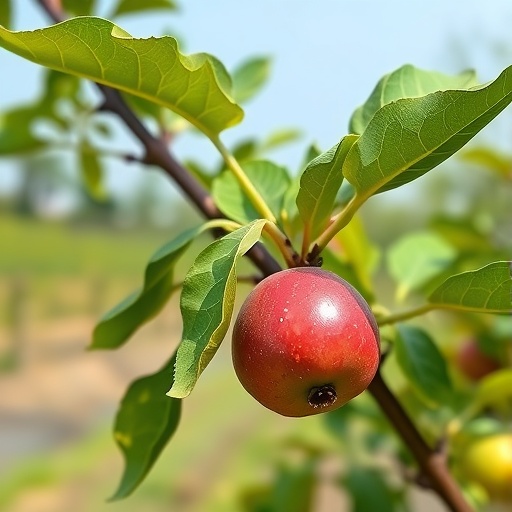
A newly emerging wilt disease in Pyrus pyrifolia, commonly known as Asian pear, has raised significant alarms among agricultural scientists and horticulturists in Jiangsu province, China. Unlike previously documented pear diseases, this wilt syndrome initiates its assault from the root system, progressing upward through the vascular tissues. One of the most distinctive clinical signs is the extensive browning in the vascular bundles, which can extend over two meters above the soil line. This symptomatology signals a systemic invasion that is both aggressive and fatal, with afflicted trees succumbing typically within the current or subsequent growing seasons, posing a critical threat to pear orchards and fruit production in the impacted regions.
Researchers at the Jiangsu Academy of Agricultural Sciences undertook a comprehensive investigation to identify the causative agent of this devastating disease. Their approach combined classical mycological techniques with advanced molecular biology tools. They began with pathogen isolation from symptomatic root and stem tissues, followed by detailed morphological characterization under microscopy, focusing on colony morphology and conidial structures which initially indicated a Fusarium species. To conclusively assign species-level identification, they employed multilocus sequence analysis, examining the translation elongation factor 1-alpha (tef1), calmodulin (CaM), and RNA polymerase II second largest subunit (rpb2) gene loci, all of which are standard markers for Fusarium taxonomy and phylogeny.
Their analyses revealed that the responsible pathogen is Fusarium cugenangense, a species hitherto unreported as a plant pathogen in China, let alone as an agent causing systemic wilt in Pyrus pyrifolia. The presence of this fungus marks a novel threat to pear cultivation, expanding the geographical and host range of Fusarium species implicated in vascular diseases. Fusarium cugenangense’s pathogenic potential was confirmed through rigorous pathogenicity assays adhering to Koch’s postulates, which included inoculating healthy pear seedlings and reproducing the characteristic wilt symptoms, verifying this fungus’s role as the primary pathogen rather than a secondary colonizer or contaminant.
To elucidate the infection dynamics and systemic colonization process, the research team employed innovative fluorescence microscopy techniques using a green fluorescent protein (GFP)-labeled Fusarium cugenangense strain. This enabled real-time visualization of pathogen ingress and movement within host tissues. Intriguingly, this pathogen penetrated roots and ascended through xylem vessels to colonize the stem and foliage, demonstrating its capacity for systemic infection. Further confirmation via transmission electron microscopy revealed hyphal structures within the vascular parenchyma, supporting the observed phenotypic browning and vascular dysfunction responsible for the wilt symptoms.
The systemic nature of F. cugenangense infection underscores the complexity of managing this disease in commercial and subsistence pear orchards. Notably, the disease has been observed to continue spreading to adjacent healthy trees even after the removal of visibly symptomatic hosts, indicating possible soil-borne persistence or root-to-root transmission. This epidemiological characteristic complicates disease containment strategies, demanding integrated management approaches that combine sanitary measures, resistant rootstocks, and possible chemical or biological controls tailored to Fusarium wilt pathogens.
Fusarium species are well-known for their versatility as plant pathogens, often causing devastating wilt and root rot diseases across diverse crops worldwide. However, the identification of F. cugenangense as a causal agent in pear wilt is unprecedented. Previous reports of Fusarium-associated diseases in pears predominantly involved species such as Fusarium oxysporum or Fusarium solani complexes. The appearance of F. cugenangense thus signals a potential shift or expansion in the Fusarium species complex affecting Pyrus crops, highlighting the evolutionary adaptability and emerging phytopathological challenges posed by this genus.
With global challenges to agriculture mounting owing to climate changes and globalization of trade, such emergent diseases necessitate urgent scientific attention. This study not only provides crucial baseline data on pathogen identification and infection mechanisms but also alerts agronomists and policymakers to the potential for rapid disease spread that can imperil pear production sustainability. Surveillance and biosecurity protocols must be strengthened to monitor the presence of F. cugenangense in nurseries and production areas.
The interdisciplinary research integrating plant pathology, molecular genetics, microscopy, and field epidemiology exemplifies the cutting-edge approaches essential for unraveling complex plant disease problems. Future research avenues should focus on resistance breeding, fungicide efficacy screening, and the exploration of novel biocontrol agents that can mitigate Fusarium cugenangense’s deleterious impact on pear orchards. Additionally, genomic sequencing of this pathogen may reveal virulence factors and pathways amenable to targeted intervention.
This first report of Fusarium cugenangense causing systemic wilt disease in Pyrus pyrifolia in China marks a critical milestone in plant pathology, emphasizing the need for heightened awareness and collaborative efforts to safeguard economically vital fruit crops. The study’s findings have been articulated clearly in the Journal of Integrative Agriculture, providing an open-access resource for researchers worldwide. As this pathogen continues to spread, the integration of molecular diagnostics with field management will be paramount.
The discovery by Professors Yancun Zhao and Fengquan Liu, alongside their research teams, shines a light on emerging plant pathogens and highlights the invaluable role of advanced molecular tools in pathogen characterization. Their work not only closes a diagnostic gap in pear crop pathology but also opens avenues for developing novel management strategies, which are crucial in addressing the ongoing global food security challenges.
In conclusion, Fusarium cugenangense’s emergence as a lethal agent of pear wilt represents an urgent call to arms for the agricultural research community. Concerted research efforts, allied with practical disease management approaches, are vital to prevent widespread economic and ecological damage. This case study underlines the dynamic nature of plant-pathogen interactions and the critical importance of ongoing vigilance in agricultural ecosystems.
Subject of Research: Cells
Article Title: Identification of Fusarium cugenangense as a causal agent of wilt disease on Pyrus pyrifolia in China
Web References: http://dx.doi.org/10.1016/j.jia.2024.02.018
References: Li C H, et al. Journal of Integrative Agriculture, 2024.
Image Credits: Li C H, et al.


