


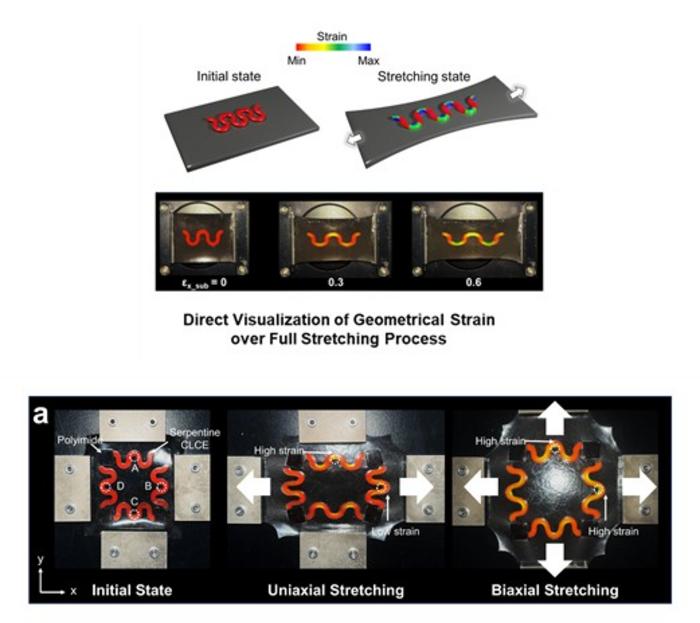
A groundbreaking advancement in stretchable technology has emerged from a research team at Pohang University of Science and Technology (POSTECH), led by Professor Su Seok Choi. The team has developed a sophisticated method that enables real-time analysis of the deformation of serpentine structures, pivotal components in the realm of stretchable electronics. By harnessing the unique properties of Chiral Liquid Crystal Elastomers (CLCE), they can visualize these deformations as they happen, a feat previously unattainable. This novel approach not only showcases the potential of these structures but also paves the way for future innovations in flexible devices.
Stretchable technology is not merely an engineering curiosity; it represents the forefront of technological evolution in electronics. Researchers have long strived to create devices that can bend, fold, roll, and slide without compromising functionality. However, the latest focus has shifted towards fully stretchable systems, which can undergo freeform deformation. This leap forward is crucial for several industries, including wearable technology, smart textiles, and advanced robotics, where adaptability and resilience are paramount.
The serpentine interconnect, characterized by its wavy and elastic design, serves as a vital link between rigid electronic components and flexible substrates. This design allows electronic circuits to maintain electrical connectivity while stretching or bending, an essential property as consumer demands for more versatile devices continue to increase. The research team recognized that a deep understanding of the structural dynamics and deformation behaviors of these serpentine interconnects is vital to further advancements in stretchable technology.
Historically, the analysis of these structures has been limited to post-failure scenarios. Engineers often had to wait for physical damage to occur before gaining insights into the performance and strength of serpentine designs. This reactive approach restricted the potential for innovation and optimization, as it did not allow for real-time adjustments or predictive modeling based on structural performance. The introduction of a mechanistic, real-time monitoring system changes this paradigm entirely.
By exploiting the mechanochromic properties of CLCE, the POSTECH research team has embraced an innovative approach to visualize the deformation of serpentine structures dynamically. Under stress, CLCE materials exhibit distinct color changes, providing a powerful optical indicator of deformation. The ability to observe color transitions at the nanoscale during stretching allows researchers and engineers alike to gauge the mechanical responses of these materials in real time, significantly enhancing their understanding of the structural behaviors during deformation.
This advancement carries profound implications for the design of next-generation stretchable devices. Not only does it provide immediate feedback about the performance of serpentine structures, but it also establishes a framework for optimizing materials and geometries under various stretching conditions. Engineers now have the ability to iterate on designs and make informed decisions without the prolonged cycles of trial and error characteristic of experimental research involving physical prototypes.
The validation of their methodology through theoretical finite element analysis further underscores the reliability and accuracy of this new visualization technique. This dual approach allows for more robust design strategies in stretchable technology, as it combines empirical observation with theoretical backing. As the technology matures, its capability to inform design guidelines will be instrumental in accelerating the commercialization process of stretchable electronics.
Visionary applications abound across numerous sectors, including wearable health monitors, next-generation mobile devices, and electronic skin technologies. These applications highlight the intersection of engineering and biomimicry, where nature-inspired designs are employed to solve complex problems in technology. With the ability to visualize deformation in real time, researchers can tailor solutions that emulate biological systems to enhance product performance and durability.
In addition to its practical applications, this groundbreaking research could redefine materials science and engineering paradigms. By challenging the limitations of traditional material analysis, the team’s work invites a broader inquiry into how other materials can be engineered to display similar response characteristics under varied stresses. This perspective shift holds promise for a new generation of responsive materials that autonomously adapt and optimize performance in unpredictable environments.
Professor Su Seok Choi aptly summarizes the significance of their findings, stating that the research "opens the door to precise evaluation and design of the connection structures central to stretchable technology." His statement captures the essence of innovation, positioning this work at the confluence of academic inquiry and practical application. The insights and methodologies developed could enhance the versatility of electronic systems across multiple industries, facilitating advancements in smart textiles and soft robotics.
Funding from prestigious initiatives such as the Samsung Future Technology Development Program emphasizes the importance of research in this domain. It reflects a broader commitment to advancing technology that poises countries and corporations at the forefront of an increasingly digitalized world. The significance of such support cannot be overstated, as it highlights collaboration between academia and industry to drive innovation forward.
As fireworks of progress light the path ahead, the implications of this research are boundless. The leap to a world where devices respond dynamically to user interactions will change how industry, healthcare, and personal devices function. The POSTECH research team stands as a testament to this possibility, unearthing new understandings that promise an exciting horizon for stretchable technology.
In conclusion, this revolutionary exploration of serpentine structures will undoubtedly catalyze a significant shift in the design and functionality of stretchable devices. The real-time visualization of these mechanical behaviors allows not only for immediate enhancement but also long-term evolution of design strategies. As we witness the fusion of innovation with necessity, the future of stretchable technology beckons with abundant potential, establishing new benchmarks for what is possible in next-generation electronics.
Cite Scienmag News
Courtney Benton. (December 24, 2024). Discover the Hidden Potential of Color in Stretchable Technology! Scienmag. https://scienmag.com/discover-the-hidden-potential-of-color-in-stretchable-technology/
Courtney Benton. "Discover the Hidden Potential of Color in Stretchable Technology!" Scienmag, 24 December 2024, https://scienmag.com/discover-the-hidden-potential-of-color-in-stretchable-technology/. Accessed 4 September 2026.
Courtney Benton. "Discover the Hidden Potential of Color in Stretchable Technology!" Scienmag. December 24, 2024. https://scienmag.com/discover-the-hidden-potential-of-color-in-stretchable-technology/


