Uterine artery embolization performed with a heavily diluted mixture of the liquid embolic agent N-butyl cyanoacryrate and lipiodol produced substantial fibroid shrinkage and symptom relief in a small prospective study, with a mean volume reduction of 64.7 percent at three to six months. The single-arm study, conducted at a tertiary referral university hospital, enrolled forty consecutive women with symptomatic uterine fibroids between 2024 and 2025 and followed them with magnetic resonance imaging and clinical assessment. The findings, published in CVIR Endovascular, suggest that a liquid embolic strategy usually reserved for hemorrhage, vascular malformations and hypervascular tumors may have a role in fibroid treatment, although the authors themselves caution that the short follow-up and absence of a control group prevent definitive conclusions about efficacy.
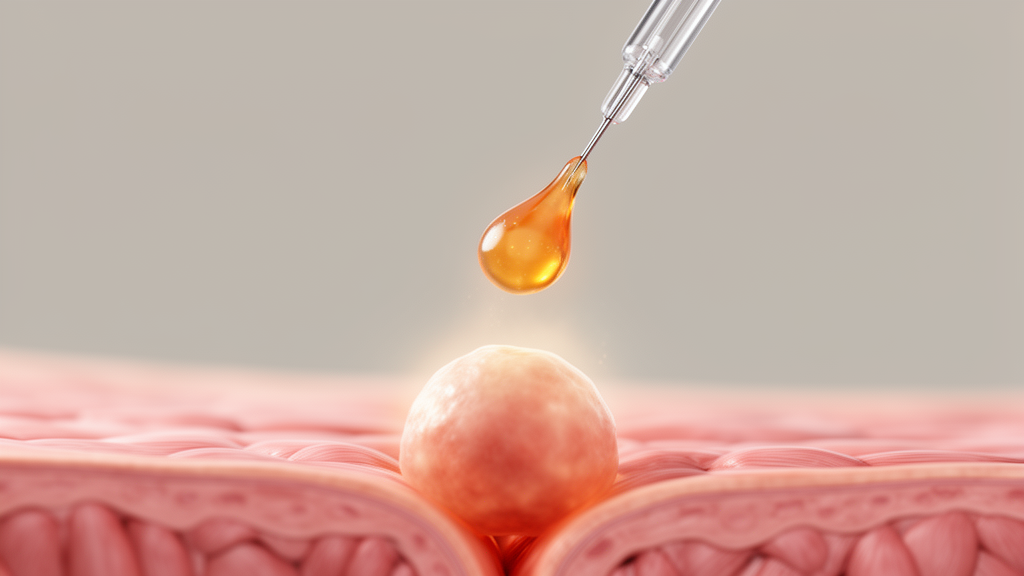
The procedure differed from conventional uterine artery embolization in two important ways. First, instead of the permanent particulate embolics such as polyvinyl alcohol particles or calibrated microspheres that dominate current practice, the interventional radiologists used N-butyl cyanoacrylate, a glue that polymerizes almost instantly on contact with blood and produces immediate, permanent vascular occlusion. Second, the mixture was deliberately diluted at a ratio of one part NBCA to ten parts lipiodol, a concentration chosen to slow polymerization, extend distal penetration into the tiny vessels feeding the fibroid, and maintain radiopacity under fluoroscopy. Access was obtained through the right radial artery with a 4-Fr sheath rather than the femoral route, using a standardized protocol that included intra-arterial vasodilators and systemic heparinization.
Technically, the embolization followed a plug-and-push approach. After superselective catheterization of each uterine artery with a 1.9-Fr microcatheter, approximately 0.2 milliliters of the NBCA mixture was injected, followed by a 2-milliliter flush of 5 percent dextrose solution to clear the catheter. This sequence was repeated two to three times until forward progression of the glue ceased and reflux appeared at the microcatheter tip. Limited reflux of roughly two to three centimeters was permitted for up to three minutes. Bilateral embolization was routine unless contraindicated, but in one documented case a woman whose fibroid was supplied almost exclusively by the left uterine artery underwent unilateral embolization while the right artery was preserved. Technical success was defined as embolization of all intended uterine arteries to the angiographic endpoint while preserving perfusion of the normal uterus, and it was achieved in all planned procedures, with no conversion to femoral access or significant access-site complications.
The forty enrolled women had a mean age of 41 years, with a standard deviation of 6.5 years, and a mean uterine volume of 137.7 milliliters before treatment. Eligibility required symptomatic fibroids or asymptomatic enlarging fibroids deemed appropriate for embolization after multidisciplinary evaluation by gynecologists and interventional radiologists, and patients had to desire uterine preservation, be poor surgical candidates, or decline surgery after counseling. Symptoms attributable to fibroids included abnormal uterine bleeding, pelvic pain, bulk-related symptoms, and anemia from fibroid-associated bleeding. Exclusion criteria covered pregnancy, suspected gynecologic malignancy, active pelvic infection, allergy to iodinated contrast or Lipiodol, severe comorbid conditions, prior uterine artery embolization, and ongoing fibroid-directed hormonal therapy. No restriction was placed on fibroid size, number, or location.
At follow-up imaging three to six months after embolization, the mean dominant fibroid volume had fallen from 137.7 cubic centimeters to 51 cubic centimeters, a difference that was statistically significant with a p value below 0.001, corresponding to a mean volume reduction of 64.7 percent with a standard deviation of 22.7 percent. Hemoglobin levels also rose significantly among patients with baseline anemia, again with a p value below 0.001. Clinical follow-up was available for all patients, and every patient reported improvement in fibroid-related symptoms such as menstrual bleeding and pelvic pain, while symptoms disappeared entirely in 87.5 percent of the group. No patient required additional intervention such as repeat embolization or surgery during the follow-up window.
Safety results were broadly reassuring but not unblemished. No major intraprocedural adverse events were observed, and no cases of non-target embolization or catheter entrapment were recorded. Major complications occurred in 2.5 percent of patients, a single case of fibroid expulsion: a 40-year-old woman with a large submucosal fibroid who presented two weeks after the procedure with abdominal pain, vaginal bleeding and exteriorization of the tumor, and who was treated successfully with dilation and curettage. Her MRI at three months showed a striking reduction in fibroid volume from 263 to 24 milliliters, approximately 91 percent. Minor complications, principally post-embolization syndrome characterized by pain, affected 20 percent of patients. Post-embolization pain was assessed with a visual analog scale during the first 24 hours; the authors report that mean scores reflected moderate-to-severe intensity but that pain was transient, controlled with standard analgesia including patient-controlled analgesia, and not associated with prolonged hospitalization or permanent sequelae. The mean hospital stay was 1.9 days with a standard deviation of 0.8 days.
Late adverse events appeared in 10 percent of patients and included alopecia in 7.5 percent and vaginal dryness in 2.5 percent. Three patients reported hair loss during follow-up, and the authors note that radiation-induced alopecia was considered unlikely because the radiation field was confined to the pelvis. Although the hair loss was temporally associated with the procedure, the study team explicitly states that a causal relationship could not be established and that this finding should be interpreted with caution. The authors also classified the post-embolization pain as a minor adverse event based on its clinical consequences and the level of treatment required, rather than on pain intensity alone.
The choice of a 1:10 dilution received considerable attention in the paper. The authors explain that more diluted NBCA travels further distally before polymerizing, potentially producing more complete devascularization and less risk of recanalization or collateral circulation, while more concentrated mixtures such as 1:2 to 1:4 are typically reserved for high-flow conditions like arteriovenous malformations. In their experience, the 1:10 dilution provided a predictable and controllable injection profile that enabled the plug-and-push technique while minimizing excessive reflux and non-target embolization. They suggest that the combination of diluted NBCA and transradial access may represent a simplified and efficient embolization strategy, particularly in cases requiring deep intratumoral penetration, and that liquid embolics may represent a viable alternative in selected patients even though particulate agents remain the most common materials.
Context from the broader literature frames these results. Uterine artery embolization was first reported in 1995, and prior work has shown shorter hospital stays and faster return to work compared with surgery, alongside roughly 20 percent of patients eventually requiring an additional invasive procedure such as hysterectomy or repeat embolization. A large meta-analysis cited in the paper reported major complications in 2.9 percent of patients, leiomyoma tissue passage in 4.7 percent, and permanent amenorrhea in 3.9 percent, while minor complication rates up to 34 percent have been reported, usually related to post-embolization syndrome. Against these benchmarks, the present study’s 2.5 percent major complication rate and 20 percent minor complication rate fall within the range previously described, though direct comparison is not possible without a control group.
The authors are explicit about the limits of what this study can show. It was a prospective single-arm study without a control group using conventional particulate embolic agents, so comparative safety and efficacy cannot be established. MRI follow-up relied on non-contrast imaging and focused on volume reduction rather than direct assessment of fibroid infarction, even though complete infarction on contrast-enhanced MRI is a stronger predictor of long-term clinical success and residual viable fibroid tissue may contribute to symptom recurrence. Angiographic evaluation was limited to the uterine arterial circulation, with no routine assessment of ovarian arterial supply or utero-ovarian anastomoses, so the potential contribution of collateral ovarian perfusion to treatment response or recurrence could not be evaluated. Follow-up was limited to three to six months. The authors call for future prospective comparative studies incorporating contrast-enhanced MRI, comprehensive angiographic assessment of collateral blood supply, and longer clinical follow-up to define the role of diluted NBCA-lipiodol mixtures in uterine artery embolization. Until such data exist, the study stands as an early, carefully hedged signal that a diluted liquid embolic delivered through the radial artery can shrink fibroids and relieve symptoms in the short term.
Subject of Research: Uterine artery embolization with a diluted NBCA-lipiodol mixture for treating uterine fibroids
Article Title: Prospective evaluation of uterine artery embolization using diluted NBCA-lipiodol mixture for uterine fibroids: preliminary treatment outcomes
Article References: Van, N. T. B., Khiem, N. T., Cuong, N. N., Giang, P. H., Trung, N. Q., My, T. T. T., Thao, B. T. P., & Hoa, T. Q. (2026). Prospective evaluation of uterine artery embolization using diluted NBCA-lipiodol mixture for uterine fibroids: preliminary treatment outcomes. CVIR Endovascular, 9(1), Article 128. https://doi.org/10.1186/s42155-026-00782-9
Image Credits: AI Generated
DOI: 10.1186/s42155-026-00782-9
Keywords: uterine fibroids, uterine artery embolization, NBCA, lipiodol, interventional radiology, transradial access, liquid embolic agent, MRI volume reduction, menorrhagia, post-embolization syndrome, single-arm study, minimally invasive treatment
Cite Scienmag News
Ophelia Keating. (October 29, 2026). Diluted glue mixture shows early promise for shrinking uterine fibroids. Scienmag. https://scienmag.com/diluted-glue-mixture-shows-early-promise-for-shrinking-uterine-fibroids/
Ophelia Keating. "Diluted glue mixture shows early promise for shrinking uterine fibroids." Scienmag, 29 October 2026, https://scienmag.com/diluted-glue-mixture-shows-early-promise-for-shrinking-uterine-fibroids/. Accessed 29 October 2026.
Ophelia Keating. "Diluted glue mixture shows early promise for shrinking uterine fibroids." Scienmag. October 29, 2026. https://scienmag.com/diluted-glue-mixture-shows-early-promise-for-shrinking-uterine-fibroids/