

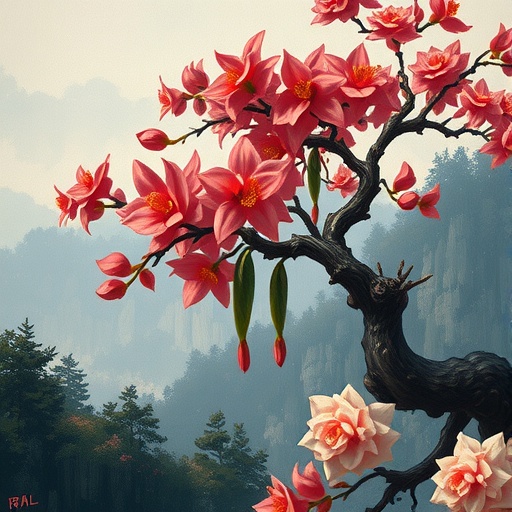
In a groundbreaking study that promises to reshape the contours of contemporary art, researchers Wang and Yan have unveiled compelling evidence demonstrating how digital multimedia tools are revolutionizing the practice of oil painting. This meticulous investigation bridges the historical depth of traditional artistic methods with the cutting-edge capabilities of advanced computational techniques, revealing an unprecedented synergy that enhances both creative workflow efficiency and visual uniformity without compromising fundamental aesthetic values.
The study meticulously employed sophisticated analytical methodologies such as Structural Similarity Index Measurement (SSIM), Principal Component Analysis (PCA), Fourier analysis, alongside the deployment of Convolutional Neural Networks (CNNs). These digital methodologies were integrally combined with expert human perception assessments, forming a comprehensive evaluative framework that robustly gauges the likeness between digitally produced works and traditional oil painting styles. The integration of quantitative computational metrics with qualitative human insights marks a pivotal advancement in art analysis, providing a nuanced understanding unattainable by either approach in isolation.
A significant revelation of this research is the dualistic nature of digital tools in the artistic process. On the one hand, digital multimedia technologies exhibit clear superiority in the domains of compositional planning and texture modeling. Artists leveraging digital platforms can experiment with and refine intricate compositional structures with a precision and flexibility that traditional media scarcely afford. Additionally, computational texture simulations enable hyper-realistic surface renderings, which can be iteratively honed with minimal material waste or time expenditure.
Conversely, the study identifies critical limitations within digital workflows, particularly concerning the spontaneity and materiality intrinsic to physical brushwork. The tactile engagement with paint and canvas—central to the expressive freedom and inherent unpredictability that characterize traditional oil painting—is notably absent in purely digital creations. This absence affects the nuanced interplay of pigment layering, paint viscosity, and brushstroke dynamics, aspects deeply valued by practitioners and critics for their contribution to a work’s emotive power and authenticity.
Importantly, artists participating in the study articulated a forward-looking perspective: digital tools are not replacements but rather supplements that can enrich artistic practice when integrated judiciously. This recognition fosters a hybridized workflow model that marries the strengths of digital precision and experimental agility with the tactile, gestural, and sensory richness of classical oil painting. Such blended modalities are anticipated to form the cornerstone of fine art’s future trajectory, expanding creative horizons while preserving the essence of human artistry.
The framework proposed by Wang and Yan, which synthesizes high-dimensional feature analytics with perceptual validation, stands as a baseline reference for the burgeoning field of computational aesthetics. Its rigorous structure invites future research efforts to benchmark emerging digital instruments, enabling a standardized yet flexible appraisal of creative artifacts mediated by technology. This constitutes a meaningful stride towards formalizing interdisciplinary collaborations where art and computer science converge.
Looking ahead, the research lays out a clear roadmap for the next phase of innovation centered on refining AI models to capture more granular stylistic details inherent in traditional oil painting. The authors emphasize the critical role of expansive, curated artistic datasets in training generative adversarial networks (GANs) that can authentically replicate varied painting styles with increased fidelity. Such advancements could dramatically broaden the applicability and acceptance of AI-augmented art tools within institutional, commercial, and individual artist contexts.
The intersection of traditional artistry and digital technology heralds a transformative epoch characterized by co-evolutionary dynamics. Human creativity, with its intuitive leaps and emotional depth, alongside the precision and scalability of machine algorithms, is poised to generate novel modes of expression. This synergistic convergence not only challenges conventional definitions of originality and craftsmanship but potentially inaugurates an era of hybrid aesthetics where the boundaries between man and machine blur creatively.
Crucially, the study highlights that the adoption of digital mediums does not dilute the value of physical craft but rather recontextualizes it. The dialogue between digital and analog practices fosters reflective artistic processes where decisions made in virtual stages inform and enrich physical execution. The iterative interplay encourages artists to explore new conceptual frameworks while maintaining intimate connections to materiality and technique.
The implications of these findings extend beyond individual artists to influence art education, curation, and preservation. Educational institutions are encouraged to integrate digital literacy with classical training, equipping emerging artists with hybrid competencies suited for a digitized creative environment. Galleries and museums might also embrace digital reproductions and augmented reality experiences that enhance accessibility and deepen audience engagement without supplanting original works.
Moreover, from a technical standpoint, the ability to quantify stylistic fidelity and perceptual similarity via SSIM, PCA, and Fourier-based analyses presents exciting prospects for art authentication and conservation. These tools potentially empower curators and historians with precise metrics to assess restoration approaches, verify provenance, or detect forgeries by comparing nuanced stylistic fingerprints across artworks.
The research also implicitly addresses broader cultural narratives about technology’s role in human endeavor. The nuanced balance between embracing innovation and honoring tradition echoes societal dialogues about progress and heritage preservation. In art, this tension manifests as both challenge and opportunity, requiring stakeholders to navigate ethical, aesthetic, and practical dimensions thoughtfully.
In summary, Wang and Yan’s work offers a comprehensive and forward-thinking vision of the evolving interplay between digital technology and oil painting. By proving that computational and AI-based tools can augment without undermining traditional aesthetics, their study lays foundational knowledge for a future art ecosystem enriched by technological sophistication yet deeply rooted in humanistic values.
As digital and traditional paradigms continue their fusion, the art world is on the brink of an extraordinary creative Renaissance. This new wave will celebrate an adaptive synergy where machine precision amplifies the nuances of human creativity, ultimately expanding the expressive potentialities of painting. Such innovation signals not only an evolution in technique but a profound transformation in how we conceive of authorship, authenticity, and artistic experience.
The study’s insights encourage artists, technologists, and theorists alike to imagine and engineer new kinds of artworks and workflows. It prompts renewed dialogue about the meaning of art in a digital age, inspiring experimental collaborations that leverage algorithmic power without sacrificing soulful expression. The path forward is one of hybrid invention, fueled by both silicon circuits and human hands, unlocking untapped dimensions of visual storytelling and cultural resonance.
Wang and Yan’s investigation is more than a technical exploration—it is a poetic invitation to harmonize tradition and innovation, to harness the strengths of opposing modes, and to celebrate the dynamic essence of art as a living, evolving conversation between past and future.
Subject of Research: Integration of digital multimedia tools and traditional oil painting practices through advanced image processing and AI techniques.
Article Title: Bridging Tradition and Technology: Digital Oil Painting Creation Using Advanced Image Processing Techniques and Generative Adversarial Network.
Article References:
Wang, Y., Yan, W. Bridging tradition and technology: digital oil painting creation using advanced image processing techniques and generative adversarial network. Humanit Soc Sci Commun 12, 1891 (2025). https://doi.org/10.1057/s41599-025-06162-3
Image Credits: AI Generated


