


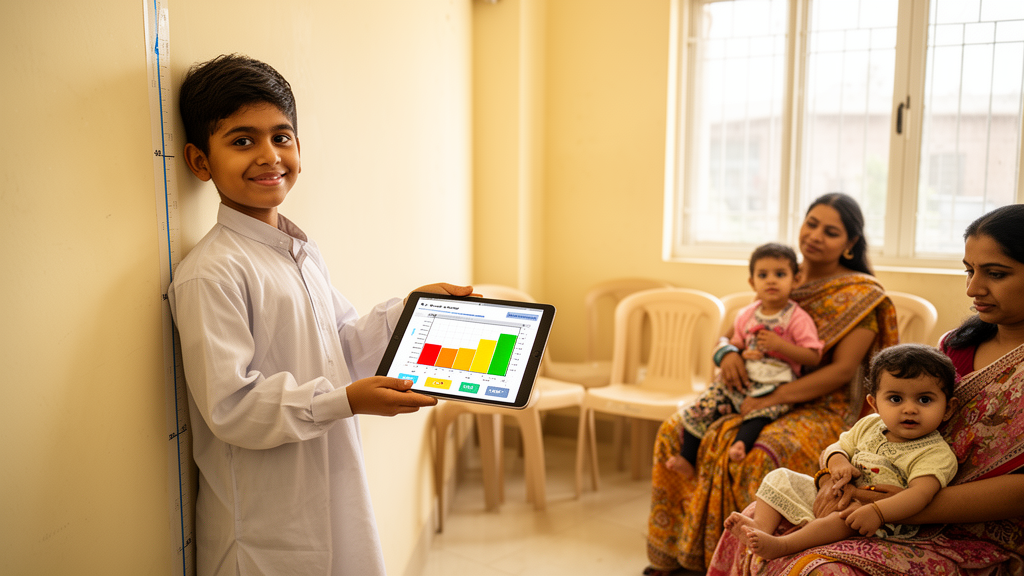
In the crowded low-income settlements of Karachi, Pakistan, a new digital health tool has begun turning private clinics into frontline posts against child undernutrition. Between 1 July and 31 December 2024, the Mazboot Bunyad digital nutrition registry was used to screen and enroll 8,406 children aged 6 to 59 months across 33 private provider clinics, according to a descriptive implementation study published in BMC Digital Health. Of the children screened, 71.4 percent were classified as well nourished, 22.3 percent as having moderate acute malnutrition, and 6.2 percent as having severe acute malnutrition.
The study’s authors are careful to note that these figures describe the nutritional status of children who presented to the clinics through outpatient and immunization services, not community-level prevalence. As a facility-based, help-seeking sample drawn from settlements designated high-risk or super high-risk for polio transmission, the cohort is likely to differ from the underlying population. The numbers represent the screened caseload rather than population burden, and the authors caution that they should inform service planning rather than be read as estimates of how widespread malnutrition is in these neighborhoods.
Undernutrition remains a leading driver of child mortality and morbidity in low- and middle-income countries, and Pakistan is among the countries with the highest rates of child undernutrition, with progress slower than in other South Asian countries. According to the National Nutrition Survey 2018, 40.2 percent of Pakistani children under five were stunted and 17.7 percent had wasting. In Sindh province, which includes Karachi, the burden is the highest of any region, with 45.5 percent stunting and 23.3 percent wasting among young children. Within urban areas, undernutrition disproportionately affects children in low-income settings due to limited food security, lower buying power, and weak public health infrastructure.
What makes the Karachi intervention distinctive is where it operates. The private sector accounts for roughly three-quarters of total health expenditure in Pakistan, yet nutrition programming has historically targeted public facilities and remains heavily donor dependent. The unregulated private sector, the authors write, has been a blind spot for nutrition programming. Mazboot Bunyad was embedded within an Integrated Nutrition-Immunization programme, a collaboration between Aga Khan University, the Sindh Health Department, and the Expanded Programme of Immunization, which established 33 Integrated Nutrition Immunization centres at existing private clinics in five super high-risk and ten high-risk union councils selected in coordination with EPI Sindh based on weak immunization performance.
Each participating clinic was refurbished with child-friendly corners and staffed with two additional vaccinators and one female community nutrition worker, providing vaccination, nutrition services, infant and young child feeding counselling, and water, sanitation, and hygiene counselling at no service charge. Five of the 33 clinics were designated as outpatient therapeutic programme sites where ready-to-use therapeutic food was made available, serving as referral points for children with severe acute malnutrition. Children identified with severe acute malnutrition and complications could be referred to government-run nutrition stabilization centres for specialized care.
Technically, the system consists of an Android mobile application and a cloud-linked web dashboard. At each new child’s first visit, a unique QR code is generated and affixed to the child’s home-based record following informed consent from parents or caregivers, linking the child to the electronic system. During follow-up visits, the health worker scans the QR code to retrieve the child’s nutrition history and recommended interventions, and new data are synchronized with a cloud server. The embedded digital decision support system uses built-in algorithms to classify children as having severe acute malnutrition, moderate acute malnutrition, or healthy based on mid-upper arm circumference measurements, generates the quantities of ready-to-use therapeutic food to be provided, and offers customized nutrition counselling and referral recommendations. The system also tracks each child’s MUAC, weight, and height over time, showing status changes from severe to moderate to normal, and automatically generates follow-up reminders for health workers.
Screening followed the Community-based Management of Acute Malnutrition guidelines adopted by the Government of Pakistan, using left mid-upper arm circumference rather than weight-for-height z-score. Children with a MUAC of 12.5 centimeters or above were considered well nourished and received dietary counselling and routine follow-up. Those with readings between 11.5 and 12.5 centimeters were classified as having moderate acute malnutrition and provided micronutrient powder fortnightly for six months before reassessment. Children with readings below 11.5 centimeters were managed at the therapeutic programme sites with ready-to-use therapeutic food or referred to stabilization centres if complications were present. All children were re-evaluated after 15 days to monitor progress.
The application was designed through a participatory process using the AHEAD framework, in consultation with provincial and district health authorities, EPI staff, a nutrition consultant with more than 15 years of experience, project managers, and community nutrition workers. The development team reviewed digital nutrition registries in other low- and middle-income countries and the CMAM guidelines, conducted workflow observations at clinics, and held informal interviews with vaccinators, community nutrition workers, and managers to capture bottlenecks and user needs. A structured five-day capacity building workshop trained all frontline health workers on malnutrition detection, classification, counselling techniques, and hands-on use of the mobile application, with refresher trainings conducted periodically after incorporating worker feedback.
The six-month data reveal both patterns and fragilities. The largest share of enrollments, 40.5 percent, was among children aged 13 to 24 months, and this age band also concentrated the malnutrition caseload, accounting for 59.2 percent of the 525 severe acute malnutrition cases and 47.0 percent of the 1,878 moderate cases. Male children made up a slightly larger share of enrollments at 52.2 percent, but girls carried a higher burden of both conditions: severe acute malnutrition affected 7.3 percent of enrolled girls versus 5.3 percent of boys, and moderate acute malnutrition affected 23.7 percent of girls versus 21.1 percent of boys. Screening volumes fluctuated markedly, falling from 1,807 children in July to 912 in September before recovering to a peak of 1,774 in November. The September dip coincided with temporary supply chain interruptions of ready-to-use therapeutic food, and the authors suggest that communities may have a preference for treatment over screening and counselling in isolation, making supplements something of a hook for participation.
Supervisory teams used the dashboard to identify defaulters, monitor stock availability of micronutrient powder and therapeutic food, and follow case recovery timelines, capabilities the authors describe as largely absent from traditional community-based management models in South Asia, which still rely on paper registers and fragmented reporting. The authors also position Mazboot Bunyad against Pakistan’s existing District Health Information System 2, which captures aggregate facility-level nutrition data through monthly reporting but does not support patient-level tracking, real-time alerts, or embedded decision support. Compared with digital nutrition registries in India, Bangladesh, Bhutan, Tanzania, Nigeria, and Honduras, Mazboot Bunyad incorporates features absent from most comparators, including QR code-based registration, defaulter tracking with alerts for severe and moderate acute malnutrition, geospatial identification of high-risk areas, and interoperable architecture, though stock management remains the least consistently addressed domain across such systems globally.
Important limitations temper the findings. This was a service delivery enhancement rather than a randomized controlled trial, so causal attribution of outcome changes to the digital tool cannot be guaranteed, and the retrospective analysis does not yet include outcomes such as cure rates or recovery timelines, which are the subject of a planned evaluation. Capacity gaps among community nutrition workers in obtaining accurate MUAC, weight, and height readings posed a significant challenge, requiring active surveillance and corrective feedback before quality-assured data could be produced, and future iterations could incorporate AI-assisted measurement tools. The study protocol was not prospectively registered, and additional research is needed to assess long-term sustainability, cost-effectiveness, and integration into broader government maternal, newborn, and child health programmes. Still, the authors argue the experience demonstrates how digital tools embedded within existing care systems can bridge gaps in child nutrition surveillance in underserved communities, provided such initiatives are supported by sustained investment in supply chains and workforce capacity.
Subject of Research: Implementation of a digital nutrition registry for screening and managing child undernutrition at private clinics in Karachi, Pakistan
Article Title: Development and implementation of “Mazboot Bunyad”: a digital health intervention for the screening and management of undernutrition among children aged 6–59 months, at private provider clinics in urban slums of Karachi, Pakistan
Article References: Habib, S. S., Ali, A., Qureshi, M. F. H., Zaidi, S., Hansmukh, F., Ahmed, W., Hasham, T., Alam, S., Memon, K., Bhutto, N., Mohan, D., & Memon, Z. A. (2026). Development and implementation of “Mazboot Bunyad”: a digital health intervention for the screening and management of undernutrition among children aged 6–59 months, at private provider clinics in urban slums of Karachi, Pakistan. BMC Digital Health, 4(1), Article 72. https://doi.org/10.1186/s44247-026-00303-7
Image Credits: AI Generated
DOI: 10.1186/s44247-026-00303-7
Keywords: digital health, child undernutrition, Karachi, Pakistan, nutrition surveillance, acute malnutrition, MUAC, private sector health care, mHealth, decision support system, immunization integration, urban slums
Cite Scienmag News
Daisy Hatcher. (October 28, 2026). Digital nutrition registry screens 8,406 children in Karachi’s private clinics. Scienmag. https://scienmag.com/digital-nutrition-registry-screens-8406-children-in-karachis-private-clinics/
Daisy Hatcher. "Digital nutrition registry screens 8,406 children in Karachi’s private clinics." Scienmag, 28 October 2026, https://scienmag.com/digital-nutrition-registry-screens-8406-children-in-karachis-private-clinics/. Accessed 4 November 2026.
Daisy Hatcher. "Digital nutrition registry screens 8,406 children in Karachi’s private clinics." Scienmag. October 28, 2026. https://scienmag.com/digital-nutrition-registry-screens-8406-children-in-karachis-private-clinics/




