

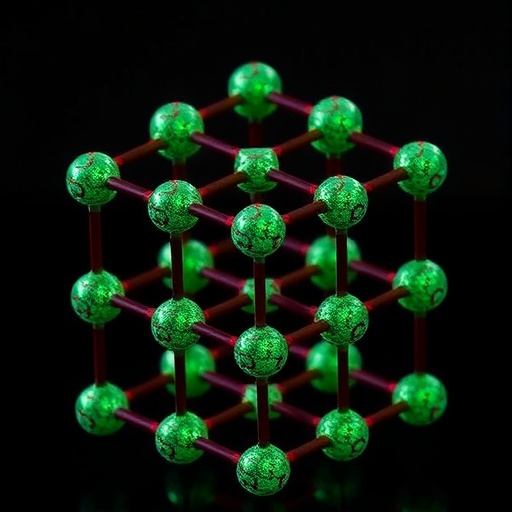
In a groundbreaking advancement in the field of supramolecular chemistry, researchers led by Prof. Shigui Chen at Wuhan University have successfully engineered a stable halogen-bonded organic framework anchored on the elusive [N⋯Cl⁺⋯N] halogen bond. This innovative study not only overcomes longstanding challenges associated with the inherent instability of chlorine(I)-based halogen bonds under standard conditions but also paves the way for their incorporation into multidimensional functional materials. The results, published in the prestigious journal CCS Chemistry, hold significant promise for catalysis and material science applications.
Halogen bonding, a type of directional and highly tunable non-covalent interaction, has traditionally been harnessed via iodine and bromine atoms owing to their larger atomic sizes and strong polarizability. These heavier halogens facilitate the formation of robust halogen-bonded supramolecular architectures that have found utility across crystal engineering, sensing, and catalysis. Conversely, chlorine has been notoriously difficult to integrate into stable frameworks due to its high electronegativity and poor electron cloud polarizability, which render [N⋯Cl⁺⋯N] interactions prone to rapid dissociation and instability.
The instability of the chlorine(I) halogen bond has confined its existence to transient, low-temperature conditions—often around −80°C—and has limited its exploration in advanced materials. The team circumvented this fundamental obstacle by adopting a precise stepwise synthetic strategy paving the way to stabilize these sensitive bonds within an extended two-dimensional organic framework. This approach successfully yielded a novel halogen-bonded organic framework (XOF(Cl)-TPy-BF₄/OTf) that exhibits remarkable chemical and thermal robustness.
The synthetic route began with the assembly of a metal-organic framework (MOF) bridged by the [N⋯Ag⁺⋯N] coordination complex using the linker 4,4’,4’’-triazatriangulenium (TPy). Post assembly, chlorine gas was introduced to selectively replace silver ions with chlorine cations (Cl⁺) in situ, establishing the [N⋯Cl⁺⋯N] halogen bond that underpins the framework’s stability. Spectroscopic techniques, including ^1H NMR and UV-Vis, combined with electron microscopy and X-ray diffraction methods, confirmed the successful transformation and the high crystallinity of the resultant XOF(Cl) structure.
Distinguishing itself from fleeting small-molecule chlorine halogen bonds, the newly designed XOF(Cl)-TPy-BF₄/OTf framework maintains its structural integrity even in diverse organic solvents and under ambient conditions. This enhanced stability was further elucidated through comparative studies evaluating the influence of counterions BF₄⁻ and OTf⁻, revealing stronger electrostatic interactions in the presence of OTf⁻. Such interactions not only stabilize the framework but also introduce avenues for tunable anion exchange processes, thereby broadening the functional scope.
Capitalizing on this anion exchange capability, the research group incorporated tetrachloropalladate (PdCl₄²⁻) into the framework to generate XOF(Cl)-TPy-Pd(II), which was subsequently reduced to form palladium(0) nanoparticles uniformly distributed within the framework. A comprehensive suite of characterization tools, including X-ray photoelectron spectroscopy, ^13C NMR, and extended X-ray absorption fine structure spectroscopy (XAFS), verified the successful loading and conversion of Pd species alongside preserving the framework’s architecture.
The catalytic prowess of the palladium-loaded framework was demonstrated across a range of classical palladium-catalyzed cross-coupling reactions, namely Suzuki, Heck, and Sonogashira couplings. Impressively, these catalytic processes proceeded with high efficiency and yield under mild and aerobic conditions. In an industrial context, the catalyst achieved near-zero palladium contamination in biphenyl liquid crystal synthesis, well below stringent international standards. Equally noteworthy, the catalyst sustained its activity over multiple cycles of recovery and reuse via simple filtration methods, underscoring its practical applicability.
This milestone underlines a vital leap in understanding how to harness and stabilize inherently fragile halogen bonds within extended materials. The efficient, modular assembly strategy and comprehensive analytical verification establish a blueprint for future exploitation of chlorine(I)-based halogen bonds in multifunctional materials. Such materials could revolutionize fields ranging from green catalysis to sensor design, especially when paired with fine-tuned anion exchange properties.
The implications of this study also extend to theoretical insights into halogen bonding principles. By stabilizing the [N⋯Cl⁺⋯N] interaction within a multidimensional framework, the research enriches the conceptual framework for dynamic non-covalent interactions in chemical systems. It challenges preconceived notions surrounding chlorine’s chemical inactivity in halogen bonding and unveils a new paradigm for exploiting subtle electronic and electrostatic effects in supramolecular chemistry.
Looking forward, this work sets the stage for the rational design of halogen-bonded frameworks with tailored functionalities. The ability to combine framework stability with catalytic utility opens exciting avenues for industrially relevant processes, including pharmaceutical synthesis and advanced materials manufacturing. Additionally, manipulating counterion environments may yield customized platforms for selective adsorption and sensing applications.
The revelation of a chlorine(I)-bridged two-dimensional halogen-bonded organic framework by Prof. Chen’s team is a remarkable feat that transcends traditional halogen bonding chemistry. It demonstrates how meticulous molecular engineering and innovative synthetic chemistry can unlock the latent potential of less-explored chemical interactions, fostering advances that resonate across chemistry and materials science disciplines.
This landmark achievement has been published as an open-access article in CCS Chemistry, the flagship journal of the Chinese Chemical Society, with doctoral student Xuguan Bai serving as the first author. The publication underscores the collaborative dedication to expanding the frontiers of halogen bond chemistry and offering sustainable solutions to catalytic challenges.
As halogen bonding continues to captivate chemists worldwide, the successful integration of chlorine-centered halogen bonds into stable, functional organic frameworks offers a compelling vision for the future of supramolecular materials. This research not only enriches fundamental scientific understanding but also promises transformative impacts on technology and industry driven by non-covalent chemistry.
Subject of Research: Not applicable
Article Title: A Type of Halogen-Bonded Organic Frameworks Based on N⋯Cl⁺⋯N Bonds: Stabilizing Sensitive Species
News Publication Date: 24-Sep-2025
Web References:
https://www.chinesechemsoc.org/journal/ccschem
http://dx.doi.org/10.31635/ccschem.025.202506172
Image Credits: CCS Chemistry
Keywords
Supramolecular chemistry


