


By Urbi Mukhopadhyay, Postdoctoral Fellow, EMBL Grenoble

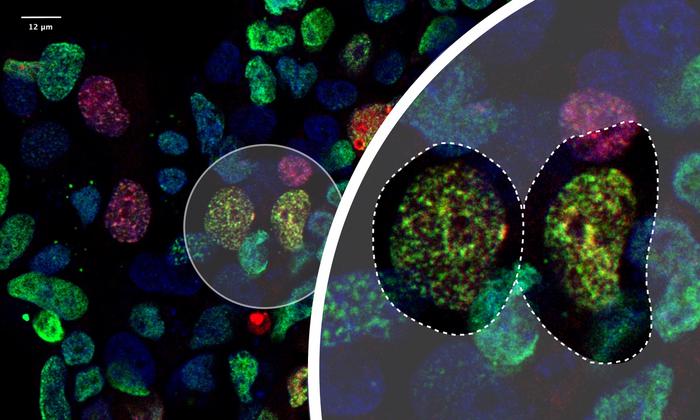
Credit: Urbi Mukhopadhyay/EMBL, Isabel Romero Calvo/EMBL
By Urbi Mukhopadhyay, Postdoctoral Fellow, EMBL Grenoble
Human proteins undergo a variety of chemical modifications following their synthesis. These modifications regulate their structure, function, and stability. Researchers from the Bhogaraju Group at EMBL Grenoble have developed a new method to study a critical type of protein modification process called ubiquitination. Ubiquitination plays an integral role in diverse cellular functions, and its dysregulation contributes to many human diseases, including neurodegeneration and cancer.
During ubiquitination, a group of enzymes called E3 ubiquitin ligases attach a small protein called ubiquitin to other proteins. This tagging, in turn, helps determine the fate of the targeted protein. Ubiquitination is highly pervasive in humans and it is estimated that every human protein undergoes ubiquitination at least once in its lifetime.
The diversity of cellular functions of ubiquitination is reflected in the existence of over 600 human E3 ligase genes, representing ~3% of the human genome. Mapping the human E3 target protein landscape can help us understand their function and eventually target them for therapeutics.
However, a significant number of E3 ligases and their targets remain poorly characterised, one of the reasons being the extremely transient nature of their interaction. Current methods for mapping such interactions are also highly resource-intensive, which limits their use and scalability.
To solve this problem, the Bhogaraju Group, which investigates ubiquitination pathways in various physiological contexts, developed a simple, cost-effective method, named Ub-POD, to quickly and easily label the targets of a given E3 ligase enzyme directly in human cells.
The work, which was recently published in the journal Science Advances, was led by Urbi Mukhopadhyay, an EMBO postdoctoral fellow in the Bhogaraju group, who found a way to effectively label the ubiquitinated targets of a given E3 ligase with biotin directly inside cells. This allows the targets to be identified later using a technique called quantitative mass spectrometry. Biotin is a small organic compound that can be biochemically attached to proteins of interest and used to isolate them from a mixed sample.
The simplicity of the method and the use of common chemicals means that it can be used anywhere in the world, in any lab that has basic molecular biology facilities.
Using this method and as a proof of principle, the researchers identified new targets of E3 ligases, RAD18 and CHIP, which are involved in cancer and neurodegenerative diseases, respectively. Christian Behrend’s lab at the Ludwig-Maximilians University (LMU), Munich, who are collaborators of the Bhogaraju Group, have also applied this method to TRAF6 – another E3 ligase and a critical immune signalling regulator – and successfully identified known and novel substrates.
In the future, the team plans to apply this method to all known human E3 enzymes. “We believe this will help fill the disparity in the therapeutic space between the kinase family of proteins and the ubiquitin ligase family,” said Sagar Bhogaraju, Group Leader, EMBL Grenoble. “Despite hosting a similar number of enzymes, there are ~80 FDA-approved therapeutic agents that target kinases, while only a handful of drugs target the ubiquitin system. The method we developed would contribute to expanding the scope of E3 ligases or their substrates as drug targets.”
Journal
Science Advances
Method of Research
Experimental study
Article Title
A ubiquitin-specific, proximity-based labeling approach for the identification of ubiquitin ligase substrates
Article Publication Date
9-Aug-2024
Cite Scienmag News
Nathaniel Bowman. (August 12, 2024). Developing a simple, cost-effective method to study an important protein modification. Scienmag. https://scienmag.com/developing-a-simple-cost-effective-method-to-study-an-important-protein-modification/
Nathaniel Bowman. "Developing a simple, cost-effective method to study an important protein modification." Scienmag, 12 August 2024, https://scienmag.com/developing-a-simple-cost-effective-method-to-study-an-important-protein-modification/. Accessed 4 September 2026.
Nathaniel Bowman. "Developing a simple, cost-effective method to study an important protein modification." Scienmag. August 12, 2024. https://scienmag.com/developing-a-simple-cost-effective-method-to-study-an-important-protein-modification/

