


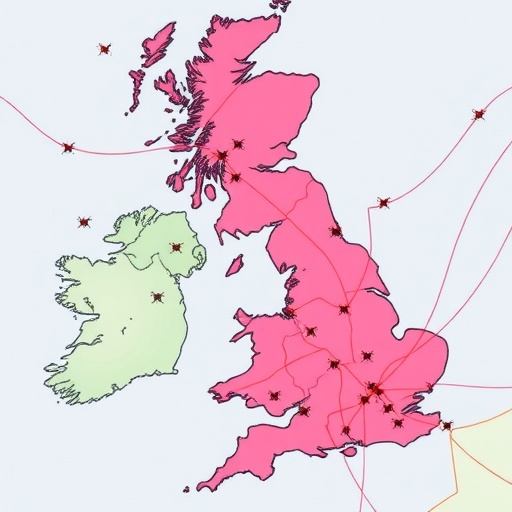
A recently published study in PLOS Global Public Health reveals a groundbreaking development in the ongoing battle against invasive mosquito species in the United Kingdom. This rigorous surveillance effort, led by senior medical entomologist Colin Johnston and colleagues from the UK Health Security Agency (UKHSA) and Edge Hill University, has documented the first detection of Aedes aegypti eggs in the UK for the first time ever, alongside new detections of Aedes albopictus, commonly known as the tiger mosquito. These findings, arising from intensive monitoring between 2020 and 2024, highlight an urgent public health concern as these vectors pose serious risks by carrying diseases such as dengue, chikungunya, and Zika virus.
Historically, Aedes aegypti and Aedes albopictus have been confined to tropical and subtropical climates, thriving in regions with consistently warm temperatures and high humidity. However, recent climatological shifts, notably rising global temperatures and milder winters, have facilitated the northward expansion of these mosquitoes. Ae. albopictus, in particular, has successfully established breeding populations across southern and central Europe, signaling a potential future where the UK’s temperate climate becomes favorable for these species. This northward encroachment puts new populations at increasing risk of vector-borne disease transmission.
The UKHSA, recognizing the threat of these invasive populations, initiated a comprehensive surveillance program targeting key entry points such as ports, airports, and major transport hubs. These sites are especially vulnerable given the international movement of goods and passengers. Surveillance teams deployed ovitraps—specially designed mosquito egg collection devices—at strategic points throughout England, Wales, and Northern Ireland. These traps were checked biweekly during peak mosquito activity months, from June to October each year, enabling a detailed temporal and spatial mapping of invasive mosquito presence.
The methodology behind species identification combined traditional morphological techniques with cutting-edge molecular methods. Collaborating with entomologists at Edge Hill University, the study ensured high accuracy in differentiating species, which can be notoriously difficult given the morphological similarities between mosquito eggs. Genetic sequencing further corroborated findings, lending weight to the evidence of invasive species incursions and enabling precise tracking of their geographic sources and potential pathways of introduction.
A striking discovery occurred in September 2023, when Ae. aegypti eggs were found within a freight storage facility near London Heathrow Airport. This detection marked the first recorded evidence of this species’ eggs in the UK environment, signaling a new chapter in the vector surveillance landscape. Subsequently, in August 2024, Ae. albopictus eggs were detected at a motorway service station in Kent. This site represents a critical node on major transit routes, underscoring the pervasive nature of mosquito dispersal facilitated by human transportation networks.
The authors of the study emphasize that, while there is no current evidence of established Aedes populations breeding extensively within the UK, the frequency and distribution of these detections indicate an increasing trend of importation. Without timely and robust intervention, there is a tangible risk that these invasive species could establish sustainable populations capable of local transmission of arboviral diseases, a development with potentially serious public health implications.
To counter this looming threat, UKHSA has advocated for proactive, enhanced surveillance combined with rapid local response protocols. Enhanced surveillance includes increased trap density, real-time data sharing between agencies, and integration of citizen science contributions to widen detection net coverage. When detections occur, swift mitigation actions such as targeted insecticide application and habitat removal are deployed to prevent mosquito establishment. These measures have thus far hindered invasive species from setting footholds, demonstrating the effectiveness of coordinated vigilance.
Engagement with local governments, private landowners, and public stakeholders has been pivotal in shaping a responsive and adaptable control framework. The cross-sector collaboration ensures swift mobilization of resources following detection events. This integrated approach combines scientific excellence, operational readiness, and community participation, creating a resilient surveillance network capable of addressing the dynamic challenges posed by invasive mosquitoes.
Alongside the continued monitoring of egg presence, the UKHSA’s Mosquito Entomology and Zoonosis Emerging (MEZE) group incorporates adult mosquito surveillance and genomic surveillance strategies. Adult mosquito traps supplement egg surveillance by validating species presence and abundance, while genomic tools facilitate the tracking of mosquito lineage and insecticide resistance markers. Additionally, citizen science initiatives engage public participation in mosquito detection, expanding surveillance reach and increasing public awareness regarding the risks posed by these invasive species.
Colin Johnston reflects on the dynamic nature of this surveillance work: each detection event prompts an immediate escalation in local surveillance and vector control, underscoring the ongoing threat and the importance of rapid response. The absence of further specimens following these detection events suggests that current incursions are isolated and controlled. However, the continuous arrival of invasive mosquitoes from international sources demands sustained attention and adaptive management strategies.
The ecological versatility of Ae. albopictus, including its capacity to survive colder winters in Europe, illuminates the potential challenges facing vector control efforts in the UK. Climate models project increasing temperatures and reduced frost frequency, factors that could enable broader geographic establishment and seasonal persistence of these vectors. Consequently, surveillance and control strategies must anticipate these environmental changes and rapidly adjust.
This surveillance study not only underscores the urgency of maintaining and expanding vector monitoring but also highlights the importance of global interconnectedness in vector ecology. International trade and travel remain pathways through which invasive mosquito species spread, necessitating international cooperation and information exchange to address this transboundary issue effectively.
By detecting isolated incursions early, the UK’s surveillance program exemplifies a proactive approach to public health protection, emphasizing prevention over reaction to vector-borne disease outbreaks. Maintaining such vigilance is critical to avoiding the establishment and spread of Aedes mosquitoes, thereby protecting millions from devastating arboviral diseases.
In summary, this study provides a comprehensive and timely warning that invasive mosquito species, historically absent from the UK, are increasingly arriving and potentially poised for establishment. The concerted efforts of scientific researchers, public health authorities, and community stakeholders illustrate a model of proactive defense against environmental and epidemiological threats. It is a clarion call for sustained investment in vector surveillance and control as climate change and globalization continue to transform the landscape of infectious disease risk.
News Publication Date: 1-Oct-2025
Web References: 10.1371/journal.pgph.0004968
References: Johnston CJ, Edwards AC, Vaux AGC, Abbott AJ, Hardy H, Wilson R, et al. (2025) Invasive mosquito surveillance in the United Kingdom 2020 to 2024: First detection of Aedes aegypti eggs in the UK and further detection of Aedes albopictus. PLOS Glob Public Health 5(10): e0004968.
Cite Scienmag News
Phoebe Ingram. (October 1, 2025). Detection of Invasive Mosquito Vector Species in UK Surveillance Traps Raises Public Health Concerns. Scienmag. https://scienmag.com/detection-of-invasive-mosquito-vector-species-in-uk-surveillance-traps-raises-public-health-concerns/
Phoebe Ingram. "Detection of Invasive Mosquito Vector Species in UK Surveillance Traps Raises Public Health Concerns." Scienmag, 1 October 2025, https://scienmag.com/detection-of-invasive-mosquito-vector-species-in-uk-surveillance-traps-raises-public-health-concerns/. Accessed 4 September 2026.
Phoebe Ingram. "Detection of Invasive Mosquito Vector Species in UK Surveillance Traps Raises Public Health Concerns." Scienmag. October 1, 2025. https://scienmag.com/detection-of-invasive-mosquito-vector-species-in-uk-surveillance-traps-raises-public-health-concerns/


