

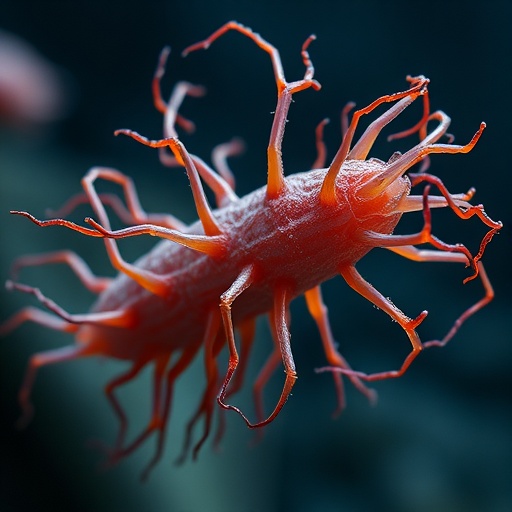
A recent breakthrough in marine microbiology has unveiled a critical vulnerability in SAR11, a clade of ocean bacteria that dominates surface seawater across the globe. Despite their overwhelming abundance — often constituting up to 40% of marine bacterial cells — these bacteria, renowned for their streamlined genomes and remarkable adaptation to nutrient-scarce environments, may face unforeseen challenges in the wake of environmental variability. The findings, stemming from sophisticated genomic and microscopic analyses, shed light on how SAR11’s evolutionary efficiency paradoxically leaves them susceptible to disruptions in their cell cycle, a vital biological process.
SAR11 bacteria have long been esteemed as paragons of evolutionary refinement, having honed a minimalist genomic architecture that slashes energy demands, enabling their survival in nutrient-poor marine habitats. This genome streamlining phenomenon involves the shedding of non-essential genes, a strategy thought to be instrumental to SAR11’s ecological dominance. However, new research indicates this genetic parsimony entails trade-offs, particularly in the genetic toolkit required to orchestrate the cell cycle—the highly regulated sequence of events coordinating DNA replication and cellular division.
The investigative team conducted extensive comparisons of hundreds of SAR11 genomes, revealing a conspicuous absence of canonical regulatory genes typically indispensable in maintaining cell cycle fidelity in bacteria. In most prokaryotes, these genes ensure balance between DNA synthesis and cell septation, securing the health and viability of daughter cells. In contrast, SAR11’s lack of these controls appears to predispose them to severe cellular dysfunctions when environmental conditions fluctuate—an insight that challenges erstwhile assumptions about their resilience.
High-resolution transmission electron microscopy (TEM) of SAR11 cells cultivated to late exponential growth phase vividly illustrated these abnormalities. Under stressors such as nutrient influx or temperature shifts, SAR11 cells decoupled the processes of genome replication and cell division. Instead of synchronizing DNA duplication with cytokinesis, these bacteria continued DNA replication unabated while failing to execute proper cell division. This led to an accumulation of multiple chromosomal copies within single cells, anomalies that were consistently replicated across experimental replicates.
The aberrant cells often exhibited marked morphological changes, including increased cell size and irregular shapes, culminating in heightened mortality rates. Unlike typical bacterial growth curves where nutrient abundance directly correlates with population expansion, SAR11 populations displayed unexpected stagnation or decline even in nutrient-rich conditions. This uncoupling of replication and division challenges conventional models of microbial population dynamics and demands a reevaluation of SAR11’s ecological role, especially during episodic environmental shifts.
Moreover, the findings illuminate previously puzzling ecological patterns. SAR11 populations are known to dwindle during the senescent phases of phytoplankton blooms, periods characterized by surges in organic matter and nutrient input. The present study provides a mechanistic explanation: these nutrient and environmental perturbations trigger cellular dysregulation in SAR11, rendering them less competitive and less able to capitalize on the transient resource availability. Such dynamics underscore how microbial physiology intersects with biogeochemical cycles.
The implications ripple beyond microbial ecology into the broader context of global climate change and ocean health. SAR11’s pivotal position in the marine carbon cycle means that any factor impairing its growth or survival can reverberate through carbon fluxes and nutrient transformations. Environmental instability, including ocean warming and episodic nutrient pulses, could induce widespread disruptions in SAR11 communities, consequently reshaping microbial consortia and affecting the ocean’s capacity to sequester carbon.
Intriguingly, the study signals that organisms equipped with more elaborate cell cycle regulatory networks may gain a competitive edge in increasingly variable marine environments. This prospect suggests a potential shift in microbial community composition driven not simply by resource availability but by physiological robustness to environmental fluctuations. It emphasizes the evolutionary dance between adaptation and vulnerability, where specialization may limit future flexibility.
Parallel lines of inquiry are now being pursued to decipher the molecular underpinnings of SAR11’s cell cycle dysregulation. Researchers aim to pinpoint the precise genetic and biochemical mechanisms that fail under stress, seeking to unravel how genome streamlining constrains regulatory capacities. Such knowledge will be vital for modeling microbial responses to climate perturbations and for anticipating changes in oceanic microbial ecosystems.
The study also showcases how integrating high-throughput genomic data with cutting-edge microscopy can revolutionize our understanding of microbial life. Visualizing cellular anomalies directly links genomic insights with phenotypic outcomes, providing compelling evidence of how genetic architecture shapes organismal responses to their environment. This methodological synergy establishes a new paradigm for exploring microbial ecology in situ.
Ultimately, this research challenges the romanticized notion of SAR11 as an invincible marine specialist, revealing instead a nuanced portrait of an organism finely tuned yet potentially brittle in the face of environmental upheaval. It highlights the importance of regulatory genes in maintaining cellular integrity and punctuates the evolutionary cost of an overly pared-down genome. As oceans become more dynamic, the balance between efficiency and resilience in these microscopic titans will play a critical role in shaping marine ecosystems.
As scientists continue to probe the vulnerabilities embedded within SAR11’s streamlined genome, their findings will redefine our comprehension of microbial adaptation and ecosystem function. The insights gained promise to inform conservation strategies and predictive models vital for safeguarding ocean health in an era of rapid climatic change.
Subject of Research: Cells
Article Title: Cell cycle dysregulation of globally important SAR11 bacteria resulting from environmental perturbation
News Publication Date: 22-Jan-2026
Web References:
https://www.nature.com/articles/s41564-025-02237-8
http://dx.doi.org/10.1038/s41564-025-02237-8
References:
Cheng C., Thrash C., et al. (2026). Cell cycle dysregulation of globally important SAR11 bacteria resulting from environmental perturbation. Nature Microbiology.
Image Credits: Thrash Lab/USC Dornsife
Keywords: Cell biology, Computational biology, Evolutionary biology, Microbiology


