


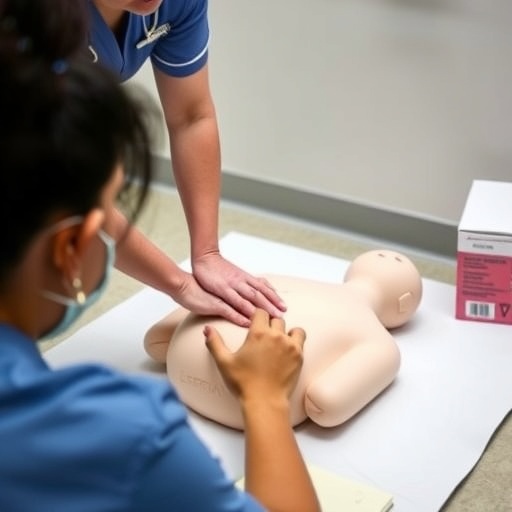
In the realm of healthcare education, particularly in critical skills training like Cardiopulmonary Resuscitation (CPR), staying ahead is essential. A recent study conducted by Jimenez-Jimenez, Lopez-Torre, Galan-Lominchar, and colleagues sheds light on this vital area by employing innovative design thinking methodologies. This qualitative study emphasizes the role of understanding training needs among nursing students and professionals, demonstrating how this approach can radically enhance CPR educational frameworks.
The concept of design thinking, often celebrated in the fields of product design and business, has begun to permeate various spheres of education, particularly in healthcare. Its foundational principle revolves around understanding the user experience—in this case, nursing students and professionals who deliver CPR training. By engaging these stakeholders directly, the researchers aimed to uncover specific challenges and gaps within current educational practices.
Through in-depth interviews and focus groups, the study unraveled a tapestry of perspectives on CPR education. Participants not only shared their educational experiences but also articulated their needs, frustrations, and expectations. The insights derived from these discussions offered a rich context, paving the way for the identification of training deficiencies that may hinder effective learning and application of CPR techniques.
A recurring theme highlighted by the participants was the overwhelming amount of information typically presented during CPR training sessions. Many participants felt that these training sessions were too theoretical and lacked practical application. The discomfort of students not feeling adequately prepared for real-life emergency situations was palpable. The study posits that design thinking can address this disconnect, transforming abstract knowledge into tangible skills through immersive learning environments.
Moreover, the study illuminated the importance of collaboration among educators, students, and professionals in refining CPR training. The notion of co-creation in educational design was embraced, where all stakeholders contribute to the development of the curriculum. This collaborative effort not only fosters a sense of ownership among participants but also ensures that the training is relevant and pragmatic, equipped to meet the demands of modern healthcare settings.
The researchers observed that emotional factors significantly influence learning outcomes in CPR training. Anxiety, stress, and confidence emerged as critical elements that could either hinder or enhance the learning experience. A holistic approach to training, which incorporates these emotional aspects, could lead to more effective education and retention of critical life-saving skills.
Another pivotal finding was the necessity for ongoing training and refresher courses, as knowledge retention for CPR techniques significantly diminishes over time without practice. The traditional one-off training sessions were criticized for their limitation in reinforcing learning and maintaining skills. The study strongly advocates for a continuous professional development framework, where periodic training is embedded into the schedules of nursing students and professionals.
Through interviews, the researchers also noted a strong desire for interactive and engaging training methodologies. Traditional lectures and videos were seen as monotonous, potentially leading to disengagement from the learning process. Incorporating simulations, gamification, and hands-on practice could foster a more dynamic environment, facilitating not only skill acquisition but also confidence in performing CPR.
The findings of this research have vital implications extending beyond the classroom. They highlight the critical need for educational reforms that are responsive to the identified training needs, ultimately ensuring better preparedness among healthcare providers when it comes to delivering emergency care. A shift towards more practical, learner-centered methodologies is essential in nurturing not only competent but also confident caregivers.
Furthermore, the study argues that institutions must anchor curricula on empirical evidence gathered from stakeholders. This strategy would aid in aligning training programs with both the educators’ insights and the real-world challenges due to dynamics within healthcare. Bridging the gap between theory and practice will not only enhance the quality of education but also improve patient care outcomes on a broader scale.
As the world grapples with increasing emergency medical needs, ensuring that healthcare professionals are adequately trained in CPR is non-negotiable. Innovative educational strategies like design thinking offer a pathway to elevate training standards. The fundamental takeaway from this research is that true educational advancement in CPR education requires an evolution in how training needs are approached and addressed.
In conclusion, the qualitative insights from this study underscore a significant shift in educational practices required in CPR training. By employing a design thinking approach, nursing programs can nurture an environment that prioritizes learner engagement, practical skill application, and emotional preparedness. As we anticipate future developments in healthcare education, it is crucial that strategic efforts focus on transforming training frameworks to meet the evolving needs of healthcare professionals and, ultimately, the patients they serve on the front lines.
Cite Scienmag News
Ophelia Keating. (February 2, 2026). Design Thinking Unveils CPR Training Needs for Nurses. Scienmag. https://scienmag.com/design-thinking-unveils-cpr-training-needs-for-nurses/
Ophelia Keating. "Design Thinking Unveils CPR Training Needs for Nurses." Scienmag, 2 February 2026, https://scienmag.com/design-thinking-unveils-cpr-training-needs-for-nurses/. Accessed 4 September 2026.
Ophelia Keating. "Design Thinking Unveils CPR Training Needs for Nurses." Scienmag. February 2, 2026. https://scienmag.com/design-thinking-unveils-cpr-training-needs-for-nurses/


