


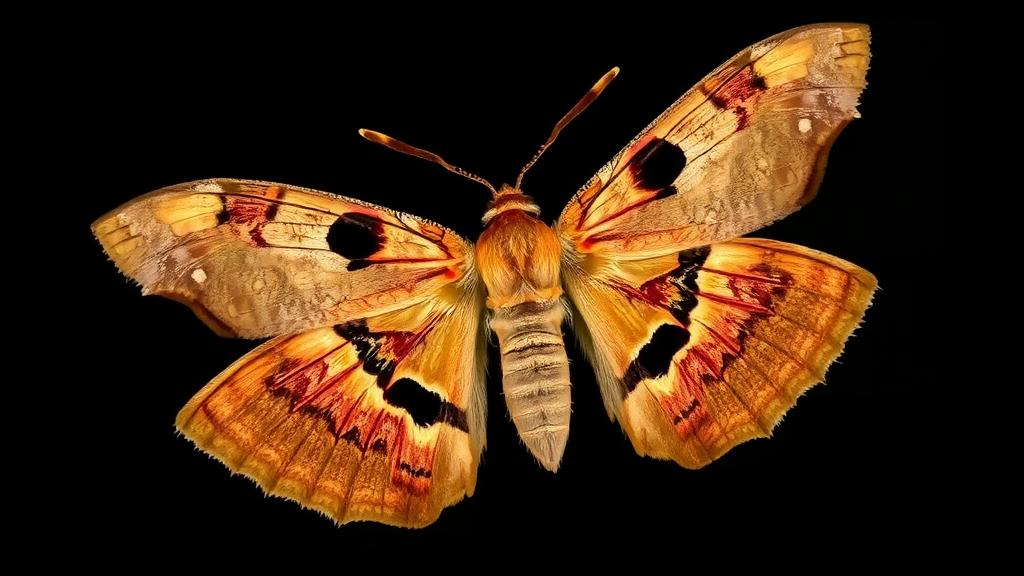
A moth of the desert has been quietly knocking on Europe’s door. Agrotis herzogi, a noctuid moth whose natural range stretches across the arid belt from the Canary Islands and Morocco to western India, is turning up more and more often on the southern fringes of the Iberian Peninsula. A new study in the Deutsche Entomologische Zeitschrift has now assembled the fullest picture yet of these appearances, and the verdict is striking: the moths are being blown in from North Africa on southerly winds, but so far there is no evidence that any of them has ever managed to build a lasting population on European soil.
The research team, led by José Luis Yela of the University of Castilla-La Mancha together with Eduardo Marabuto and Antonio S. Ortiz, compiled every reliable record of A. herzogi from the Iberian-Balearic area, deliberately excluding unverified internet sightings. That effort added 27 previously unpublished records to the handful already in the literature, expanding the species’ known footprint dramatically, from the Lisbon coastline all the way to Alicante on the Mediterranean, with a single specimen even captured in Mallorca in the Balearic Islands in October 2025. Yet beneath this apparent range expansion lies a very different story.
The distribution of records is anything but uniform. Seventeen of the 27 new observations come from the Strait of Gibraltar area and its immediate surroundings in the province of Cádiz, including the Tarifa and Vejer de la Frontera localities, with the rest clustered in the Algarve region of Portugal and along the south-eastern Spanish coast. The Strait is the point where Europe and Africa come closest, a mere 14 kilometres of water apart, and it acts as one of the principal aerial bottlenecks for anything carried northward on the wind. The authors argue that this spatial clustering reflects an arrival zone, a place where wind-borne immigrants are disproportionately detected, rather than a stronghold of resident moths.
Even more telling is the timing. Despite nearly continuous light-trapping at key sites such as Tarifa and Vejer over the past decade, the records bunch into a small number of years: 2015 in western Portugal and Britain, 2017 in southern Portugal, 2022 around Tarifa and Huelva, and 2025 along the Mediterranean coast as far as Mallorca. A stable resident population would be expected to produce regular detections year after year. Instead, the pattern of boom-and-bust appearance, with nothing in between, is the classic signature of episodic immigration, where insects cross the sea in discrete pulses whenever the atmosphere cooperates.
That cooperation is precisely what the meteorological analysis revealed. When the team plotted the dates of the 19 nights with records against wind reconstructions from the HYSPLIT trajectory model and the Ventusky platform, they found that on 14 of those nights, some 74 percent, prevailing winds blew from the south, south-west or south-east. On individual nights, the inferred origins shifted across North Africa: south-easterlies pointed toward the coastline between Morocco and Tunisia, including Algeria, while south-westerlies suggested sources as far afield as the Canary Islands, Morocco or north-western Algeria. The authors caution that these attributions remain tentative, since moths may arrive hours or days before detection and winds shift with altitude and time of night, but the overall correlation is biologically compelling.
Genetics added a final layer of evidence. The team sequenced the mitochondrial COI barcode region from two adults collected in Cádiz and compared the sequences with public data in the Barcode of Life Data System, then built a maximum likelihood phylogenetic tree with related Agrotis species and an Euxoa outgroup. Both Iberian specimens fell squarely into Barcode Index Number BOLD:AFE3262, a cluster that also includes individuals from Saudi Arabia, Iran, Israel and Tenerife in the Canary Islands. The differentiation among these seven moths was shallow and showed no geographic structure, exactly what would be expected if recurrent long-distance immigration keeps gene flowing across an enormous range, and if the Iberian arrivals represent recent contact with those distant source populations rather than an isolated, diverging colony.
Ecology tells a similar story of failed settlement. No immature stages of A. herzogi have ever been confirmed in the wild in the Iberian-Balearic area, and the habitats where the moths are caught do not fully match those known from its core range. In Israel, the only place with published larval data, the species feeds subterraneously on the roots of Atriplex leucoclada bushes on semi-consolidated sand dunes, a plant that does not occur in Iberia. Other Atriplex species, such as A. halimus along the coast and A. patula and A. prostrata inland, are widespread in southern Spain and could in principle serve as hosts, but the moth’s specific requirements for soft sedimentary soils in shallow ravines and large depressions may simply be missing from most of the region. The scarcity of records away from the coast further suggests that arriving individuals remain confined to peri-coastal environments and never penetrate far inland.
The study also puts A. herzogi in a wider context of Afro-Mediterranean insect traffic. In recent years, numerous moth species of African origin have been recorded for the first time in the southern Iberian Peninsula, including Mythimna languida, Agrotis subspinifera, Chrysodeixis acuta and Tytroca dispar. Most remain occasional vagrants, but a few, such as M. languida, Eublemma baccatrix and Condica capensis, have established themselves. The contrast with E. baccatrix is especially instructive: unknown in both North Africa and Iberia as recently as 2022, it is now recorded regularly across the southern third of the peninsula, with continuous records across years and clear spatial expansion, hallmarks of genuine colonisation that A. herzogi conspicuously lacks. Repeated arrival, it turns out, is not the same thing as successful establishment; ecological compatibility ultimately decides the outcome.
The phenology of the Iberian moths, with adults flying from October to April, matches the autumn-to-spring flight period described across the species’ range and points to an extended univoltine life cycle. That seasonality aligns neatly with the autumn and winter wind regimes that dominate the Strait of Gibraltar region, reinforcing the picture of a species whose European presence is written and rewritten each year by the weather rather than sustained by local reproduction. Whether that balance might shift under a warming, drying climate is an open question. Ongoing aridification of southern Iberia could eventually create conditions suitable for permanent colonisation by desert-adapted insects, a possibility the authors highlight as reason for continued monitoring.
For now, A. herzogi stands as an elegant case study in atmospheric connectivity, showing how the Sahara’s edges and Europe’s southern coast are linked by invisible aerial highways. Its recurring guest appearances, clustered in space, punctuated in time, tied to southerly winds and genetically indistinguishable from moths thousands of kilometres away, demonstrate that a rising tally of records does not automatically mean a species is conquering new ground. Sometimes, as with this snow-white-winged wanderer from the desert, the northward march of a warming world is still just a matter of catching the right wind.
Subject of Research: Wind-assisted immigration and failed establishment of the desert moth Agrotis herzogi in the Iberian-Balearic area
Article Title: Peripheral presence or transient colonist? Distribution, phenology and exploratory inferences about the origin of Agrotis herzogi Rebel, 1911 ( Lepidoptera , Noctuidae ) in the Iberian-Balearic area
Article References: Yela, J. L., Marabuto, E., Domínguez, L. A., Grundy, D., Guerrero, J. J., Knapp, S., Olvera, M., Ranki, T., & Ortiz, A. S. (2026). Peripheral presence or transient colonist? Distribution, phenology and exploratory inferences about the origin of Agrotis herzogi Rebel, 1911 (Lepidoptera, Noctuidae) in the Iberian-Balearic area. Deutsche Entomologische Zeitschrift, 73(1), 275-288. https://doi.org/10.3897/dez.73.189021
Image Credits: AI Generated
Keywords: Agrotis herzogi, Noctuidae, moth migration, Iberian Peninsula, Strait of Gibraltar, wind-assisted dispersal, North Africa, DNA barcoding, COI, phenology, climate change, vagrancy
Cite Scienmag News
Gavin Prescott. (October 16, 2026). Desert moth rides African winds into Spain but never stays, DNA and weather records reveal. Scienmag. https://scienmag.com/desert-moth-rides-african-winds-into-spain-but-never-stays-dna-and-weather-records-reveal/
Gavin Prescott. "Desert moth rides African winds into Spain but never stays, DNA and weather records reveal." Scienmag, 16 October 2026, https://scienmag.com/desert-moth-rides-african-winds-into-spain-but-never-stays-dna-and-weather-records-reveal/. Accessed 16 October 2026.
Gavin Prescott. "Desert moth rides African winds into Spain but never stays, DNA and weather records reveal." Scienmag. October 16, 2026. https://scienmag.com/desert-moth-rides-african-winds-into-spain-but-never-stays-dna-and-weather-records-reveal/


