

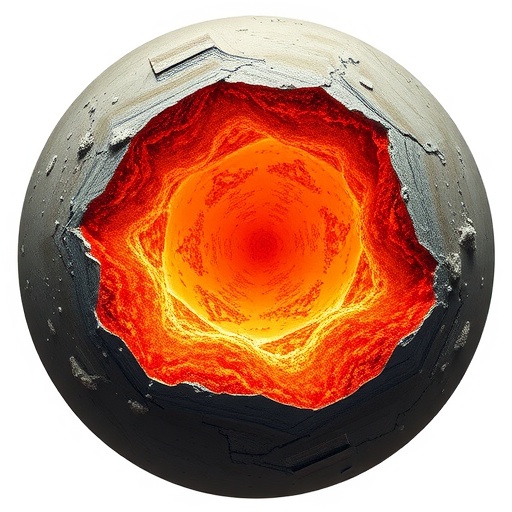
In a groundbreaking exploration of Earth’s deep interior, a team of geoscientists has unveiled revealing insights into the elusive nature and distribution of dense hydrous magnesium silicates (DHMS) within the mantle transition zone. This investigation sheds new light on the complex interplay of water, mineral stability, and mantle dynamics at depths previously considered poorly understood. The mantle transition zone, located roughly between 410 and 660 kilometers beneath the Earth’s surface, plays a pivotal role in regulating geochemical cycles and influencing tectonic processes, yet its water content and mineralogy remain enigmatic. The findings, recently published in Communications Earth & Environment, emphasize how low water activity conditions dramatically affect the stability and spatial distribution of DHMS, challenging prevailing models of water storage deep within the Earth.
Dense hydrous magnesium silicates are uniquely important minerals that incorporate water into their crystal structure, effectively acting as carriers of hydrogen deep into the Earth’s interior. Previous studies have suggested their presence in the transition zone, but there has been considerable debate about the extent and conditions of their stability. Understanding these minerals’ stability fields is critical because they influence the physical and chemical properties of the mantle and impact processes such as mantle convection, seismic anisotropy, and even volcanic activity. The current research leverages cutting-edge experimental techniques to simulate the pressures and temperatures found in the mantle transition zone while carefully adjusting water activity to novel low levels, offering a fresh perspective on these crucial hydrous phases.
The experimental framework used by the team involved advanced high-pressure apparatus capable of reproducing the severe conditions endured within the mantle transition zone. By controlling the water activity—a measure of available water for mineral formation—the researchers were able to mimic scenarios where water is scarce, akin to natural geochemical environments deep below the Earth’s surface. This approach contrasts with earlier studies that often assumed relatively hydrated conditions, potentially skewing interpretations of DHMS stability. The nuanced control over water activity allowed the scientists to determine threshold boundaries for the formation and breakdown of key DHMS minerals, thereby refining our understanding of where and how these phases can persist.
One of the most significant revelations from this study is the finding that under low water activity conditions, certain DHMS exhibit markedly restricted stability ranges. This discovery challenges the prevailing notion that these minerals broadly populate the mantle transition zone’s entirety. Instead, the research indicates a patchy and selective distribution, influenced heavily by the availability of water and the local pressure-temperature regime. Consequently, this could imply that some regions of the transition zone might be relatively dehydrated, altering the interpretation of seismic data and our models for mantle water cycling. Such heterogeneity in water content has profound implications for understanding mantle rheology and the dynamics driving plate tectonics.
Moreover, the team’s results highlight the thermodynamic complexity of DHMS phases. The experimental data show that key hydrous magnesium silicates, such as phases akin to phase A and phase E, only remain stable within narrow water activity ranges. Below specific thresholds, these minerals tend to break down, potentially releasing water and influencing partial melting processes or the formation of other hydrous phases. This behavior not only has ramifications for the deep water cycle but also suggests feedback mechanisms where water availability can promote localized melting or influence mantle viscosity. These insights pave the way for more sophisticated models of mantle behavior that incorporate realistic water contents and mineral stability constraints.
Importantly, the distribution patterns that emerged from these experiments align intriguingly with seismic observations of the mantle transition zone. Seismologists have long noted variations in seismic wave velocities that hint at heterogeneities in mineral composition and water content. The research findings provide mineralogical explanations for these anomalies, suggesting that discrete pockets of hydrous minerals—governed by low water activity conditions—could account for observed seismic discontinuities and anisotropic behavior. By integrating mineral physics data with geophysical observations, this study bridges a significant gap between laboratory models and real-world seismic imaging.
The study also underscores the potential role of these hydrous phases in deep Earth geochemical cycling. Water stored in the mantle, often locked in dense hydrous minerals, is instrumental in moderating melting points, influencing magma genesis, and transporting volatiles to shallower regions of the Earth’s interior. The team’s refined constraints on DHMS stability suggest that water transport is more compartmentalized, possibly controlled by subduction zone dynamics and mantle hydration variability. Such compartmentalization could affect the geochemical signature of volcanic outputs, linking deep mantle processes with surface volcanism in novel ways.
Furthermore, this work carries profound implications for understanding the origin and evolution of water on Earth. The deep mantle transition zone serves as a reservoir that exchanges water with the surface over geological time scales. The newly identified stability windows for dense hydrous magnesium silicates under low water activity reinforce the idea that the transition zone may act as both a sink and source for deep water storage. This dual role is essential for long-term planetary habitability and shapes Earth’s deep water cycle, potentially impacting continental growth, atmospheric evolution, and even climate over millions of years.
From a methodological standpoint, the precision achieved in these experiments highlights the importance of fine-tuned control over experimental variables in high-pressure mineral physics. The ability to manipulate water activity specifically allowed the researchers to pinpoint how minute variations in hydration can lead to significant changes in mineral stability. This methodological innovation sets a new benchmark for future investigations aiming to understand mineral stability amid complex chemical environments prevalent within the Earth’s deep interior. Other research groups will likely build on these experimental protocols to explore additional volatile-bearing phases and their roles in Earth’s geodynamics.
The findings may also catalyze renewed interest in the exploration of hydrous minerals at mantle depths beyond the traditionally studied peaks at 410 km and 660 km. Given that the stability of DHMS phases now appears more constrained than previously thought, there is a pressing need to revise mantle models to include variable hydration patterns that can influence mantle convection and thermal evolution. This could include more detailed mapping of water distribution in three-dimensional mantle models, potentially enhancing predictions of geodynamic behavior and seismic response.
In addition to these scientific advances, the environmental and planetary science implications merit attention. The deep Earth water cycle influences surface conditions, including volcanic emissions of greenhouse gases and crustal deformation, which in turn impact ecosystems and climate. Understanding the mineralogical mechanisms controlling water storage at depth provides a foundation for interpreting how Earth’s deep interior links to surface environmental changes. Furthermore, such knowledge might inform comparative studies of other terrestrial planets and moons, where water reservoirs in deep interiors could shape planetary evolution and habitability.
This research also contributes to the ongoing discussion concerning the role of water in controlling seismic discontinuities within the mantle transition zone. The localized stability of DHMS under low water activity conditions offers a plausible mineralogical explanation for the existence of mid-transition zone discontinuities, which have long puzzled geophysicists. By correlating mineral stability with seismic velocity anomalies, the study opens pathways to more accurately interpret seismic tomography data and to better understand the water content’s distribution and its influence on mantle dynamics.
A particularly compelling aspect of this research is the exploration of how low water activity conditions result in mineralogical and chemical gradients within the mantle transition zone. These gradients can drive localized melting or mantle heterogeneities that propagate upward, influencing magmatic processes in the upper mantle and crust. As a result, the study provides a mechanistic link between deep Earth mineral physics and surface geological phenomena, enhancing our holistic understanding of Earth system processes.
Finally, the investigation underscores the vital role of multidisciplinary collaboration in advancing geosciences. By integrating experimental petrology, mineral physics, and geophysical data, this research team has constructed a detailed framework that refines our understanding of deep Earth water storage and its implications for planetary dynamics. Future research building on these findings will undoubtedly continue to deepen our knowledge of Earth’s mantle and its critical role in the planet’s long-term evolution.
As we push the boundaries of our understanding of Earth’s interior, the work on dense hydrous magnesium silicates under low water activity conditions emerges as a milestone, compelling us to rethink the deep Earth water cycle and its far-reaching consequences. This profound advancement enhances not only our academic comprehension but also our appreciation for Earth’s dynamic complexity and the subtle yet powerful role of water hidden deep beneath our feet.
Subject of Research: Stability and distribution of dense hydrous magnesium silicates in the mantle transition zone under varying water activity conditions.
Article Title: Stability and distribution of dense hydrous magnesium silicates in the mantle transition zone under low water activity conditions.
Article References:
Song, Y., Guo, X., Zhai, K. et al. Stability and distribution of dense hydrous magnesium silicates in the mantle transition zone under low water activity conditions. Commun Earth Environ 7, 265 (2026). https://doi.org/10.1038/s43247-026-03379-1
Image Credits: AI Generated


