


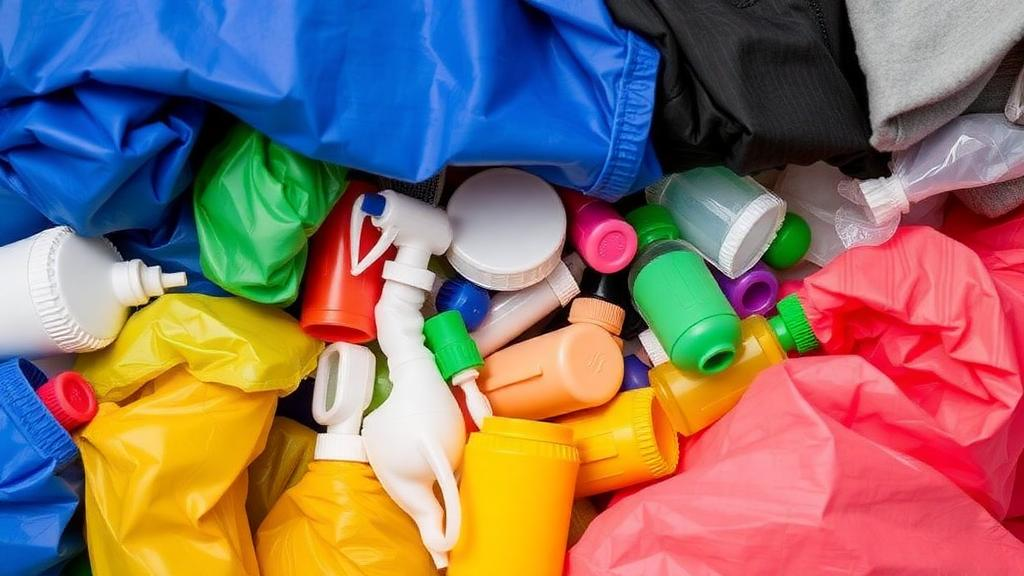
The circular economy has become one of the most fashionable ideas in modern environmental policy, embraced by governments, corporations and civil society as a way to keep growth going while healing the planet. Yet a new study published in Frontiers in Sustainability argues that the concept, as currently practiced, may be far too timid to confront the scale of the sustainability crisis. Researchers from the Institute for Ecological Economy Research in Berlin, the University of Salford and the University of Hull examined how circular economy and degrowth ideas intersect in two of the world’s most environmentally problematic material streams: textiles and plastic packaging. Their conclusion is uncomfortable for policymakers: the far-reaching socio-ecological transformation that a genuinely sustainable circular economy would require is seldom addressed in the literature and lies largely beyond the ability of today’s companies and stakeholders to even comprehend, let alone act upon.
The research team, led by Frieder Rubik and including Pauline Deutz, Ulrich Petschow, Anne Kildunne and Florian Hofmann, set out to bridge two literatures that have had a substantially separate existence. The circular economy, with its promise of decoupling economic growth from environmental harm through recycling, reuse and efficiency, has taken firm hold with policymakers, particularly in the European Union, where the 2020 Circular Economy Action Plan forms a key pillar of the European Green Deal. Degrowth, by contrast, calls for a managed, intentional downscaling of the economy to operate within planetary boundaries, and remains politically unpalatable. But the authors argue that the two concepts overlap far more than either camp typically acknowledges, and that circular economy research and practice could learn a great deal from degrowth’s insistence on absolute reductions in environmental impact.
To test these ideas empirically, the team combined integrative literature reviews with two contrasting case studies built on semi-structured interviews. The first focused on textile manufacturers in South West Germany, a region with a proud industrial textile heritage now fighting for survival in specialized market niches. Fourteen interviews were conducted with companies ranging from small firms with fewer than 49 employees to large enterprises employing more than 250 people. The second case study examined plastic packaging stakeholders on the east coast of England, in the North Humberside region encompassing Hull and the East Riding of Yorkshire, where the local economy is concentrated in agriculture and food production. Twenty-two interviews captured perspectives from local authorities, waste companies, retailers, food and packaging manufacturers, and non-profit organizations.
The numbers behind both sectors are stark. Global fiber production more than quadrupled between 1970 and 2023, reaching 125 million tons, with synthetic fibers now accounting for roughly 67 percent of the total. Fast fashion has accelerated into ultra-fast fashion, with companies like Shein launching new lines every five to seven days. Only an estimated 1 to 7 percent of textile waste is recycled, and recycled fibers make up just 0.7 percent of textile production inputs. Plastics tell a similar story: less than 10 percent of plastic waste was recycled worldwide in 2020 according to the OECD, while microplastics have now been detected in rivers and oceans across the globe, with documented health consequences for aquatic organisms and humans alike. Even under optimistic extrapolations of current recycling growth rates, secondary materials would still account for only around 16 percent of total plastics production by 2040, meaning absolute volumes of waste would continue to climb.
Against this backdrop, the researchers applied a framework that sorts the circular economy’s famous R-strategies, from refuse and rethink through to recycling and energy recovery, into three clusters. Long-loop options such as recycling are the most widely implemented but are, in the authors’ assessment, necessary yet insufficient on their own to keep production and consumption within planetary boundaries. Medium-loop strategies like refurbishing and remanufacturing could slow resource consumption but remain marginal in practice. Short-loop options, including reducing consumption, refusing purchases, repairing and reusing, carry the highest potential for genuine absolute reductions, but they demand lifestyle changes and social reorganization that current economic structures actively discourage.
The interview findings from both case studies were strikingly consistent. In Germany, all the textile manufacturers pursued one or more R-strategies, but long-loop recycling and energy recovery dominated, chosen because they are administratively simple and economically viable in the short term. Only one company used recycled textile fibers as input material, and short-loop strategies existed only as small pilot projects. The companies framed circularity as a competitive advantage and a way to keep pace with global rivals, particularly from China. As one interviewee put it, textile waste is an economic loss, and another declared the ambition to be pioneers. Not a single company was contemplating a shift toward sufficiency-oriented business models geared to a stabilizing or shrinking textile market. Barriers cited included customer unwillingness to pay premiums for recycled yarns, unreliable supply relationships, concerns about the quality of recycled fibers, and unpredictable regulation.
The English plastics case study revealed a similar picture, though with an intriguing difference. Interviews conducted in 2019 and 2020, shortly after the BBC’s Blue Planet II brought plastic pollution into living rooms, captured a wave of environmental concern that several respondents attributed to the so-called Attenborough effect. A social enterprise representative stated bluntly that it needs to stop because the planet has finite resources, while a local authority official questioned how long it would take for people to realize the urgency. Yet this personal awareness rarely translated into action beyond long-loop recovery. Recycling remained the default approach, reinforced by policy instruments such as the UK’s plastic packaging tax on packaging with less than 30 percent recycled content. A retailer that described removing packaging as the holy grail still found a packaging-free trial fraught with obstacles, from supplier contracts to transport, storage and consumer expectations. Most respondents saw systemic barriers as beyond their control, and personal environmental convictions were explicitly separated from professional obligations to support economic growth and local jobs.
The literature analysis reinforced what the interviews suggested. Of the dozens of publications examined for each case study, only a small minority engaged with degrowth or post-growth perspectives at all, and no papers were found examining plastic packaging from a post-growth angle. Studies that did take a degrowth view, such as modeling work by Bachmann and colleagues showing that even a circular, climate-optimal plastics industry could transgress sustainability thresholds by up to four times, remain outliers. In the textile field, one notable scenario study found that a consumption-reduction strategy would be more effective than a recycling-focused strategy for the EU by 2030, while design researchers have argued that a paradigm shift away from volume growth is essential. Fast fashion companies’ own sustainability reports, meanwhile, simply do not address growth at all.
The authors argue that these findings expose a significant implementation gap between circular economy and degrowth policies. Businesses in both sectors operate within a green growth paradigm, treating circularity as material optimization and risk diversification rather than a pathway to absolute reductions. Local authorities, bound by obligations to support local economies and impoverished populations, reinforce the same logic. Degrowth scholarship, for its part, focuses on social innovations and system-level transformation but offers little practical guidance on transforming specific large industrial sectors. The researchers propose that closing this gap requires sector-specific transformation strategies linking company, networking and policy approaches, potentially oriented around what they call a precautionary post-growth strategy that prioritizes planetary boundaries while remaining open to technological and social innovation.
Ultimately, the study suggests that a genuinely sustainable circular economy would likely require mandated reductions in global production of materials like plastics and textiles, enforced through international agreements of a kind that have so far proven elusive, as the collapse of UN plastics negotiations in August 2025 demonstrated. Whether framed as a fiber diet for fashion or a packaging diet for food, the message is the same: efficiency alone cannot deliver sustainability on a finite planet. The groundswell of public anxiety over plastic pollution, the authors note, could yet translate into formal concern for planetary boundaries and, from there, into political appetite for the deeper transformation that degrowth thinking has long demanded. Until then, the circular economy risks remaining what the evidence shows it to be today: a greening of growth rather than a scaling down of resource use.
Subject of Research: The intersection of circular economy and degrowth approaches in plastic packaging and textile sectors
Article Title: Learning from degrowth: strengthening circular economy approaches through case studies of plastic packaging and textiles
Article References: Rubik, F., Deutz, P., Petschow, U., Kildunne, A., & Hofmann, F. (2026). Learning from degrowth: strengthening circular economy approaches through case studies of plastic packaging and textiles. Frontiers in Sustainability, 7, Article 1767324. https://doi.org/10.3389/frsus.2026.1767324
Image Credits: AI Generated
DOI: 10.3389/frsus.2026.1767324
Keywords: circular economy, degrowth, post-growth, plastic packaging, textiles, planetary boundaries, recycling, sufficiency, fast fashion, green growth, R-strategies, sustainability transformation
Cite Scienmag News
Sloane Callahan. (October 15, 2026). Degrowth Lessons Expose the Limits of the Circular Economy in Plastics and Textiles. Scienmag. https://scienmag.com/degrowth-lessons-expose-the-limits-of-the-circular-economy-in-plastics-and-textiles/
Sloane Callahan. "Degrowth Lessons Expose the Limits of the Circular Economy in Plastics and Textiles." Scienmag, 15 October 2026, https://scienmag.com/degrowth-lessons-expose-the-limits-of-the-circular-economy-in-plastics-and-textiles/. Accessed 15 October 2026.
Sloane Callahan. "Degrowth Lessons Expose the Limits of the Circular Economy in Plastics and Textiles." Scienmag. October 15, 2026. https://scienmag.com/degrowth-lessons-expose-the-limits-of-the-circular-economy-in-plastics-and-textiles/


