


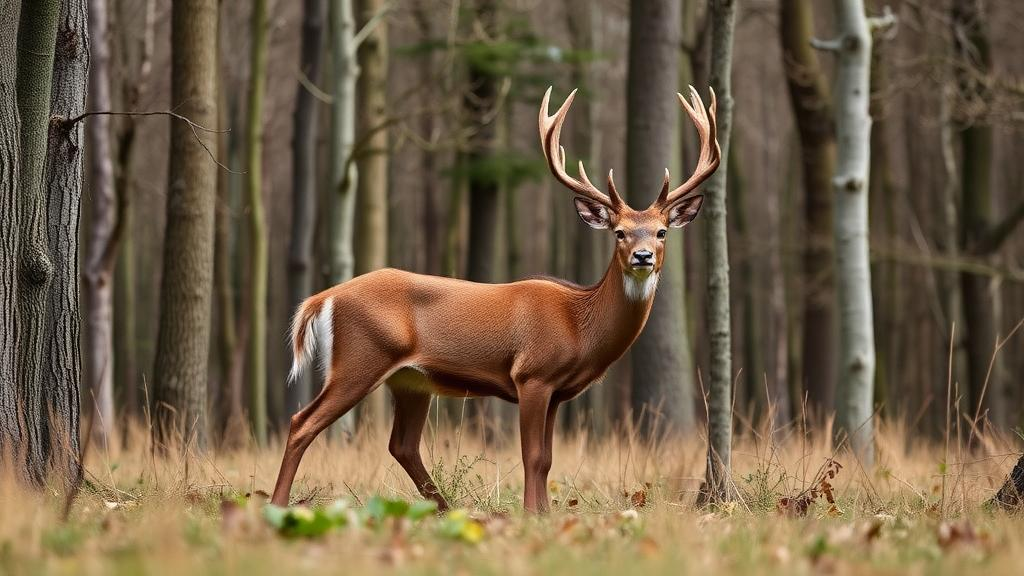
Across the temperate broadleaved forests of Western Europe, foresters are betting the next century on a simple idea: mix things up. Plant more species, open the canopy in patches, let stands grow uneven in age and structure, and the forest will be better armed against heat, drought and the other shocks of a changing climate. A new modelling study from Belgium, published in Regional Environmental Change, delivers a sobering caveat to that strategy. Diversification works, the research finds, but only if deer and other hoofed mammals are kept in check. Under heavy browsing pressure, the ecological and economic advantages of diversification essentially evaporate, leaving even the most forward-looking management plans unable to deliver balanced outcomes.
The study, led by Mathilde Pau of the University of Liège’s Gembloux Agro-Bio Tech together with colleagues at UCLouvain, the Canadian Forest Service and INRAE, used a process-based forest model called HETEROFOR to peer 120 years into the future. Unlike purely statistical growth models, HETEROFOR simulates individual trees, tracking carbon fluxes, water cycling, light competition and tree-to-tree interactions in spatially explicit stands. That level of detail matters when the question is not simply whether a forest survives, but whether it regenerates, produces timber, stores carbon and maintains a varied structure under the combined stresses of warming and herbivory.
The researchers ran their simulations across six representative stands typical of Western European broadleaved forests dominated by European beech (Fagus sylvatica) and oaks (Quercus species). These are the workhorses of temperate European forestry, ecologically and economically, and they are increasingly vulnerable. Climate change is already altering growth patterns across the continent, with drought and heat events linked to declining vitality in beech in particular. At the same time, populations of red deer, roe deer and wild boar have risen sharply in many regions, and their browsing on seedlings and saplings can quietly erase an entire generation of trees long before foresters notice the gap.
To capture this interplay, the team built a factorial experiment of unusual scope. Each stand was simulated under three climate scenarios drawn from the shared socio-economic pathways: SSP1-2.6 representing low warming, SSP2-4.5 an intermediate trajectory, and SSP3-7.0 a high-warming future. On top of that, they applied four levels of ungulate browsing pressure, from negligible to intense. And across all of these combinations they tested three silvicultural strategies: a business-as-usual even-aged approach mirroring current practice in the studied public forests; an oak-oriented strategy promoting moderate species diversification; and a more ambitious diversification scheme combining species enrichment with increased structural heterogeneity, the kind of close-to-nature management many European foresters advocate as the path to resilience.
Performance was judged with 32 indicators, distilled into six scores covering productivity, profitability, economic sustainability, carbon storage, species diversity and structural diversity. This multidimensional scorecard is what makes the study’s central finding so striking. The diversification strategies did exactly what their proponents promise: they enhanced species diversity while keeping the forest economically sustainable. But their benefits were strongly conditional on browsing pressure. Under low to moderate ungulate densities, diversification delivered the best balance of ecological and economic outcomes. Under high browsing intensity, those advantages vanished, and the diversified stands suffered marked declines in productivity, carbon storage, economic sustainability, and both species and structural diversity.
The reason lies in the biology of regeneration. Diversification strategies depend on successfully establishing a wider range of tree species, many of which are precisely the seedlings deer prefer to eat. Palatable species such as oaks and various broadleaved companions face a browsing gauntlet that unpalatable or simply more abundant competitors may escape. When deer numbers are high, the carefully planted or naturally recruited mixture collapses toward whatever the animals leave behind, undermining both the species mix and the structural complexity the strategy was designed to create. Even-aged conventional management, by contrast, proved less sensitive to browsing, partly because large clearcut-style regenerations can overwhelm browsers with sheer seedling numbers, but it produced the lowest species diversity of the three approaches, locking forests into a less adaptable future.
The economic dimension adds a layer of urgency. Diversification is expensive: it requires more labour, more planting, more careful tending, and it delays returns compared with conventional even-aged forestry. Economic uncertainty is a major reason adoption remains limited despite widespread scientific endorsement. The study’s results suggest that foresters and policymakers who invest in diversification while ignoring ungulate management may be pouring resources into forests that cannot convert that investment into actual diversity. Conversely, where browsing pressure is genuinely low, the simulations indicate diversification can pay off across nearly the whole scorecard, from carbon to profitability.
These findings arrive at a moment when European forest policy is pushing hard toward mixed, structurally complex stands. The rationale is well supported: diverse forests tend to resist disturbances better, buffer drought through complementary water use, support more biodiversity and may store carbon more reliably. But the Belgian study adds a crucial third variable to the equation. Climate scenarios alone did not determine outcomes; the interaction between climate, management and browsing did. A forest could be given the right species mix and the right structure on paper, yet fail to regenerate into that vision if ungulates browse the future away. The authors emphasize that diversification alone is unlikely to ensure forest adaptation where ungulate pressure remains high.
The implications reach well beyond Belgium. Rising ungulate densities are a continent-wide phenomenon, driven by factors including reduced hunting pressure in some areas, milder winters, abundant forest-edge habitat and fragmented landscapes that favour deer. Previous research has documented how browsing shapes climate-change impacts on forest biodiversity elsewhere in Europe, and how ungulate herbivory can manipulate vegetation trajectories for decades. What this study adds is a quantitative, forward-looking framework that puts herbivory on equal footing with climate and management in long-term forest projections, something few simulation studies have attempted at this resolution.
For forest managers, the practical message is a sequencing one: get ungulate pressure under control first, or at least simultaneously, before committing to costly diversification programs. That may mean coordinated hunting regimes, fencing, or landscape-level population management, all of which carry their own social and economic challenges. For scientists, the study demonstrates the value of process-based, tree-level models like HETEROFOR for stress-testing management strategies against multiple simultaneous uncertainties rather than one factor at a time. And for anyone who imagines that planting the right trees is enough to climate-proof a forest, the Belgian Ardennes offer a cautionary tale: the forest of 2146 will be written not only by the seeds foresters choose, but by what the deer leave standing.
Subject of Research: Silvicultural diversification, ungulate browsing and climate change effects on temperate broadleaved forest regeneration
Article Title: Impact of contrasting silvicultural strategies on broadleaved forest regeneration under various levels of ungulate pressure and changing climate in Belgium
Article References: Pau, M., Jonard, M., André, F., Fortin, M., de Coligny, F., & Ligot, G. (2026). Impact of contrasting silvicultural strategies on broadleaved forest regeneration under various levels of ungulate pressure and changing climate in Belgium. Regional Environmental Change, 26(4), Article 190. https://doi.org/10.1007/s10113-026-02673-0
Image Credits: AI Generated
DOI: 10.1007/s10113-026-02673-0
Keywords: forest regeneration, silviculture, climate change, ungulate browsing, forest diversification, HETEROFOR model, beech, oak, Belgium, carbon storage, forest management, species diversity
Cite Scienmag News
Sloane Callahan. (October 1, 2026). Deer May Undo the Forests of the Future: Diversity Alone Cannot Save Europe’s Woods. Scienmag. https://scienmag.com/deer-may-undo-the-forests-of-the-future-diversity-alone-cannot-save-europes-woods/
Sloane Callahan. "Deer May Undo the Forests of the Future: Diversity Alone Cannot Save Europe’s Woods." Scienmag, 1 October 2026, https://scienmag.com/deer-may-undo-the-forests-of-the-future-diversity-alone-cannot-save-europes-woods/. Accessed 5 October 2026.
Sloane Callahan. "Deer May Undo the Forests of the Future: Diversity Alone Cannot Save Europe’s Woods." Scienmag. October 1, 2026. https://scienmag.com/deer-may-undo-the-forests-of-the-future-diversity-alone-cannot-save-europes-woods/


