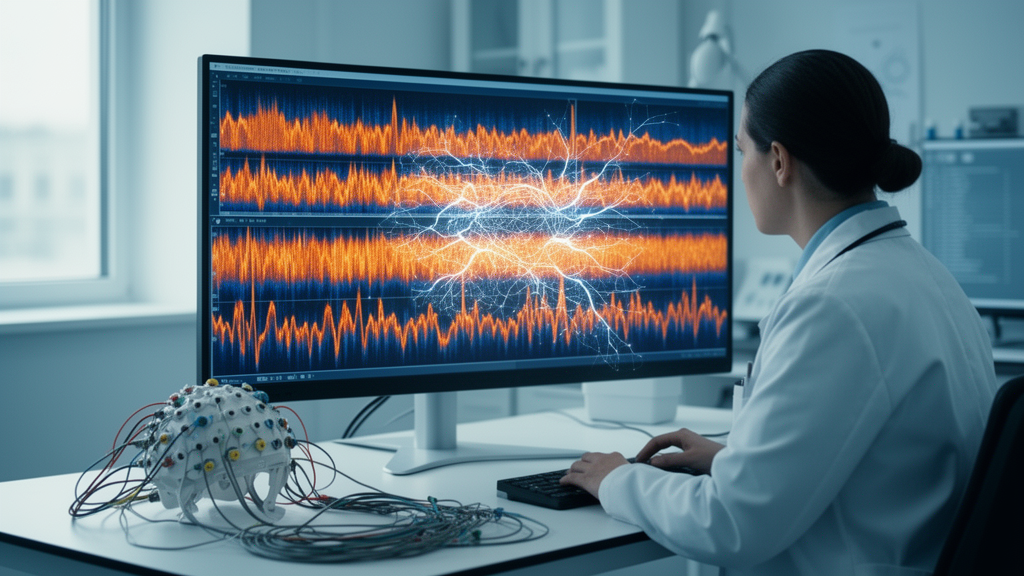
Automated seizure classification from electroencephalography (EEG) has long been hampered by the complexity of brain signals and the way seizure patterns differ from one patient to another. A new study reports that converting EEG recordings into two-dimensional time-frequency images and feeding them to deep learning models can improve the classification of seizure types, with the best configurations reaching accuracies of roughly 78 to 80 percent.
The research, published in BioData Mining, used EEG data from the Temple University Hospital (TUH v2.0.1) dataset covering three signal categories: background activity, focal seizures, and generalized seizures. The signals were first pre-processed and segmented, and each segment was then transformed into a two-dimensional time-frequency image using one of three techniques: the Short-Time Fourier Transform (STFT), the Mel-spectrogram, and the Continuous Wavelet Transform (CWT).
This allows architectures designed for image recognition, such as convolutional neural networks, to be applied directly to EEG data.
The team developed and evaluated nine deep learning architectures for the classification task. The list included AlexNet, VGGNet, a configurable Convolutional Neural Network (cCNN), a configurable Recurrent Neural Network, a configurable Long Short-Term Memory (LSTM) network, a CNN-LSTM hybrid, a CNN with Bidirectional LSTM, a Residual Bidirectional LSTM model, and the Swin Transformer.
Performance was reported across standard metrics including accuracy, precision, recall, F1-score, false positive rate, and area under the curve, together with standard deviations and 95 percent confidence intervals.
Continuous wavelet transform images classified by the configurable CNN achieved an accuracy of 77.22 percent, with a standard deviation of 5.68 percent and a 95 percent confidence interval of 73.32 to 80.55. Mel-spectrogram images classified by AlexNet performed slightly better, reaching 79.83 percent accuracy with a standard deviation of 2.81 percent and a 95 percent confidence interval of 78.20 to 81.41.
The authors conclude that the combination of Mel-based time-frequency features with AlexNet, and of CWT representations with the cCNN model, proved most effective for distinguishing seizure types in this dataset. They suggest that deep learning combined with time-frequency analysis can contribute to the development of reliable EEG-based seizure classification systems.
The study’s scope is worth keeping in mind. The work was conducted on a single hospital dataset with three signal classes, and the reported accuracies, while consistent across the cross-validation folds, still leave room for error in clinical settings. The published version is an early-release, peer-reviewed accepted manuscript that remains subject to further editorial edits before the final version of record appears. The authors present the approach as a step toward automated tools that could eventually assist clinicians in interpreting EEG recordings, rather than as a system ready for immediate diagnostic use.
Subject of Research: Deep learning classification of seizure types from time-frequency representations of EEG signals
Article Title: Deep learning-based EEG seizure classification using comparative time–frequency spectral representations
Article References: Mewada, P., Siddartha, K. M., Kumar, P. S., Gabriel, R., Sainidhi, V. V. S. N., Yuvaraj, R., Thomas, J., Karthik, P. A., & Ronickom, J. F. A. (2026). Deep learning-based EEG seizure classification using comparative time–frequency spectral representations. BioData Mining. https://doi.org/10.1186/s13040-026-00613-6
Image Credits: AI Generated
DOI: 10.1186/s13040-026-00613-6
Keywords: EEG, seizure classification, deep learning, time-frequency analysis, Mel spectrogram, continuous wavelet transform, AlexNet, convolutional neural network, Swin Transformer, Temple University Hospital dataset, epilepsy, cross-validation
Cite Scienmag News
Blake Davidson. (October 28, 2026). Deep learning reads EEG spectrograms to sort seizure types. Scienmag. https://scienmag.com/deep-learning-reads-eeg-spectrograms-to-sort-seizure-types/
Blake Davidson. "Deep learning reads EEG spectrograms to sort seizure types." Scienmag, 28 October 2026, https://scienmag.com/deep-learning-reads-eeg-spectrograms-to-sort-seizure-types/. Accessed 28 October 2026.
Blake Davidson. "Deep learning reads EEG spectrograms to sort seizure types." Scienmag. October 28, 2026. https://scienmag.com/deep-learning-reads-eeg-spectrograms-to-sort-seizure-types/