


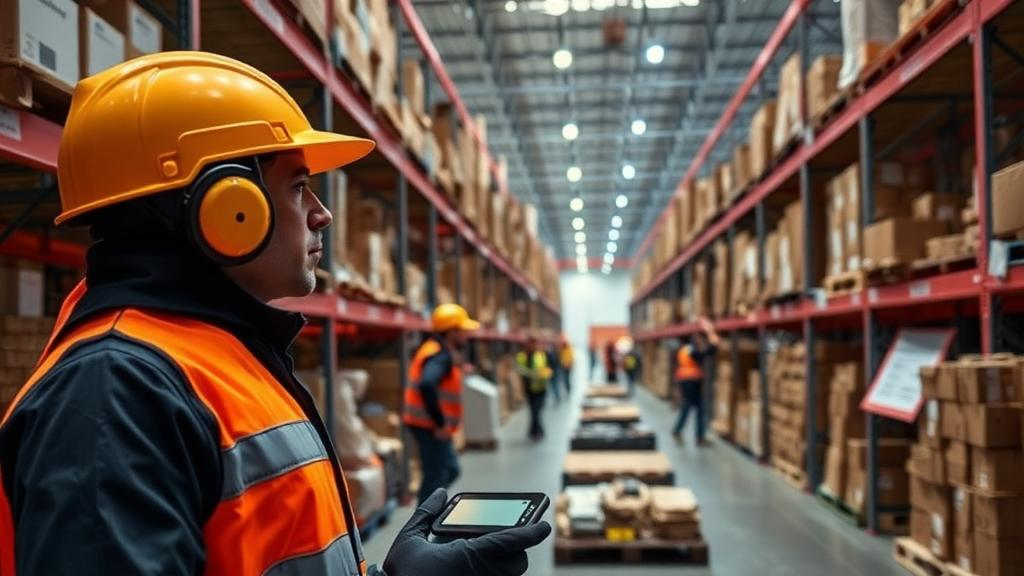
E-commerce warehouses have become some of the busiest workplaces on the planet. In China alone, express delivery volume exceeded 150 billion parcels in 2025, with more than 400 million packages processed every single day. Behind those numbers sit vast, highly automated storage facilities that run around the clock, where forklifts, conveyor systems, dense racks of goods and crowds of workers share the same floor. That combination has made safety management one of the industry’s most pressing problems, and a new study suggests that artificial intelligence trained to watch human movement could become the industry’s watchful eye.
Researchers Yanxia Ma and Yufeng Zou of Shanghai Sipo Polytechnic have developed a deep learning pipeline that identifies abnormal worker behaviors in warehouse surveillance footage, reporting their results in the open-access journal Discover Artificial Intelligence. Their system chains together three neural network components: one that finds and locates people in each video frame, one that converts each detected person into a stick-figure skeleton of seventeen joints, and one that reads the motion of that skeleton over consecutive frames to decide whether the person is operating normally, falling, colliding with a colleague, or climbing on storage racks.
The first stage relies on YOLOv5, a member of the You Only Look Once family of object detectors. The authors deliberately chose version 5 over its newer successors, YOLOv6 through YOLOv8, arguing that the later versions’ structural refinements buy extra accuracy at the cost of substantially longer training times, which slows down model iteration and deployment. For warehouse monitoring, where small targets and rapid retraining matter more than squeezing out the last percentage point of precision, YOLOv5 struck the right balance. Architecturally, the model splits into a backbone that extracts convolutional features at multiple scales using CBS modules, C3 bottleneck blocks and a spatial pyramid pooling fast module; a neck that fuses features from different scales through upsampling; and a head that regresses candidate bounding boxes back onto the original image coordinates to localize each worker.
Once a worker is boxed, the second stage extracts their pose using a two-branch, multi-stage network in the style of OpenPose. One branch predicts part confidence maps, heat maps that estimate where each skeleton joint sits in the image, while the other predicts part affinity fields, vector maps that encode the direction in which adjacent joints should be connected. Each stage refines the estimates of the previous one, with the original image features fed in repeatedly, and training is driven by a summed loss that compares predicted heat maps and affinity fields against manually annotated ground truth, masked by a binary function that ignores unannotated regions. YOLOv5 supplies the image features inside each bounding box, tying the two stages together.
The third stage classifies action types from skeletal data accumulated over consecutive frames. The researchers normalize joint coordinates, remove head joints and fill in missing points, then derive features including joint positions and movement speeds. These flow into a back-propagation neural network, a classic fully connected architecture with input, hidden and output layers whose hidden-layer activation functions fit the nonlinear patterns linking skeleton dynamics to behavior labels.
To test the system, the team drew on a week of surveillance video from a logistics company recorded in November 2025, covering warehousing zones, goods handling areas and shelf areas, with footage of normal operations as well as genuine falls, collisions and illegal climbing. After discarding blurred, occluded or empty segments and sampling one frame in every thirty, they assembled 20,000 valid images, split into 12,000 training and 8,000 test samples, with single-person and multi-person scenarios kept separate throughout. Annotators marked bounding boxes, seventeen key joints from head to ankles with connecting limb lines, and behavior labels; a cross-review pass removed mislabeled samples. Experiments ran on a laboratory server with a Core i7 processor, an RTX 4060 graphics card and 32 gigabytes of memory.
The benchmarks pitted each stage of the proposed system against established alternatives. For person detection and localization, YOLOv5 outperformed R-CNN, YOLOv3 and a fully convolutional neural network, and it was notably the most stable when moving from single-person to multi-person images, a scenario in which the competitors’ performance visibly declined. For skeleton extraction, the proposed pose network produced smaller joint-point errors than the CPM and CPN algorithms in both scenarios. For action classification, the BPNN beat both a support vector machine and a random forest, with the SVM faring worst. Performance was quantified with precision, recall, F-score and intersection-over-union, with each algorithm tested three times and results reported as means with standard deviations.
Ablation experiments underscored why the full pipeline matters. Stripping out YOLOv5 and asking the skeleton network to work on raw images degraded results, because cluttered warehouse backgrounds and passing colleagues inject noise that accurate framing of the target removes. Removing skeleton extraction and classifying from raw image features hurt even more, confirming that articulated pose is the core feature representation. And swapping the BPNN for an SVM under identical front-end modules lowered classification quality, which the authors attribute to the neural network’s stronger nonlinear fitting on high-dimensional skeleton time series, particularly in crowded scenes.
The practical payoff, the researchers argue, is a shift from reactive to proactive warehouse safety. A fall can leave an injured worker unattended while blocking colleagues; collisions damage goods and sour teamwork; climbing racks loads shelving beyond its design and can trigger collapses and property losses. A system that flags these behaviors the moment they appear on camera can summon help to a fallen worker, mediate a collision before it escalates, and warn off anyone scaling the shelves, all without waiting for a human supervisor to happen to be watching the right monitor at the right moment.
Limitations remain. The validation rested on one week of footage from a single company processed in simulation on modest hardware, and the study focused exclusively on personnel behavior rather than the fire, shelf-structure and dangerous-goods scenarios the authors identify as the other pillars of intelligent warehouse safety. Still, by fusing detection, pose estimation and classification into one stable pipeline that holds up in multi-person images, the work sketches a plausible near future in which the same cameras that watch inventory also watch out for the people moving it.
Subject of Research: Deep learning-based recognition of abnormal personnel behaviors in e-commerce warehouse safety management
Article Title: Research on intelligent safety management of e-commerce logistics storage through a deep learning model
Article References: Ma, Y., & Zou, Y. (2026). Research on intelligent safety management of e-commerce logistics storage through a deep learning model. Discover Artificial Intelligence, 6(1), Article 1347. https://doi.org/10.1007/s44163-026-02236-6
Image Credits: AI Generated
DOI: 10.1007/s44163-026-02236-6
Keywords: deep learning, YOLOv5, skeleton extraction, action recognition, warehouse safety, e-commerce logistics, surveillance, computer vision, BPNN, pose estimation, abnormal behavior detection, logistics
Cite Scienmag News
Blake Davidson. (October 11, 2026). Deep learning model watches warehouse workers to spot dangerous moves in real time. Scienmag. https://scienmag.com/deep-learning-model-watches-warehouse-workers-to-spot-dangerous-moves-in-real-time/
Blake Davidson. "Deep learning model watches warehouse workers to spot dangerous moves in real time." Scienmag, 11 October 2026, https://scienmag.com/deep-learning-model-watches-warehouse-workers-to-spot-dangerous-moves-in-real-time/. Accessed 11 October 2026.
Blake Davidson. "Deep learning model watches warehouse workers to spot dangerous moves in real time." Scienmag. October 11, 2026. https://scienmag.com/deep-learning-model-watches-warehouse-workers-to-spot-dangerous-moves-in-real-time/


