Thursday, October 29, 2026
Science
No Result
View All Result
  • Login
  • HOME
  • SCIENCE NEWS
  • CONTACT US
  • HOME
  • SCIENCE NEWS
  • CONTACT US
No Result
View All Result
Scienmag
No Result
View All Result
Home Science News Medicine

Deep learning maps ventilator-associated pneumonia on CT and predicts mortality risk

October 29, 2026
in Medicine
Ophelia Keating
By Ophelia Keating Scienmag Editorial Profile - Health Services Research
Reading Time: 3 mins read
0
Deep learning maps ventilator-associated pneumonia on CT and predicts mortality risk

Deep learning maps ventilator-associated pneumonia on CT and predicts mortality risk

65
SHARES
587
VIEWS
Share on FacebookShare on Twitter
ADVERTISEMENT

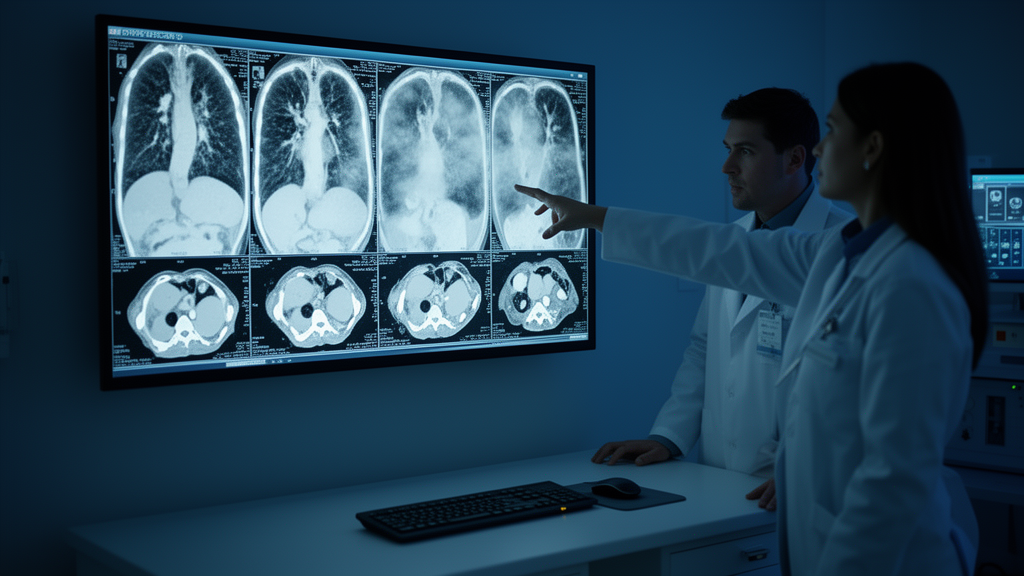
A multimodal deep-learning framework can segment pneumonia lesions on chest CT scans, classify radiological findings, and grade the overall burden of disease in patients with ventilator-associated pneumonia, according to a retrospective study published in Frontiers in Medicine. In a cohort of 512 patients clinically diagnosed with the condition, the model’s radiological burden grade remained significantly associated with 28-day mortality even after adjustment for clinical covariates including APACHE II score, with a hazard ratio of 2.34 (P < 0.001).

Ventilator-associated pneumonia is a major complication in the intensive care unit, and the study’s authors argue that objective computed tomography assessment is needed to complement clinical evaluation. The framework was designed to perform three tasks simultaneously: voxel-level lesion segmentation, multi-label classification of radiological findings, and grading of radiological burden.

Technically, the system combines several components. Anatomical priors from TotalSegmentator help the network understand lung and thoracic structure. A three-dimensional Swin UNETR multi-task network carries out the segmentation and classification work, and a cross-attention fusion mechanism integrates CT image features with ventilation parameters drawn from the patients’ clinical monitoring.

Internal validation produced a Dice score of 0.847 for lesion segmentation, a macro-average area under the receiver operating characteristic curve of 0.919 for the classification tasks, and a weighted kappa of 0.826 for burden grading. External validation on separate data yielded a Dice score of 0.821, and the researchers report no significant differences in performance across scanner manufacturers, suggesting the segmentation component is reasonably robust to hardware variation.

The prognostic finding is the study’s central clinical claim. After adjusting for clinical covariates, including the APACHE II severity score, patients at higher radiological burden grades showed a significantly higher hazard of death within 28 days, with the model-derived grade independently associated with mortality. The authors present this as evidence of the grade’s potential prognostic relevance rather than as proof that the tool changes outcomes.

Several limitations frame these results. The study was retrospective and enrolled only patients already clinically diagnosed with ventilator-associated pneumonia, so the findings do not establish diagnostic performance in undifferentiated ICU patients. The reported associations are observational; the model’s burden grade is a measured imaging feature, and the mortality link is a statistical association from a hazard model, not a demonstrated causal effect or a validated prediction tool deployed at the bedside.

External validation, while performed, covered segmentation performance, and the full generalizability of the classification and grading components across institutions, patient populations, and ventilation practices would require further prospective testing. The article is an original research publication by Fuwen Zheng and Andee Dzulkarnaen Zakaria of Universiti Sains Malaysia, received in August 2026 and accepted in September 2026.

A reproducible burden grade that carries prognostic information beyond established severity scores could help stratify patients in future studies, though any clinical use would depend on validation beyond this retrospective cohort.

Subject of Research: Deep-learning analysis of chest CT for lesion segmentation and prognostic burden grading in ventilator-associated pneumonia

Article Title: Deep learning–based CT lesion analysis and radiological burden stratification in clinically diagnosed ventilator-associated pneumonia

Article References: Zheng, F., & Zakaria, A. D. (2026). Deep learning–based CT lesion analysis and radiological burden stratification in clinically diagnosed ventilator-associated pneumonia. Frontiers in Medicine, 13, Article 1966805. https://doi.org/10.3389/fmed.2026.1966805

Image Credits: AI Generated

DOI: 10.3389/fmed.2026.1966805

Keywords: ventilator-associated pneumonia, deep learning, chest CT, image segmentation, intensive care unit, Swin UNETR, TotalSegmentator, radiological burden, 28-day mortality, APACHE II, medical imaging, prognosis

Cite Scienmag News

Ophelia Keating. (October 29, 2026). Deep learning maps ventilator-associated pneumonia on CT and predicts mortality risk. Scienmag. https://scienmag.com/deep-learning-maps-ventilator-associated-pneumonia-on-ct-and-predicts-mortality-risk/


Ophelia Keating. "Deep learning maps ventilator-associated pneumonia on CT and predicts mortality risk." Scienmag, 29 October 2026, https://scienmag.com/deep-learning-maps-ventilator-associated-pneumonia-on-ct-and-predicts-mortality-risk/. Accessed 29 October 2026.

Ophelia Keating. "Deep learning maps ventilator-associated pneumonia on CT and predicts mortality risk." Scienmag. October 29, 2026. https://scienmag.com/deep-learning-maps-ventilator-associated-pneumonia-on-ct-and-predicts-mortality-risk/

Tags: 28-day mortalityadvanced imaging techniques for ICU pneumonia managementAI-driven prognosis of ventilator-associated pneumoniaAPACHE IIchest CTCT-based assessment of pneumonia severitydeep learningdeep learning CT analysisdisease burden grading in pneumoniaimage segmentationintegrated clinical and imaging analysis for pneumoniaintensive care unitMedical Imagingmortality risk prediction in ventilator-associated pneumoniamultimodal deep learning models for lung imagingpneumonia lesion segmentationprognosisradiological burdenradiological findings classificationSwin UNETRTotalSegmentatorventilator-associated pneumoniaVentilator-associated pneumonia diagnosisvoxel-level lesion segmentation in chest CT
Share26Tweet16
Previous Post

Physics-guided AI turns sparse GPS and camera data into citywide traffic volumes

Next Post

Upskirting on London’s rail network clusters at rush hour but rarely ends in charges

Related Posts

Machine Learning Predicts ICU Deaths in PAD Patients, but Hemodynamics Add Little
Medicine

Machine Learning Predicts ICU Deaths in PAD Patients, but Hemodynamics Add Little

October 29, 2026
Common Shrinkage Formula for Prediction Models Is Biased, Simulation Study Finds
Medicine

Common Shrinkage Formula for Prediction Models Is Biased, Simulation Study Finds

October 29, 2026
Nearly Half of HIV Patients in Nigerian Cohort Hit First Drug Reaction Within 13 Months
Medicine

Nearly Half of HIV Patients in Nigerian Cohort Hit First Drug Reaction Within 13 Months

October 29, 2026
Virtual Reality Falls Short of Standard Scans in Pancreatic Cancer Surgery Planning Trial
Medicine

Virtual Reality Falls Short of Standard Scans in Pancreatic Cancer Surgery Planning Trial

October 29, 2026
Eye surgery for thyroid disease shifts vision for months, study finds
Medicine

Eye surgery for thyroid disease shifts vision for months, study finds

October 29, 2026
Next-generation KRAS inhibitor divarasib extends survival in advanced lung cancer
Medicine

Next-generation KRAS inhibitor divarasib extends survival in advanced lung cancer

October 29, 2026
Next Post
Upskirting on London’s rail network clusters at rush hour but rarely ends in charges

Upskirting on London's rail network clusters at rush hour but rarely ends in charges

  • Mothers who receive childcare support from maternal grandparents show more optimized

    Mothers who receive childcare support from maternal grandparents show more parental warmth, finds NTU Singapore study

    27656 shares
    Share 11059 Tweet 6912
  • University of Seville Breaks 120-Year-Old Mystery, Revises a Key Einstein Concept

    1061 shares
    Share 424 Tweet 265
  • Bee body mass, pathogens and local climate influence heat tolerance

    682 shares
    Share 273 Tweet 171
  • Researchers record first-ever images and data of a shark experiencing a boat strike

    546 shares
    Share 218 Tweet 137
  • Groundbreaking Clinical Trial Reveals Lubiprostone Enhances Kidney Function

    531 shares
    Share 212 Tweet 133
Science

Embark on a thrilling journey of discovery with Scienmag.com—your ultimate source for cutting-edge breakthroughs. Immerse yourself in a world where curiosity knows no limits and tomorrow’s possibilities become today’s reality!

RECENT NEWS

  • Soil Bacterium Boosts Saffron Yield and Quality, But Location and Ecotype Decide How Much
  • Robot NAO Learns to Plug Itself In With a Low-Cost Autonomous Charging Dock
  • Machine Learning Predicts ICU Deaths in PAD Patients, but Hemodynamics Add Little
  • Research report: Reactive compatibilization strategies for mixed polyolefin waste toward food packaging applications

Categories

  • Agriculture
  • Anthropology
  • Archaeology
  • Athmospheric
  • Biology
  • Biotechnology
  • Blog
  • Bussines
  • Cancer
  • Chemistry
  • Climate
  • Earth Science
  • Editorial Policy
  • Marine
  • Mathematics
  • Medicine
  • Pediatry
  • Policy
  • Psychology & Psychiatry
  • Science Education
  • Science News
  • Social Science
  • Space
  • Technology and Engineering

Subscribe to Blog via Email

Enter your email address to subscribe to this blog and receive notifications of new posts by email.

Join 5,150 other subscribers

© 2025 Scienmag - Science Magazine

Welcome Back!

Login to your account below

Forgotten Password?

Retrieve your password

Please enter your username or email address to reset your password.

Log In
No Result
View All Result
  • HOME
  • SCIENCE NEWS
  • CONTACT US

© 2025 Scienmag - Science Magazine

Discover more from Science

Subscribe now to keep reading and get access to the full archive.

Continue reading