


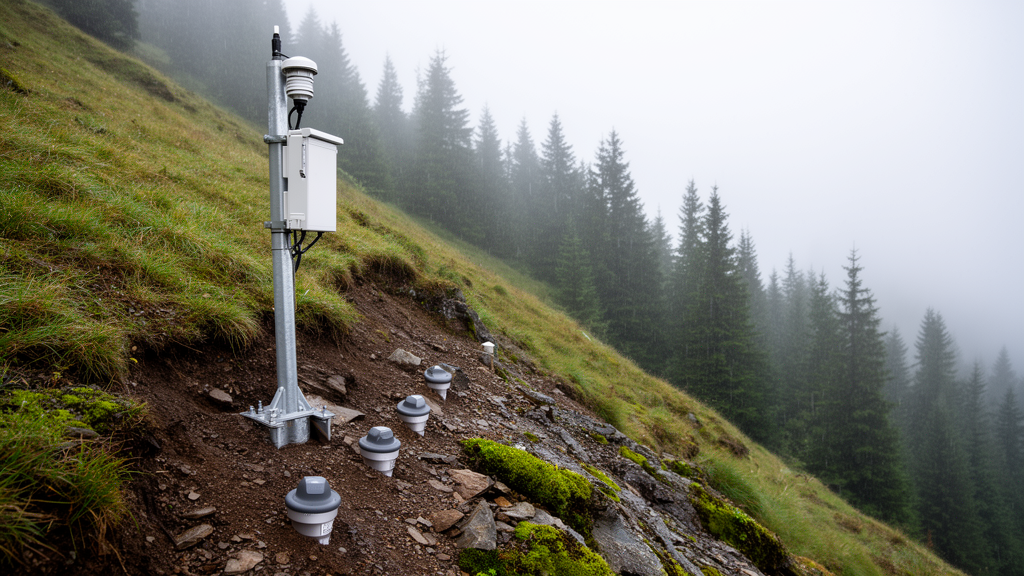
Continuous real-time surveillance of unstable mountainsides represents a crucial line of defense for safeguarding vulnerable communities, yet distributed geotechnical instrumentation frequently overwhelms human operators with nuisance alarms. In steep, rain-lashed mountainous regions such as Fujian Province in southeastern China, small-scale slope failures, defined by regulatory classifications as landslides under one hundred thousand cubic meters or collapses under ten thousand cubic meters, develop with extraordinary rapidity once soil shear strength deteriorates under heavy precipitation. To capture the earliest physical indications of ground failure, geotechnical agencies install automated Internet of Things crackmeters directly across rear tension cracks identified during field surveys. Operating at variable frequencies that reach up to one measurement per second with a resolution of a tenth of a millimeter, these digital instruments record localized crack dilation in real time. However, the operational utility of these automated networks is severely undermined by environmental interference, animal contact, human disturbance, and instrumental noise, which routinely trigger predefined displacement thresholds and flood management centers with false positives.
The operational scale of this false alarm crisis is demonstrated by historical monitoring records documented between 2020 and 2024 by the Fujian Provincial Geological Hazard Early Warning Platform. Across this four-year observation window, the operational regional platform logged approximately 2.05 million threshold-triggered device alerts from distributed field sensors. Following exhaustive manual analysis, geological expert assessments, and physical on-site field verifications, slightly more than five hundred alerts across all monitoring devices, including slightly more than one hundred crackmeter alerts, were confirmed as genuine geohazard deformations. This discrepancy corresponds to an overall effective true warning rate of less than 0.03 percent, creating severe alarm fatigue and placing an unsustainable analytical burden on operational monitoring staff. Standard trigger protocols establish site-specific, four-level warning tiers, typically categorized as blue, yellow, orange, and red, based on cumulative displacement thresholds or comparative daily variation limits. While these sensitive rule-based thresholds capture critical events and maintain high safety recall, their inability to differentiate authentic mechanical movement from transient noise spikes creates persistent systemic vulnerability.
To overcome these systemic operational bottlenecks, researchers developed an integrated binary classification framework designed to assess sensor alerts in real time without human intervention. The investigation assembled an extensive field-verified dataset encompassing 429 crackmeters deployed across 345 monitored landslide and collapse masses throughout Fujian, 342 of which were confirmed small-scale slopes. Within this monitoring inventory, rainfall was identified as the dominant triggering agent, with nearly one-third of the unstable masses exhibiting sliding thicknesses of less than two meters. From this operational record, 380 monitoring sensors provided a repository of 2,142 confirmed false alarm instances caused by non-geological anomalies. In contrast, rigorous field inspections confirmed only 82 genuine deformation instances from 52 sensors. Because deep neural architectures require adequate positive examples to generalize effectively, researchers carefully screened temporally adjacent measurements surrounding the confirmed events, identifying 173 additional crack-opening responses that were validated by a panel of three geological experts to yield an augmented corpus of 255 true early warnings.
To prevent data leakage during model training and evaluation, the research team instituted strict sensor-level isolation protocols across all validation and test partitions. Rather than randomly partitioning individual warning records or localized temporal segments, entire physical sensors were assigned exclusively to either the training-validation subset or the independent test set in an approximate one-to-one ratio. This sensor-disjoint architecture ensured that the evaluation phase measured genuine cross-site generalization on entirely unseen physical instruments rather than memorizing localized geological peculiarities. The resulting predictive architecture, designated PatchDC, incorporates a patch-based dual-branch deep temporal Transformer explicitly engineered to address the asynchronous, multi-rate nature of slope monitoring data. Real-time crackmeters generate variable-frequency displacement streams up to one hertz, whereas regional rain gauges record cumulative precipitation at fixed hourly intervals. The dual-branch architecture decouples these distinct temporal dynamics into specialized processing pathways, capturing both long-term hydrometeorological interactions and high-resolution kinematic shifts immediately preceding an alert.
The first structural pathway of the PatchDC architecture, designated the Long-Term Rainfall-Displacement Modeling Branch, operates over a standardized 360-hour retrospective temporal window. This fifteen-day historical window captures extended multi-day antecedent rainfall accumulation and delayed groundwater responses without diluting recent hydro-mechanical relationships through overly expansive timeframes. Input sequences encompass hourly median displacement measurements, missing value imputation masks, and normalized hourly precipitation accumulations, alongside derived statistical indicators including interquartile ranges and absolute displacement magnitudes. To characterize regional meteorological extremity, researchers formulated a dimensionless relative maximum rainfall intensity metric, scaling the peak single-hour rainfall within the fifteen-day window against the localized five-year mean annual precipitation derived from high-resolution national monthly precipitation grids. Within this primary branch, a Hybrid Feature Processing module applies a shared multilayer perceptron across rainfall, displacement, and missing value channels, explicitly synthesizing cross-variable dependencies before forwarding latent tokens into the temporally aware Transformer backbone.
Operating synchronously alongside the long-term hydrometeorological pathway, the High-Resolution Crack Displacement Branch focuses exclusively on fine-grained kinematic dynamics immediately prior to threshold exceedance. This secondary branch ingests a consecutive sequence of one hundred raw displacement observations leading up to the trigger point, spanning native sub-hourly durations that typically represent roughly one hundred minutes of operational monitoring. By feeding these non-interpolated high-frequency signals, alongside their corresponding interquartile ranges and absolute displacement magnitudes, into an identical masked Transformer backbone, the network preserves authentic sub-hourly deformation dynamics without distortion from data interpolation. In both branches, the Transformer encoders replace traditional bidirectional self-attention mechanisms with directional masked multi-head attention. By enforcing a lower-triangular attention mask that assigns negative infinity attention scores to subsequent temporal indices, the model architecturally prohibits future displacement observations from leaking into antecedent time steps, strictly preserving the physical temporal sequence connecting preparatory rainfall infiltration to subsequent geotechnical displacement.
Model training was executed across a five-fold cross-validation scheme utilizing Bayesian hyperparameter optimization powered by the Optuna framework with a Tree-structured Parzen Estimator. To align training dynamics with safety-critical geohazard standards, optimization trials maximized the positive-class F2-score, which assigns greater mathematical weight to hazard recall than to precision. Loss calculations integrated fold-specific positive weights derived from the negative-to-positive training distribution, preventing gradient bias toward majority false-alarm samples. When compared directly against competitive benchmark models adapted with identical dual-branch structures, PatchDC consistently demonstrated superior discriminative capabilities, exceeding standard patch-based Transformer baselines in recall by 6.562 percentage points and outperforming conventional recurrent neural networks, temporal convolutional networks, linear decomposition frameworks, and inverted Transformers.
Comprehensive inferential validation confirmed that the performance advantages of the dual-branch framework remained statistically robust under diverse uncertainty analyses. Fixed-prediction paired sensor bootstrap iterations demonstrated that improvements in recall, F2-score, overall accuracy, and precision-recall area maintained confidence intervals entirely excluding zero during sensor resampling. Paired t-tests across five random-seed ensemble initializations confirmed that recall and F2-score gains were statistically significant after Holm correction, yielding adjusted p-values of 0.00407 and 0.00253, respectively. When compared with traditional machine learning models using handcrafted physical features, PatchDC surpassed random forest architectures, which achieved strong precision but suffered severe recall deficits of 24.54 percentage points. Furthermore, an empirical Bayesian rainfall intensity-duration threshold baseline captured high recall but produced a disastrous precision of only 18.62 percent, underscoring the operational hazards of relying solely on meteorological triggers without validating corresponding physical ground displacement.
Ablation experiments and interpretability analyses illuminated the precise internal mechanisms driving the model’s discriminative success. Incorporating the Hybrid Feature Processing module into the baseline architecture increased recall by 5.16 percentage points by capturing joint rainfall-displacement dynamics, while directional masked self-attention added 2.50 percentage points of recall by enforcing temporal integrity. Normalized absolute Softmax weight contrasts across 25 independent model checkpoints revealed that high-resolution raw displacement sequences served as the most influential feature, ranking first in 48 percent of training iterations and within the top three in 68 percent of runs. The fused rainfall-displacement representation ranked second in overall importance, followed by hourly rainfall accumulation and relative maximum rainfall intensity. This learned structural hierarchy mirrors professional geological reasoning, wherein distinct progressive upward movement in recent high-frequency sensor readings provides the primary diagnostic confirmation of ground movement, while coupled precipitation dynamics supply decisive corroborating evidence during ambiguous kinematic episodes.
Detailed diagnostic investigations of false negative classifications revealed critical operational boundaries and informed robust systemic safeguards. Systematic reviews of true warnings missed in two or more experimental runs identified three recurrent physical scenarios: localized reverse displacement or contraction caused by toe uplift in clay-rich landslides encountering resistant bedrock obstruction; sustained, high-amplitude transient noise that temporarily obscured genuine upward trajectories; and incipient deformation where weak rainfall signals failed to provide strong complementary confirmation during the earliest minutes of cracking. To counteract these limitations, the authors designed enhanced operational workflows for provincial deployment. Devices exhibiting continuous alerts classified as false alarms now trigger mandatory physical field inspections to catch rare reverse displacement phenomena, while adopting a one-vote-positive multi-model ensemble increases operational hazard recall to 95.31 percent. Lowering the decision threshold from 0.5 to 0.4 similarly elevates recall to 92.50 percent, offering adjustable operational sensitivity to ensure safety across vulnerable mountainous terrains.
Subject of Research: Deep learning-based false alarm reduction in crackmeter slope deformation monitoring
Article Title: Reducing false alarms in crackmeter-based early warning of small-scale slope deformation via deep learning-driven asynchronous displacement–rainfall data fusion
Article References: Ouyang, S., Li, D., Liu, M., Ge, F., Zheng, X., Li, Y., & Wu, S. (2026). Reducing false alarms in crackmeter-based early warning of small-scale slope deformation via deep learning-driven asynchronous displacement–rainfall data fusion. Natural Hazards and Earth System Sciences, 26(11), 5441-5467. https://doi.org/10.5194/nhess-26-5441-2026
Image Credits: AI Generated
DOI: 10.5194/nhess-26-5441-2026
Keywords: slope deformation monitoring, crackmeter early warning, small-scale landslides, PatchDC transformer, asynchronous data fusion, rainfall-triggered geohazards, Fujian hazard platform, temporal masked self-attention, hybrid feature processing, nuisance alarm reduction, time series classification, displacement rate analysis, IoT sensor networks, geological disaster prevention, threshold-triggered alerts, sensor-level validation
Cite Scienmag News
Violet Maxwell. (November 10, 2026). Deep Learning Fuses Sensor And Rainfall Data To Filter Slope False Alarms. Scienmag. https://scienmag.com/deep-learning-fuses-sensor-and-rainfall-data-to-filter-slope-false-alarms/
Violet Maxwell. "Deep Learning Fuses Sensor And Rainfall Data To Filter Slope False Alarms." Scienmag, 10 November 2026, https://scienmag.com/deep-learning-fuses-sensor-and-rainfall-data-to-filter-slope-false-alarms/. Accessed 29 November 2026.
Violet Maxwell. "Deep Learning Fuses Sensor And Rainfall Data To Filter Slope False Alarms." Scienmag. November 10, 2026. https://scienmag.com/deep-learning-fuses-sensor-and-rainfall-data-to-filter-slope-false-alarms/




