


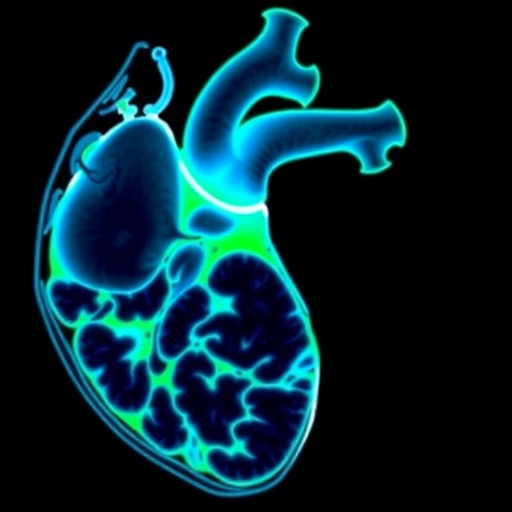
In a groundbreaking advancement for cardiology and medical imaging, researchers have harnessed the power of deep learning to tackle a longstanding challenge in the quantitative assessment of atrial fibrillation—a condition affecting millions worldwide. The focus is on the left atrial volume (LAV), a crucial biomarker linked to atrial fibrillation onset and progression. By integrating sophisticated cardiac computed tomography angiography (CTA) with state-of-the-art AI models, the study illuminates new paths for precision cardiac diagnostics and patient management.
Atrial fibrillation, characterized by irregular and often rapid heartbeats, poses significant risks including stroke and heart failure. Accurate measurement of the left atrium’s volume is critical for understanding the disease’s pathogenesis and tailoring appropriate treatments. Yet, the manual delineation of the left atrial anatomy on CTA images is time-consuming and prone to inter-observer variability. Recognizing these barriers, the research team embarked on developing an automated, reproducible method that leverages deep learning for efficient and accurate segmentation.
The study assembled a comprehensive multi-center cohort comprising 182 cardiac CTA datasets, each meticulously annotated by expert cardiologists. This robust dataset underpins the comparative evaluation of five cutting-edge deep learning architectures specialized in medical image segmentation: DAResUNet, nnFormer, xLSTM-UNet, UNETR, and VNet. These architectures represent some of the latest innovations in convolutional and transformer-based neural networks, designed to capture the complex structures within the cardiac images.
Delving into the results, DAResUNet emerged as the superior model with a Dice similarity coefficient (DSC) averaging 0.924, a performance metric indicative of remarkable overlap between predicted segmentations and expert annotations. It also achieved a notable Jaccard Index of 0.859, underscoring its reliability in capturing the intricate left atrial contours. However, when it came to minimizing boundary discrepancies, VNet excelled, delivering the lowest Hausdorff Distance and Average Surface Distance values, metrics that quantify boundary closeness and segmentation precision.
The rigorous validation extended beyond raw metrics: the researchers employed Bland–Altman analysis to compare the automated left atrial volume measurements against manual calculations. The findings revealed an exceptional agreement, with a mean bias of -5.69 mL and 95% limits of agreement spanning -19 to 7.6 mL, demonstrating that automated segmentation closely mirrors expert judgment, a breakthrough for clinical applicability.
The implications of these findings are profound for both cardiologists and radiologists. The ability to rapidly and accurately segment the left atrium on cardiac CTAs paves the way for integrating biomarkers like LAV into routine clinical workflows. Such automated assessments promise enhanced diagnostic accuracy, improved patient stratification, and real-time monitoring of atrial fibrillation progression or response to therapy, potentially transforming personalized medicine practices.
Technically, the study showcased the strengths of ensemble deep learning models in addressing medical imaging challenges. DAResUNet’s architecture, which combines residual connections with attention mechanisms, facilitates the model’s focus on relevant anatomical features while maintaining computational efficiency. The transformer-based nnFormer and UNETR models introduced powerful global context understanding, though their performance in this study was slightly eclipsed by convolution-centric approaches, demonstrating the nuanced trade-offs in model design.
Another critical aspect addressed was the generalizability of these models. By utilizing a multi-center dataset, the researchers ensured that variations in image acquisition protocols and patient demographics did not compromise model robustness. This feature is pivotal for widespread adoption across diverse clinical settings without the need for extensive retraining or calibration.
Furthermore, the study identified that although VNet excelled in limiting boundary errors, the overall volumetric accuracy favored DAResUNet, highlighting the importance of selecting segmentation models based on specific clinical endpoints—whether precise volume measurement or anatomical boundary delineation. This insight encourages future research to tailor AI solutions with application-specific priorities in mind.
In the broader context of medical AI, this research exemplifies a paradigm shift where deep learning does not merely replicate human expertise but extends it by offering high-throughput, consistent, and scalable solutions. The convergence of advanced imaging modalities with AI-powered analytics is reshaping cardiovascular medicine, enabling early detection and intervention strategies that could significantly reduce morbidity and mortality associated with arrhythmias.
The study concludes that automated LAV quantification using deep learning models is a promising tool for enhancing our understanding and management of atrial fibrillation. It opens avenues for further integrating cardiac imaging biomarkers into clinical decision-making, facilitating timely interventions and improved patient outcomes. As these technologies mature, the potential for AI-driven cardiac assessments to become standard clinical practice is within reach, heralding a new era in cardiac healthcare.
This research not only advances technical knowledge but also sets the stage for interdisciplinary collaboration between computer scientists, cardiologists, and radiologists. It exemplifies how AI innovations can be meticulously validated and translated into real-world tools that address pressing clinical challenges. Future studies are anticipated to explore how these models perform longitudinally, adapt to multimodal imaging, and incorporate other cardiac structures to provide a comprehensive cardiac health profile.
As healthcare systems worldwide embrace AI, studies like this underscore the critical importance of dataset quality, model interpretability, and clinical validation. The meticulous expert annotations paired with rigorous comparative analysis serve as a template for future investigations to build upon, ensuring that AI algorithms meet the highest standards of accuracy and reliability demanded by healthcare providers.
Ultimately, the fusion of deep learning with cardiac CTA imaging heralds a transformative era wherein clinicians are empowered with tools that dramatically enhance diagnostic precision, patient monitoring, and therapeutic decision-making. This progress promises to shift the narrative around atrial fibrillation from reactive management to proactive care, leveraging technology to save lives and improve heart health globally.
Cite Scienmag News
Blake Davidson. (September 26, 2025). Deep Learning Advances Left Atrial Imaging. Scienmag. https://scienmag.com/deep-learning-advances-left-atrial-imaging/
Blake Davidson. "Deep Learning Advances Left Atrial Imaging." Scienmag, 26 September 2025, https://scienmag.com/deep-learning-advances-left-atrial-imaging/. Accessed 4 September 2026.
Blake Davidson. "Deep Learning Advances Left Atrial Imaging." Scienmag. September 26, 2025. https://scienmag.com/deep-learning-advances-left-atrial-imaging/


