


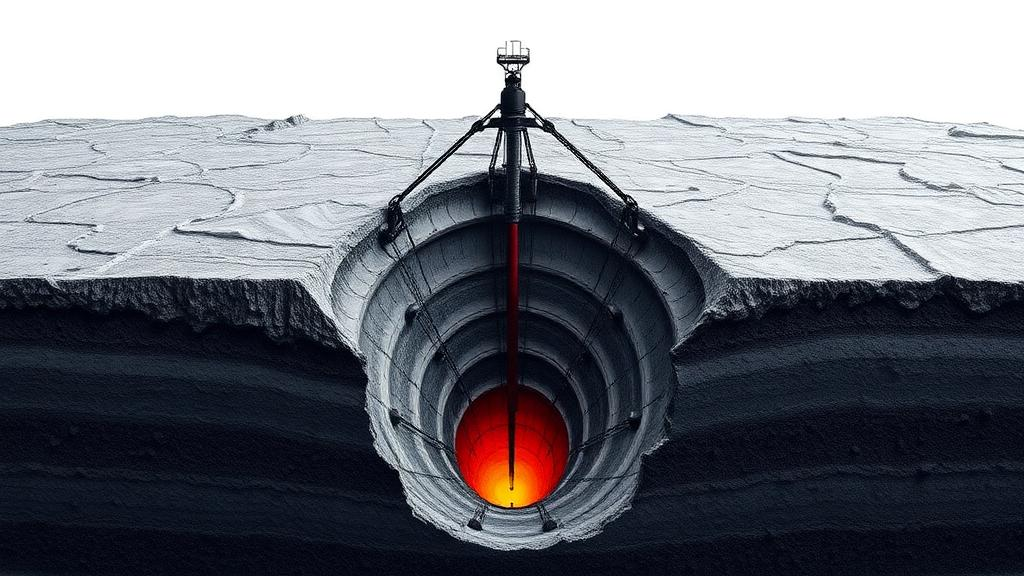
Beneath the quiet farmland of southwestern Germany, roughly 45 kilometers north of Lake Constance, lies a hidden archive of ice age violence. The Tannwald Basin, a deeply overdeepened trough carved into soft Molasse bedrock, was scoured out and filled by repeated advances of the Rhine Glacier over hundreds of thousands of years. Now, a scientific drill core recovered as part of the International Continental Scientific Drilling Program’s Drilling Overdeepened Alpine Valleys (DOVE) project has given researchers their most detailed look yet at how such buried basins form, deform, and record the rhythm of glacial cycles.
The new study, led by Bennet Schuster of the University of Freiburg together with colleagues from the University of Bern, the Leibniz Institute for Applied Geophysics, and the Baden-Württemberg State Office for Geology, was published in the journal Scientific Drilling. It presents a 166.25-meter-long sediment core from drill site ICDP DOVE 5068_1_C, retrieved in April 2021 on the western flank of the basin. The core, recovered with an overall rate of 95 percent and stored in opaque PVC liners under refrigeration, captures a layered history of glacial erosion, lake sedimentation, and tectonic-style deformation frozen into unconsolidated sediments.
Overdeepened valleys are one of the strangest legacies of glaciation. Glaciers do not simply follow the landscape; they dig below it, eroding elongated troughs beneath the fluvial base level through a combination of abrasion, plucking, and, crucially, the erosive power of pressurized subglacial meltwater. In the low-relief Alpine foreland, where steep valley gradients are absent, an increased availability of basal water is believed to have amplified this erosional potential far out onto the plains. When the ice retreated, these deep depressions became enormous sediment traps, capable of hosting stacked and nested sequences of glacial, proglacial, and post-glacial deposits that preserve evidence of advances otherwise erased from the surface record.
The Tannwald Basin first attracted scientific attention when a research drilling in 1993 and 1994, the Schneidermartin core, recovered fine-grained lacustrine sediments containing pollen indicative of the Holsteinian Interglacial, equivalent to Marine Isotope Stage 11. That discovery pushed the basin’s history back before the Holsteinian, leading researchers to assign its origins to the pre-Holsteinian Hosskirch glaciation. Seismic reflection surveys conducted in 2014 and 2015 subsequently revealed a depression up to 50 meters deep and several hundred meters wide within the basin, along with faults offsetting the upper fill by more than 2 meters and evidence of shallow glaciotectonic folding. The stage was set for a modern, high-resolution core to tie these threads together.
The DOVE team subjected the new core to a rigorous analytical workflow. Non-destructive whole-core scanning measured wet bulk density and magnetic susceptibility at 5-millimeter resolution, while high-resolution line-scan images supported the initial core description. A vane-shear tester systematically estimated undrained shear strength, and selected sections, particularly those suspected of containing ice-contact sediments, were examined with X-ray computed tomography at the University of Bern. Geochemical samples taken at 1-meter resolution provided carbon content, including total organic and inorganic carbon, which helped distinguish sediment sources and depositional settings throughout the sequence.
From these data the researchers defined 17 distinct lithotypes, 6 of them unique to the Tannwald core, and grouped them into seven lithofacies associations. At the base, the core encountered moderately consolidated sandstones, siltstones, and marls of the Upper Marine Molasse bedrock, whose sharp, planar contact at 155.90 meters depth marks the erosional floor of the overdeepening. Directly above lies a striking assemblage of deformed Molasse bedrock rafts, both consolidated and unconsolidated, intercalated with stratified diamicts containing glacially striated clasts of Alpine lithologies. Low density and shear-strength values below 50 kilopascals, combined with in-situ crushing and brecciation, identify this interval as a Type B glaciotectonite: bedrock and sediment sheared in place beneath moving ice. The team interprets it as evidence of subglacial till shearing and the mobilization of bedrock rafts, a process mirrored by the much larger, more than 10-meter bedrock slab documented in the older Schneidermartin core.
Above this basal shear zone, the record tells a story of ice proximity and retreat. Massive, matrix-supported diamicts with high densities of 2.4 grams per cubic centimeter and shear strengths of 200 to 270 kilopascals point to subglacial lodgement till deposited under temporary ice loading. These are interbedded with well-sorted, fining-upward fines bearing frequent dropstones, indicators of floating ice and deposition during episodes when the glacier bed decoupled from the ice, filling subglacial cavities or accommodation space beneath a floating tongue. Higher still, fine-grained rhythmmites and laminated clays with dropstones record an ice-contact proglacial lake, with soft-sediment deformation ranging from centimeter-thick slumps to meter-thick folded and faulted sections, evidence of gravitational slumping on water-saturated depositional slopes. The sequence culminates in glaciodeltaic sands and gravels formed by underflows from the retreating glacier front.
By integrating the core data with seismic profiles, morphostratigraphy, and previously published drill records, the team organized the basin fill into three lithostratigraphic units corresponding to at least three distinct glacial advances. Unit A records the initial erosion of the basin during the Hosskirch glaciation, subglacial traction processes, ice-proximal lake sedimentation, and finally delta formation as the glacier retreated; it is assigned to the Dietmanns Formation. Unit B documents a later glacier re-advance, likely accompanied by shallow secondary erosion, followed once again by delta development, and corresponds to the Illmensee Formation and the Riss glaciation of Marine Isotope Stage 6. Unit C, at the top, represents a proglacial outwash plain of the Würm glaciation, the Last Glacial Maximum, whose terminal moraine lies only about 100 meters southwest of the drill site. Notably, the organic matter content of the fill never reaches interglacial levels, suggesting the basin filled under persistently cold, periglacial conditions rather than during warm periods.
Perhaps the most dramatic finding concerns deformation deep within the subsurface. The Würm ice advance, which pushed push-moraines across the Lake Constance region, left cuspate-lobate folds documented by 3D seismic imaging at 60 meters depth near the drill site. Seismic reflections appear displaced and inclined at even greater depths of around 100 meters, which the authors correlate with faulting, folding, and oversteepening of strata in the older deltaic units. In other words, the Last Glacial Maximum ice, advancing across outwash beyond its moraine, physically squeezed and deformed sediments buried tens of meters below the surface, an alternative explanation to syn-sedimentary slumping for structures previously attributed to gravity alone.
The Tannwald record thus captures a multi-phase, stacked basin infill shaped by at least three glacial invasions, yet important questions remain. Without independent age control, the researchers cannot yet determine whether the recorded advances represent fluctuations within single glaciations or separate glacial cycles. Ongoing work, including a high-resolution cross-hole seismic survey between three boreholes drilled in a triangle with 28-meter sides, luminescence dating, and cosmogenic nuclide dating, promises to pin down the timing of each advance. Together with computed tomography scanning to characterize ice-contact sediments systematically, these efforts will place the Tannwald Basin within the broader glacial evolution of the Lake Constance amphitheater, and help decipher how climate teleconnections synchronized ice age glaciations across the Northern Hemisphere.
Subject of Research: Glacial overdeepening and sedimentary basin infill of the Tannwald Basin by repeated Rhine Glacier advances
Article Title: Shaped and filled by the Rhine Glacier: the overdeepened Tannwald Basin in southwestern Germany
Article References: Schuster, B., Gegg, L., Schaller, S., Buechi, M. W., Tanner, D. C., Wielandt-Schuster, U., Anselmetti, F. S., & Preusser, F. (2024). Shaped and filled by the Rhine Glacier: the overdeepened Tannwald Basin in southwestern Germany. Scientific Drilling, 33(2), 191-206. https://doi.org/10.5194/sd-33-191-2024
Image Credits: AI Generated
Keywords: Tannwald Basin, Rhine Glacier, overdeepened valleys, ICDP DOVE, glacial stratigraphy, subglacial till, glaciotectonics, Lake Constance, Quaternary glaciations, Scientific Drilling, drill core, Holsteinian Interglacial
Cite Scienmag News
Violet Maxwell. (October 10, 2026). Deep beneath a German basin, a drill core reveals three ancient invasions by the Rhine Glacier. Scienmag. https://scienmag.com/deep-beneath-a-german-basin-a-drill-core-reveals-three-ancient-invasions-by-the-rhine-glacier/
Violet Maxwell. "Deep beneath a German basin, a drill core reveals three ancient invasions by the Rhine Glacier." Scienmag, 10 October 2026, https://scienmag.com/deep-beneath-a-german-basin-a-drill-core-reveals-three-ancient-invasions-by-the-rhine-glacier/. Accessed 10 October 2026.
Violet Maxwell. "Deep beneath a German basin, a drill core reveals three ancient invasions by the Rhine Glacier." Scienmag. October 10, 2026. https://scienmag.com/deep-beneath-a-german-basin-a-drill-core-reveals-three-ancient-invasions-by-the-rhine-glacier/


