


In an extraordinary convergence of physics, chemistry, and nanotechnology, researchers at Flinders University have unveiled a groundbreaking study that harnesses the Earth’s magnetic field to influence the formation of nanomaterials in unprecedented ways. This pioneering research introduces a paradigm shift in our understanding of fluid dynamics, magnetic interactions, and chirality at the nanoscale—potentially rewriting the rules of how we manipulate materials for a sustainable future.
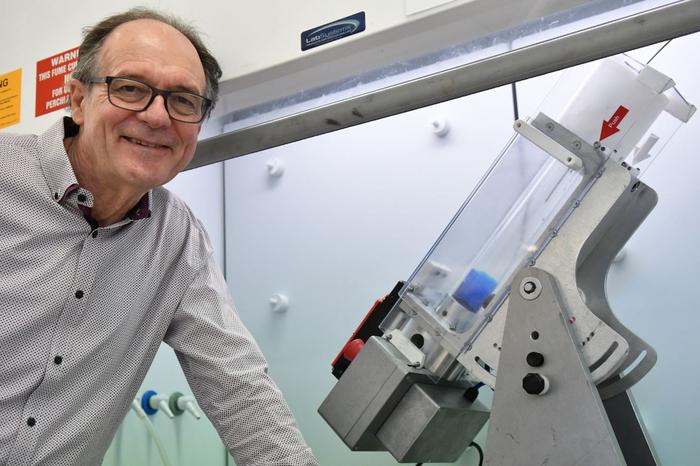
At the heart of this discovery lies the vortex fluidic device (VFD), an ingeniously designed apparatus invented nearly 15 years ago by Professor Colin Raston, a leading figure in clean technology. The VFD operates by rapidly spinning a thin film of fluid within a rotating tube, generating complex fluid flows characterized by high shear rates, double helical streams, and even typhoon-like vortices. This unique microfluidic environment creates conditions that accelerate chemical reactions, fragment tough materials, and guide molecular assembly, all while drastically reducing energy use and chemical waste.
In this latest study, the Flinders research team, in concert with international collaborators spanning the United States, Europe, and China, demonstrated for the first time that the Earth’s invisible magnetic field exerts a profound influence on these fluidic flows within the VFD. Through meticulous experimental modeling conducted in both the Northern and Southern Hemispheres, they revealed that the orientation of the rotating tube within the Earth’s magnetic field induces the formation of chiral nanostructures—structures that are distinctly ‘right-handed’ or ‘left-handed’—revealing an intrinsic coupling between fluid dynamics and geomagnetic forces.
The implications of this coupling are far-reaching. Chirality, or handedness, is a fundamental property in many biological molecules and materials, profoundly impacting their interactions and functionalities. Traditionally, controlling chirality during synthesis is a complex challenge, necessitating intricate and often costly chemical methods. The VFD’s ability to use magnetic-field-influenced fluid flows to steer chirality without added reagents offers a cleaner, energy-efficient route to fabricate chiral molecules, macromolecules, and advanced materials.
Professor Raston emphasized the subtle yet potent role of Earth’s magnetic environment, stating, “The Earth’s magnetic field is not innocent or innocuous. It aids in bird migration and now, as our experiments show, it can be harnessed as a positive force in human technological endeavors.” This revelation recasts the geomagnetic field as an underappreciated variable in nano- and micro-scale processes, opening prospects for harnessing natural forces in advanced material synthesis.
This trailblazing work involved a comprehensive data collection effort across multiple laboratories worldwide. The collaborative approach allowed for validation and reproducibility, ensuring that the observed chiral formations linked to the rotation direction—clockwise or anticlockwise—were genuinely affected by geomagnetic polarity and not artifacts of local conditions. Such robust international validation underscores the universal applicability of these findings.
Beyond elucidating this fundamental science, the study paves the way for tangible advances in areas ranging from pharmaceuticals to quantum technology. The precise control over chirality could revolutionize the development of better drug molecules, whose activity often hinges on their handedness. Moreover, the researchers highlight potential breakthroughs in the fabrication of novel metamaterials—engineered composites with unique electromagnetic properties—that are essential components in cutting-edge quantum devices designed to manipulate photons and electrons.
Notably, the sensitivity of the VFD to the Earth’s magnetic field rivals sophisticated quantum sensors based on molecular spin systems. This remarkable sensitivity could redefine how magnetic fields are detected and employed in environmental sensing, quantum information processing, and nanoscale manufacturing, cultivating a synergy between classical magnetic fields and quantum technologies.
The environmental credentials of the VFD extend beyond its magnetic field applications. Its capacity to reduce solvent use, energy consumption, and hazardous byproducts makes it a cornerstone technology for sustainable green chemistry. By extracting DNA, separating proteins, purifying water, and even ‘unboiling eggs’—a metaphor for reversibly denaturing proteins—the VFD continues to demonstrate versatility and innovation in chemical and biological processing.
This study, published in the journal Small (DOI: 10.1002/smll.202409807), is titled “Chiral Lemniscate Formation in Magnetic Field Controlled Topological Fluid Flows” and represents a significant milestone in nanomaterial science. The detailed experimental analysis and theoretical modeling shed light on the topological fluid phenomena governing chirality selection, potentially igniting a wave of future research into magnetic field-manipulated fluid dynamics at the nanoscale.
The research team’s interdisciplinary efforts reflect a growing trend in science where complex, real-world problems demand the integration of physics, chemistry, engineering, and environmental science. Professor Raston’s VFD exemplifies innovation born at such intersections, offering not only novel scientific insights but practical technologies to address urgent challenges in healthcare, materials science, and sustainability.
Looking ahead, the team envisions exploring the full three-dimensional parameter space of applied magnetic and electric fields in fluidic environments, an uncharted territory ripe with promise for optimizing reaction outcomes and fabricating new classes of quantum-functional materials. The intricate dance between magnetic field orientation, fluid rotation, and molecular assembly might become a foundation for the next generation of adaptive, responsive nanomanufacturing systems.
In conclusion, this landmark study bridges an essential gap in our understanding of how natural magnetic fields can actively shape the physical and chemical properties of materials synthesized under controlled fluid dynamic conditions. The harnessing of the Earth’s magnetic field to influence nanomaterial chirality is not only a scientific breakthrough but a beacon guiding the future of sustainable and precise nanomanufacturing.
News Publication Date: 3-Apr-2025
Web References:
DOI link
Flinders Institute for Nanoscale Science and Technology
Professor Colin Raston’s Laboratory
References:
Jellicoe, M., Gardner, Z., Alotaibi, A.E.H., Shoemaker, K.E., Scott, J.M., Wang, S., Alotaibi, B.M., Luo, X., Chuah, C., Gibson, C.T., He, S., Vimalanathan, K., Gascooke, J.R., Chen, X., Rodger, A., Huang, H., Dalgarno, S.J., Antunes, E., Weiss, G.A., Li, Q., Quinton, J.S., & Raston, C.L. (2025). Chiral Lemniscate Formation in Magnetic Field Controlled Topological Fluid Flows. Small. Wiley-VCH GmbH. DOI: 10.1002/smll.202409807
Keywords
Vortex fluidic device, Earth’s magnetic field, chiral nanomaterials, fluid dynamics, green chemistry, nanofabrication, topological fluid flows, quantum sensing, metamaterials, clean technology, sustainable nanomanufacturing, high-shear processing
Cite Scienmag News
Bethany Barker. (April 15, 2025). Decoding How Earth’s Magnetic Field Influences Fluid Flow. Scienmag. https://scienmag.com/decoding-how-earths-magnetic-field-influences-fluid-flow/
Bethany Barker. "Decoding How Earth’s Magnetic Field Influences Fluid Flow." Scienmag, 15 April 2025, https://scienmag.com/decoding-how-earths-magnetic-field-influences-fluid-flow/. Accessed 4 September 2026.
Bethany Barker. "Decoding How Earth’s Magnetic Field Influences Fluid Flow." Scienmag. April 15, 2025. https://scienmag.com/decoding-how-earths-magnetic-field-influences-fluid-flow/


