


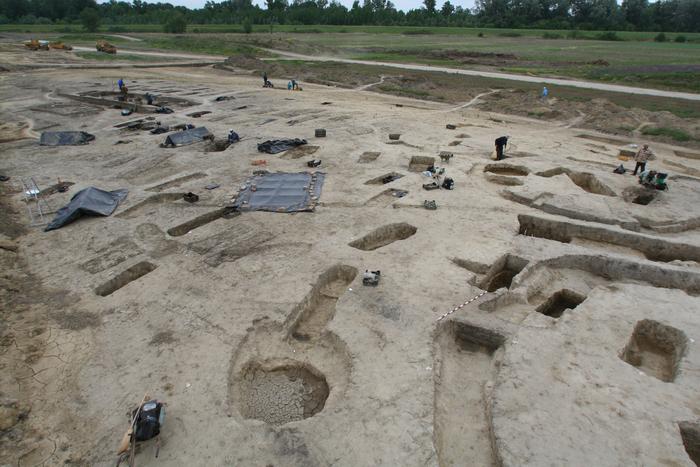
The Avars, who had come from Eastern Central Asia, ruled much of Eastern Central Europe for a quarter millennium, from the 6th to the 9th century CE. They may be less known than their less successful predecessors, the Huns. Yet in their cemeteries, they left one of the richest archaeological heritages in European history, including around 100,000 graves that have so far been excavated. From Avar funeral customs, and from written reports of their neighbours, scholars have reconstructed some of their social practices and ways of life. Yet now, archaeogenetics offer a totally new viewpoint on Avar communities who lived more than 1000 years ago. We can now analyse the ways in which individuals were related to each other up to the sixth to tenth degree.

Credit: Institute of Archaeological Sciences, Eötvös Loránd University
Múzeum, Budapest, Hungary
The Avars, who had come from Eastern Central Asia, ruled much of Eastern Central Europe for a quarter millennium, from the 6th to the 9th century CE. They may be less known than their less successful predecessors, the Huns. Yet in their cemeteries, they left one of the richest archaeological heritages in European history, including around 100,000 graves that have so far been excavated. From Avar funeral customs, and from written reports of their neighbours, scholars have reconstructed some of their social practices and ways of life. Yet now, archaeogenetics offer a totally new viewpoint on Avar communities who lived more than 1000 years ago. We can now analyse the ways in which individuals were related to each other up to the sixth to tenth degree.
By combining newly generated ancient DNA data with complementary archaeological, anthropological and historical information, a team of the multidisciplinary Synergy Grant research project HistoGenes funded by the European Research Council (ERC) has thus opened new ways to find out more about kinship patterns, social practices and population development in the distant past. The team includes researchers from the Max Planck Institute for Evolutionary Anthropology in Leipzig, Germany, together with Hungarian, Austrian and US research groups. In their collaboration, they set new standards by using all available methods, including the most advanced genetic and bio-informatic tools.
Studying whole communities
The historical knowledge on the Avar period populations was passed on to us by their enemies, mainly the Byzantines and the Franks, so we lack information on the internal organisation of their clans. Women are particularly underrepresented in historical sources, with only three incidental mentions, so knowledge of their lives is practically non-existent. We know that some groups came to Europe from the East Asian and Pontic steppes, but to what extent, if at all, were steppe traditions maintained in Avar society if at all? How did the newcomer groups from the East interact with each other and with the population of their new homeland in Europe? In essence, how did their way of life change over time in a completely new environment after they left the steppes and abandoned their nomadic way of life?
The study was carried out as part of the ERC Synergy Grant project HistoGenes (No. 856453), by a multidisciplinary research team of geneticists, archaeologists, anthropologists and historians, including researchers from the Max Planck Institute for Evolutionary Anthropology in Leipzig, Germany, the Institute of Archaeological Sciences and Department of Biological Anthropology at Eötvös Loránd University (ELTE), Institute of Archaeogenomics, HUN-REN Research Centre for the Humanities, Budapest, Hungary, the Curt Engelhorn Center for Archaeometry in Mannheim, Germany, the Institute for Austrian Historical Research of the University of Vienna, Austria, the Institute for Advanced Study in Princeton, USA, and others. Contrary to common practice in ancient DNA research, the team aimed to study whole communities and therefore focused on sampling all available human remains from four fully excavated Avar period cemeteries. Thanks to exceptional aDNA preservation, they were able to analyse a total of 424 individuals and discovered that around 300 had a close (1st and 2nd degree) relative buried in the same cemetery. This allowed the reconstruction of several extensive pedigrees, the largest of which is nine generations deep and spans about 250 years.
Community dynamics
The researchers were able to identify communities that practised a strict patrilineal descent system, where patrilocality (male individuals staying in the community after marriage) and female exogamy (female individuals moving to their partner’s community after marriage) were the norm. Communities were locally centred around a main patriline, were related to each other through the systematic practice of female exogamy. Zuzana Hofmanová, senior author of the study says: “In a way, this pattern shows the role of females in promoting the cohesion of this society, it was the role of females that connected the individual communities”. Multiple reproductive partners were common. Several independent cases show that these communities practised so-called levirate unions. This practice involves related male individuals (siblings or father and son) having offspring with the same female individual. Guido Alberto Gnecchi-Ruscone, first author of the study, adds: ”These practices, together with the absence of genetic consanguinity, indicate that the society maintained a detailed memory of its ancestry and knew who its biological relatives were over generations”.
These social practices are consistent with evidence from historical sources and anthropological research on Eurasian Steppe societies. Thanks to the high resolution provided by the extensive pedigrees and whole-cemetery data, the researchers were also able to identify a clear temporal transition within one of the sites analysed. This was revealed by the shift from one patriline to another and by changes in patterns of distant relatedness (the network of genetic relatedness, i.e. the IBD-network). Zsófia Rácz, co-first author of the study, says: “This community replacement reflects both an archaeological and dietary shift that we discovered within the site itself, but also a large-scale archaeological transition that occurred throughout the Carpathian Basin”. This change, probably related to political changes in the region, was not accompanied by a change in ancestry and would therefore have been invisible without the study of whole communities. This finding highlights how genetic continuity at the level of ancestry can still conceal replacements of whole communities, and has important implications for future studies comparing genetic ancestry and archaeological shifts.
###
This research project has been funded by the European Research Council (ERC) under the European Union’s Horizon 2020 research and innovation programme (Grant Agreement No. 856453 ERC-2019-SyG HistoGenes). HistoGenes is a research framework investigating the period of 400 to 900 CE in the Carpathian Basin from an interdisciplinary perspective.
Journal
Nature
Article Title
Network of large pedigrees reveals social practices of Avar communities
Article Publication Date
24-Apr-2024
Cite Scienmag News
Courtney Benton. (April 24, 2024). Decoding Avar society. Scienmag. https://scienmag.com/decoding-avar-society/
Courtney Benton. "Decoding Avar society." Scienmag, 24 April 2024, https://scienmag.com/decoding-avar-society/. Accessed 3 September 2026.
Courtney Benton. "Decoding Avar society." Scienmag. April 24, 2024. https://scienmag.com/decoding-avar-society/

