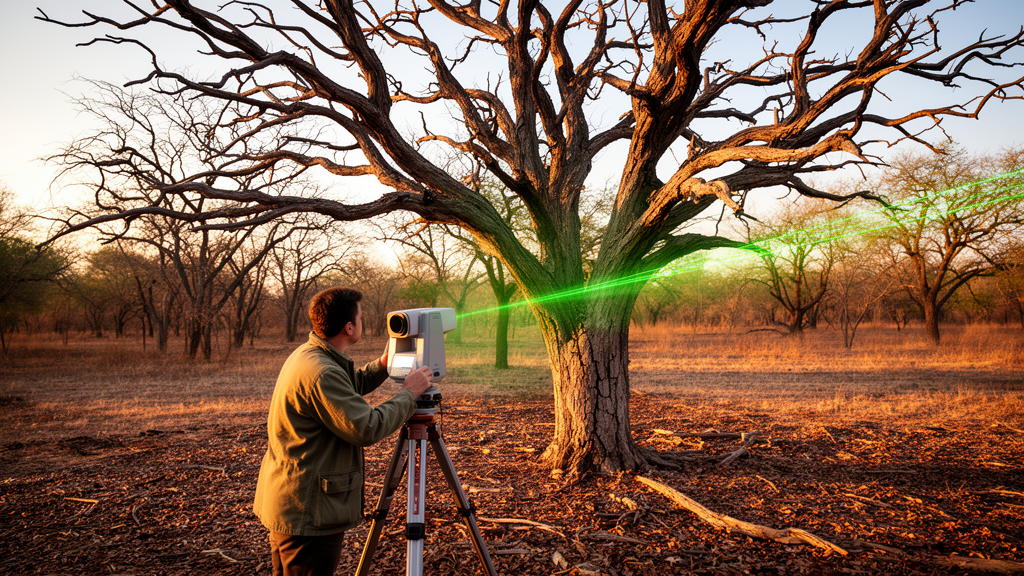
Dead branches of trees are by no means static. They move visibly in the course of the day, and for the first time this movement has been quantitatively proven under real forest conditions. Geoinformatics researchers at Heidelberg University, working with the Finnish Geospatial Research Institute (FGI), tracked the phenomenon using an autonomously operating terrestrial laser scanning system and a specially developed tracking algorithm, mapping a boreal forest plot at regular intervals and measuring even small branch displacements with precision.
Trees appear static at first sight, but they are constantly adapting to influences from their environment and continually moving their branches in response. A systematic movement of dead tree branches had long been suspected, yet it had never been quantitatively demonstrated in the field. The 3D Geospatial Data Processing (3DGeo) research group at Heidelberg University’s Institute of Geography, led by Prof. Dr. Bernhard Höfle, took up this question in international cooperation with the FGI. Using terrestrial laser scanning, the scientists automatically measured the suspected movement in detail every hour over several days, and made it visible by means of their tracking algorithm.
To explain what drives these movements, the researchers modeled the anatomical and mechanical properties of tree branches. They found that relative humidity is one of the key factors: as it changes, the branch wood absorbs or releases moisture, causing the wood to expand or contract. This hygroscopic response is the suspected engine of the daily motion, and the field measurements were designed to test whether the observed displacements actually follow it.
The mechanism is not uniform across a branch. As Vanessa Guthier, a research assistant with the 3DGeo research group, explains, the change in length does not occur uniformly across the branch’s cross-section. Depending on the tree species, the upper and lower parts expand at differing rates. As a result, even dead branches can move significantly up or down as humidity fluctuates during the day. The analyses showed that all branches studied followed a clear, systematic pattern of daily movement.
The study covered branches of 16 conifers and one deciduous tree in a boreal forest in Hyytiälä, Finland. The dead conifer branches moved downward during the day and upward at night, while the dead birch branch the team studied exhibited the opposite pattern.
The movement proved to be closely connected with what is called the wood equilibrium moisture content, a quantity calculated from relative humidity and air temperature. Crucially, the branch movements did not track this modeled moisture signal instantaneously. They occurred with a time lag that averaged approximately three and a half hours after the changes in moisture content, which the scientists modeled from the meteorological data. Guthier notes that the results support the assumption that the daily movements of dead branches are primarily due to the hygroscopic properties of the wood — that is, they are caused by the absorption and release of moisture in the wood itself.
The precise quantification also revealed that the movement signatures of living and dead branches clearly differ from one another. That distinction is what gives the method practical potential. By analyzing these patterns with the tracking algorithm and the autonomous laser scanning system, it would ultimately be possible to identify dead branches on several trees at the same time, without any physical contact with the trees being monitored.
Prof. Höfle underlines that this research approach offers great opportunities for tree monitoring in forests and cities, enabling automated tracking of tree health and the detection of an early decline in tree vitality.
The findings from the research cooperation between Heidelberg University’s Institute of Geography and the Finnish Geospatial Research Institute have been published in the journal Agricultural and Forest Meteorology. The work was funded by the German Research Foundation, the Research Council of Finland, and the Tulanet Postdoctoral Programme for Research Institutes in Finland. As with any single-plot field study, the results describe the observed boreal forest site and the branches measured there; the authors present the humidity-driven mechanism as supported by their combined measurements and modeling, and the movement patterns as a promising basis for future automated tree-health monitoring rather than a deployed operational tool.
Subject of Research: Hygroscopic daily movement of dead tree branches measured with terrestrial laser scanning in a boreal forest
Article Title: Even dead tree branches move during the day
Article References: Even dead tree branches move during the day. Original publication (Bibliographic details unavailable.)
Image Credits: AI Generated
DOI: Not provided
Keywords: terrestrial laser scanning, dead branches, hygroscopic movement, relative humidity, wood moisture content, boreal forest, tree health monitoring, geoinformatics, tracking algorithm, Heidelberg University, Finnish Geospatial Research Institute, branch movement
Cite Scienmag News
Reid Dalton. (October 28, 2026). Dead Tree Branches Move Daily, Laser Scanning Study Shows. Scienmag. https://scienmag.com/dead-tree-branches-move-daily-laser-scanning-study-shows/
Reid Dalton. "Dead Tree Branches Move Daily, Laser Scanning Study Shows." Scienmag, 28 October 2026, https://scienmag.com/dead-tree-branches-move-daily-laser-scanning-study-shows/. Accessed 29 October 2026.
Reid Dalton. "Dead Tree Branches Move Daily, Laser Scanning Study Shows." Scienmag. October 28, 2026. https://scienmag.com/dead-tree-branches-move-daily-laser-scanning-study-shows/