


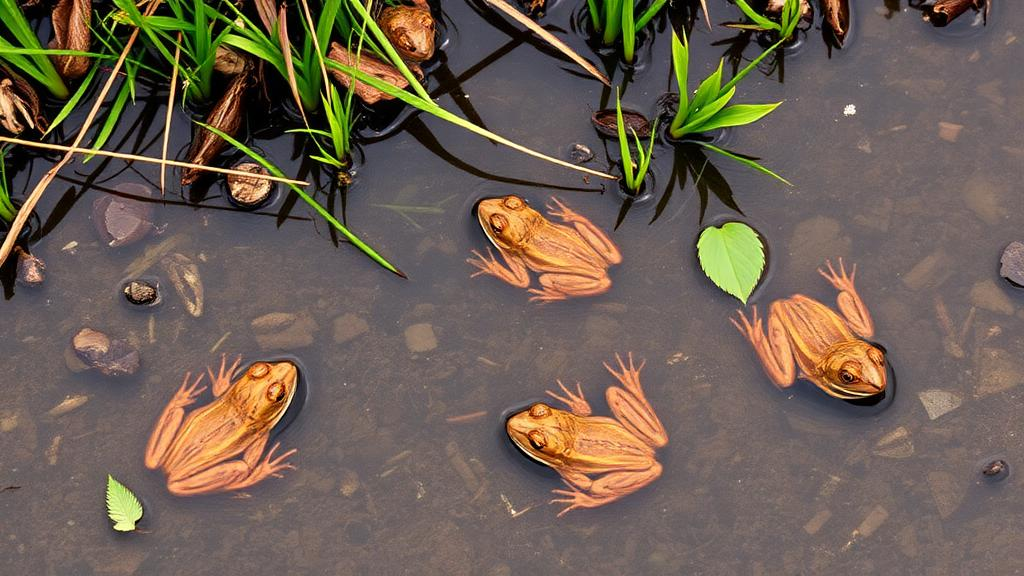
In the misty bogs of the Waldviertel region in Lower Austria, a quiet engineering project is paying unexpected dividends for some of Europe’s most threatened animals. A new study, published in the journal Herpetozoa, shows that the artificial water bodies created when ecologists block old drainage ditches in restored peatlands are being enthusiastically colonized by amphibians and reptiles. Across four restored peatlands, researchers counted more than 1,500 amphibians belonging to eight species, along with 64 individuals of four reptile species, turning what were once degraded, drained wastelands into surprisingly rich wildlife refuges.
The story of these peatlands is, until recently, a story of loss. Over the past century, artificial drainage ditches were cut through the Waldviertel’s acidic bogs so that the land could be used for forestry, agriculture and peat extraction. Draining lowers the water table, halts peat formation, alters soils and vegetation, and reshapes the entire biodiversity of the site. In Austria, the damage has been severe: more than 90 percent of the country’s peatlands have been destroyed. Growing tree cover compounds the problem, because increased transpiration dries out the peat even further, while natural water bodies are converted into linear ditch networks that restructure species composition.
Many of the surviving Waldviertel peatlands now sit inside the Natura 2000 network, the European Union’s system of protected areas, and are gradually being restored. The central technique is disarmingly simple: workers block the drainage ditches with wooden dams. Water backs up behind these barriers, refilling the ditches and flooding the peat pools that dotted the historic bog. From 2017 to 2021, the four study sites—Haslauer Moor, Heidenreichsteiner Moor, Schremser Hochmoor and Schwarzes Moos—were among those included in a cross-border INTERREG restoration project, and earlier efforts by the Worldwide Fund for Nature and LIFE projects had already dammed ditches and cleared central bog areas at some sites. These newly rewetted structures are what ecologists call secondary habitats: not pristine, but potentially valuable substitutes for the natural waters that vanished with the peat.
Whether such artificial waters actually support endangered wildlife has been an open question, particularly for amphibians—animals whose semi-permeable skin and aquatic life stages make them acutely sensitive to water chemistry. Peatland water is notoriously acidic, and laboratory and field studies elsewhere have shown that mortality rises sharply when pH falls below about 4. Yet some species persist in bogs: the Moor Frog’s spawn and larvae are known to tolerate acidic conditions, and Green Frogs use peatlands as summer habitats in North America. The Austrian team set out to determine whether blocked ditches and peat pools in the Waldviertel function as genuine breeding grounds, and to compile a baseline inventory of the region’s herpetofauna, for which data—especially on reptiles—had been scarce.
The fieldwork combined six complementary survey methods for amphibians between April and June 2018: acoustic mapping of calling males, visual searches for spawn, dip-netting for larvae with a fine 2-millimeter mesh, evening torch surveys for newts, baited fish traps set overnight, and opportunistic visual encounters. Reptiles were surveyed from June to mid-August along roughly 400-meter zigzag transects through open moorland, forest edges and the banks of water bodies, during the morning and late-afternoon hours when reptiles bask or forage. The researchers also measured the pH of every water body with a portable meter and mapped twelve distinct microhabitat types—from open moorland with moss to silting peat pools—using orthophotos and GIS software, then ran an indicator species analysis to test whether any animals showed strong habitat preferences.
The results were striking. In total, the team recorded 1,520 amphibians, including larvae and spawn, across eight species: Common Toad, European Tree Frog, Edible and Pool Frogs (grouped as Pelophylax sp., since the two hybridize and cannot be reliably separated in the field), Moor Frog, Agile Frog, Common Frog, Alpine Newt and Smooth Newt. Peat pools proved the busiest waters, holding 725 individuals, with Pelophylax water frogs the most abundant at 416 individuals and Common Toad tadpoles close behind at 250. Blocked ditches hosted 174 individuals across six species, including the tree frog and Alpine Newt. Silting peat pools emerged as the richest microhabitat of all, and Pelophylax frogs were found in nine of the twelve habitat types. Notably, the indicator analysis found no statistically significant habitat specialists, suggesting the animals use these waters opportunistically rather than depending on any single structure.
Perhaps the most remarkable finding came from Schwarzes Moos, the most damaged site, where only one hectare of the original 54-hectare bog survives beside the Czech border. Its water bodies measured a mean pH of just 3.72, with readings as low as 3.2—levels at which many amphibian species cannot survive, since mortality increases when pH drops below 4. In comparable Norwegian studies, successful reproduction was not observed below pH 5.2 for the Moor Frog. Yet at Schwarzes Moos the researchers recorded calling Common Toads, water frogs, Moor Frogs and Common Frogs, and even found Agile Frog spawn. The Moor Frog’s acid tolerance is well documented, but the presence of other species at such extreme acidity hints at local adaptation or at pH fluctuations driven by rainfall that might temporarily open windows for breeding. The authors caution that single-season measurements cannot capture the full chemical variability of bog pools, and they call for year-round abiotic monitoring to untangle the relationship between acidity and amphibian success.
The reptile picture, though sparser, was equally encouraging. Sixty-four individuals of four species were found: the legless Slow Worm, the Grass Snake, the adder (Vipera berus) and the Viviparous Lizard, the latter the most frequently recorded and present at all four sites. Viviparous Lizards, which can submerge for up to twenty minutes to escape predators, were most often spotted between wet moss cushions in open moorland, where they shelter from heat and water loss. Grass Snakes, which feed heavily on frogs, were also found at every site—a direct indication that the restored waters support enough amphibian prey to sustain predators. Most exciting was the adder, listed as vulnerable in Austria and restricted there to montane-alpine regions and the Bohemian Mass. Consistent with its need for quickly warming structures, it was found near dead wood, on moss pads and in tall grass, with all four reptile species co-occurring only at Heidenreichstein.
Five of the fifteen species potentially present in the region are classified as vulnerable, and the study confirms that restoration is delivering habitat for several of them. But the researchers also flag a looming management dilemma. Peat pools and ditches will inevitably silt up through natural succession, and dense tree canopies plus sphagnum growth have been shown elsewhere to depress amphibian breeding, while ditches left untended become poor habitat for brown frogs. Studies in drained peatlands suggest that clearing ditches and removing shrubs can boost colonization, at least in the short term. Since the Natura 2000 management plan aims for a natural climax of moor forest, the authors argue that targeted interventions—maintaining open water and sun-exposed moorland patches—should be weighed carefully in conservation planning.
For a country that has lost nearly all of its peatlands, the message from the Waldviertel is quietly optimistic: even small, artificial, highly acidic water bodies created by restoration can become functioning ecosystems within years of rewetting. As habitat loss, fragmentation, pollution, invasive species, disease and climate change continue to squeeze amphibians and reptiles worldwide, every secondary habitat counts. The wooden dams that hold back water in these Austrian bogs are doing far more than restoring carbon-storing peat—they are building nurseries for toads, frogs, newts, lizards and even adders, one flooded ditch at a time.
Subject of Research: Use of restored peatland water bodies by amphibians and reptiles in Lower Austria
Article Title: Water bodies created by peatland restoration are potential habitats for amphibians and reptiles
Article References: Stückler, S., Sonnleitner, R., & Schweiger, S. (2024). Water bodies created by peatland restoration are potential habitats for amphibians and reptiles. Herpetozoa, 37, 347-358. https://doi.org/10.3897/herpetozoa.37.e130028
Image Credits: AI Generated
DOI: 10.3897/herpetozoa.37.e130028
Keywords: peatland restoration, amphibians, reptiles, Waldviertel, Natura 2000, drainage ditches, peat pools, pH tolerance, Moor Frog, Viviparous Lizard, herpetology, Austria
Cite Scienmag News
Margaret Porter. (October 19, 2026). Damned Ditches, New Life: Restored Peatland Pools Become Havens for Frogs, Newts and Snakes. Scienmag. https://scienmag.com/damned-ditches-new-life-restored-peatland-pools-become-havens-for-frogs-newts-and-snakes/
Margaret Porter. "Damned Ditches, New Life: Restored Peatland Pools Become Havens for Frogs, Newts and Snakes." Scienmag, 19 October 2026, https://scienmag.com/damned-ditches-new-life-restored-peatland-pools-become-havens-for-frogs-newts-and-snakes/. Accessed 19 October 2026.
Margaret Porter. "Damned Ditches, New Life: Restored Peatland Pools Become Havens for Frogs, Newts and Snakes." Scienmag. October 19, 2026. https://scienmag.com/damned-ditches-new-life-restored-peatland-pools-become-havens-for-frogs-newts-and-snakes/


