

Wednesday, July 8, 2026
Science
No Result
View All Result
  • Login
  • HOME
  • SCIENCE NEWS
  • CONTACT US
  • HOME
  • SCIENCE NEWS
  • CONTACT US
No Result
View All Result
Scienmag
No Result
View All Result
Home Science News Policy

Cutting Vehicle Emissions Could Save Thousands of Canadian Lives

July 8, 2026
in Policy
Reading Time: 2 mins read
0
Cutting Vehicle Emissions Could Save Thousands of Canadian Lives

Cutting Vehicle Emissions Could Save Thousands of Canadian Lives

65
SHARES
587
VIEWS
Share on FacebookShare on Twitter
ADVERTISEMENT

A groundbreaking study led by researchers at McGill University reveals that transitioning to cleaner transportation methods could prevent over 3,600 premature deaths in Montreal and Toronto. The findings, published in the journal Environmental Science & Technology, highlight the pernicious health impacts of ultrafine particles (UFPs) emitted predominantly from vehicle exhaust.

Ultrafine particles, often less than 100 nanometers in diameter, are notorious for penetrating deep into the respiratory system and entering the bloodstream. These particles exacerbate cardiovascular and pulmonary conditions, increasing mortality risks. Despite their threat, UFPs remain unregulated in Canada, a gap this new research underscores urgently.

Marshall Lloyd, the study’s lead author and an epidemiologist at McGill, explains that while traditional air quality regulations have curtailed pollutants like nitrogen dioxide and particulate matter, UFP emissions have not been addressed with the same rigor. Given their microscopic size and abundance near traffic corridors, these particles represent a stealthy but serious public health challenge.

The study employed sophisticated modeling techniques, integrating real-world emissions data and climate policy targets from Montreal and Toronto. Scenarios explored included varying levels of electric vehicle (EV) adoption, ranging from moderate to near complete market penetration by 2040, alongside strategies for retiring older diesel trucks and reducing overall traffic volumes. Using demographic and health statistics, the researchers quantified potential reductions in premature deaths linked to UFP exposure under these conditions.

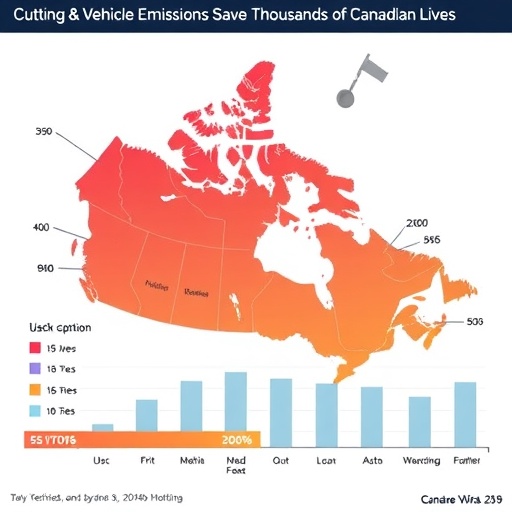
Their projections were striking: the most ambitious scenario, featuring rapid EV adoption (approximately 50% of all vehicles by 2030 and nearing 100% by 2040), accelerated retirement of pre-2007 heavy-duty diesel trucks, and decreased traffic levels, could avert around 1,100 deaths in Montreal and more than 2,500 in Toronto over two decades. Even more moderate interventions, such as maintaining current traffic volumes while retiring older diesel vehicles, still promised to prevent over 3,300 premature deaths between the two cities.

Senior author Scott Weichenthal, a professor in population and global health, emphasizes the environmental justice implications of these findings. Cleaner air would disproportionately benefit neighborhoods with higher concentrations of low-income residents, immigrants, and visible minorities—communities often situated adjacent to major highways and disproportionately exposed to harmful emissions.

This research delivers a compelling argument for urgent policy action targeting UFPs through a combination of aggressive electrification of transport fleets, elimination of legacy diesel vehicles, and urban planning to manage traffic density. It not only advances scientific understanding of ultrafine particle mortality risk but also offers a roadmap for public health improvements.

In an era marked by climate change and urban pollution, these findings illuminate a path where technological transition aligns with saving thousands of lives. As cities worldwide grapple with air quality challenges, the McGill study underscores how cleaner vehicles can be a potent weapon against an invisible but deadly pollutant.

Subject of Research: People
Article Title: Estimating Reductions in Premature Mortality Attributable to Outdoor Ultrafine Particles with Increasing Prevalence of Electric Vehicles and Other Tailpipe-Related Emission Reduction Scenarios
News Publication Date: 20-Jun-2026
Web References: http://dx.doi.org/10.1021/acs.est.6c00907
Keywords: Air pollution, Ultrafine particles, Electric vehicles, Premature mortality, Traffic emissions

Tags: air pollution modeling and climate policyCanadian air quality regulationsdiesel truck retirement policieselectric vehicle adoption in Canadaelectric vehicle market penetration targetsimpact of vehicle exhaust on respiratory healthpollution mitigation strategies in Montreal and Torontopublic health benefits of cleaner transportationtransportation-related premature deathsultrafine particles health impactunregulated ultrafine particle emissionsvehicle emissions reduction
Share26Tweet16
Previous Post

HSE Study Identifies Internet Users Most Likely to Fact-Check Online

Next Post

Medical School Leader Chosen for RWJF Health Policy Fellowship Program

Related Posts

Sister Projects Urge Stronger EU Measures to Save Europe’s Wetlands
Policy

Sister Projects Urge Stronger EU Measures to Save Europe’s Wetlands

July 8, 2026
Korea University and UNIST chosen for K-MediST health program
Policy

Korea University and UNIST chosen for K-MediST health program

July 6, 2026
At DFG annual gathering, researchers rally to safeguard scientific freedom—and deliver a blistering rebuke to AfD’s research agenda
Policy

At DFG annual gathering, researchers rally to safeguard scientific freedom—and deliver a blistering rebuke to AfD’s research agenda

July 6, 2026
Innovative Zero-Waste Techniques Revolutionize Plastic and Color Recycling
Policy

Innovative Zero-Waste Techniques Revolutionize Plastic and Color Recycling

July 2, 2026
Urban Forests: Vital Infrastructure for Climate Resilience, Biodiversity, and Public Health
Policy

Urban Forests: Vital Infrastructure for Climate Resilience, Biodiversity, and Public Health

July 1, 2026
Enhancing Hierarchical Policies: Optimizing Performance Bounds through Dynamic Skill Refinement
Policy

Enhancing Hierarchical Policies: Optimizing Performance Bounds through Dynamic Skill Refinement

July 1, 2026
Next Post
Medical School Leader Chosen for RWJF Health Policy Fellowship Program

Medical School Leader Chosen for RWJF Health Policy Fellowship Program

  • Mothers who receive childcare support from maternal grandparents show more

    Mothers who receive childcare support from maternal grandparents show more parental warmth, finds NTU Singapore study

    27656 shares
    Share 11059 Tweet 6912
  • University of Seville Breaks 120-Year-Old Mystery, Revises a Key Einstein Concept

    1061 shares
    Share 424 Tweet 265
  • Bee body mass, pathogens and local climate influence heat tolerance

    682 shares
    Share 273 Tweet 171
  • Researchers record first-ever images and data of a shark experiencing a boat strike

    546 shares
    Share 218 Tweet 137
  • Groundbreaking Clinical Trial Reveals Lubiprostone Enhances Kidney Function

    531 shares
    Share 212 Tweet 133
Science

Embark on a thrilling journey of discovery with Scienmag.com—your ultimate source for cutting-edge breakthroughs. Immerse yourself in a world where curiosity knows no limits and tomorrow’s possibilities become today’s reality!

RECENT NEWS

  • Enhancing Person-Centred Care with Saliency and Tacit Knowledge Insights
  • NEP89 enables universal neuroevolution for 89 inorganic and organic elements
  • SwRI study links primordial mini-moons to meteorite compositions
  • ORNL Wins Five DOE Transportation Technologies Office Awards

Categories

  • Agriculture
  • Anthropology
  • Archaeology
  • Athmospheric
  • Biology
  • Biotechnology
  • Blog
  • Bussines
  • Cancer
  • Chemistry
  • Climate
  • Earth Science
  • Editorial Policy
  • Marine
  • Mathematics
  • Medicine
  • Pediatry
  • Policy
  • Psychology & Psychiatry
  • Science Education
  • Social Science
  • Space
  • Technology and Engineering

Subscribe to Blog via Email

Enter your email address to subscribe to this blog and receive notifications of new posts by email.

Join 5,147 other subscribers

© 2025 Scienmag - Science Magazine

Welcome Back!

Login to your account below

Forgotten Password?

Retrieve your password

Please enter your username or email address to reset your password.

Log In
No Result
View All Result
  • HOME
  • SCIENCE NEWS
  • CONTACT US

© 2025 Scienmag - Science Magazine

Discover more from Science

Subscribe now to keep reading and get access to the full archive.

Continue reading
