

Groundbreaking advances in 3D scanning technology are revolutionizing how scientists measure and understand tropical rainforests’ complex structures, volumes, and carbon storage capacities. A pioneering pilot study led by UCL researchers has produced an unprecedented multiscale dataset that captures the intricate details of tree biomass across three continents. This unique initiative, known as ForestScan, combines terrestrial, drone-mounted, and airborne laser scanning techniques with meticulous in-situ forest census data to chart the living mass—and therefore carbon stock—within dense tropical forests with unparalleled precision.
Published in the influential journal Earth System Science Data, the ForestScan dataset represents one of the most comprehensive efforts ever undertaken to quantify forest structure in tropical ecosystems. Tropical forests play a vital role in sequestering atmospheric carbon dioxide, thus mitigating climate change. However, accurately determining the biomass stored in these forests has been an ongoing challenge due to their dense and multilayered canopies. This dataset addresses that gap by providing high-resolution, three-dimensional measurements across approximately 550 hectares in three ecologically diverse tropical regions: Paracou in French Guiana, Lopé National Park in Gabon, and the Kabili-Sepilok Forest Reserve in Malaysia.
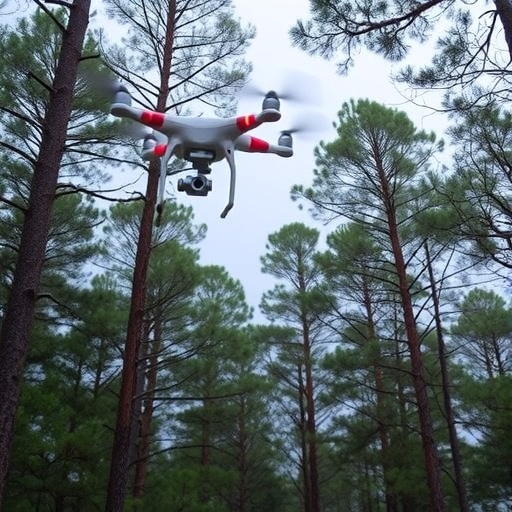
ForestScan utilizes a sophisticated suite of laser scanning technologies to capture forest structure at different spatial scales. Terrestrial Laser Scanning (TLS) systems operate from the forest floor, producing detailed scans of tree trunks and lower canopy elements. Complementing this, Uncrewed Aerial Vehicle Laser Scanning (UAV-LS) involves drones equipped with lasers that fly over the forest canopy and gather fine-scale elevation data. Meanwhile, Airborne Laser Scanning (ALS) covers larger forest areas through laser mapping performed from planes, enabling the assessment of broad landscape-level forest structures. Together, these methods build an integrative, multiscale model of forest biomass distribution, providing volumetric tree information with centimeter-level accuracy.
Critically, this remote sensing data is augmented by hands-on fieldwork through an extensive forest census. Local researchers collaborated closely to tag, measure, and count roughly 7,000 trees manually within the surveyed plots, recording trunk circumference, species identification, and spatial location. This meticulous on-the-ground data validates and refines the laser scan information, enabling algorithms to more accurately interpret remote measurements and calibrate biomass and carbon estimation models. This blend of field measurements and advanced sensing technologies is instrumental in unlocking the latent patterns embedded within tropical forest ecosystems.
Such precision in biomass measurement is crucial not only for ecological understanding but also for climate change mitigation strategies. Forests act as massive carbon sinks, absorbing carbon dioxide and storing it in woody tissues. It is estimated that approximately fifty percent of a tree’s live mass consists of carbon sequestered from the atmosphere. Consequently, determining the exact biomass is essential for calculating carbon stocks and fluxes, which informs carbon offset programs, forest conservation policymaking, and global carbon cycle modelling. ForestScan’s data enables more reliable assessments of how much carbon is stored within tropical forests and how these stocks respond dynamically to environmental pressures.
The implications for satellite remote sensing are profoundly transformative. Satellite forest monitoring missions, such as the European Space Agency’s BIOMASS satellite, rely heavily on ground-truth data to develop and validate their biomass retrieval algorithms. ForestScan provides a benchmark dataset that these satellites can leverage to improve global biomass mapping accuracy. This calibration is vital to detect changes in forest carbon levels associated with deforestation, degradation, fires, or illegal logging activities—factors that contribute substantially to carbon emissions and biodiversity loss.
The cross-continental scope and multi-institutional collaboration embodied in ForestScan exemplify the future of environmental science. As part of the larger GEO-TREES consortium, the project establishes a global network of Forest Biomass Reference Measurement Sites (FBRMS) dedicated to standardized, high-fidelity forest monitoring. This approach fosters international collaboration, data sharing, and methodological harmonization, enabling scientists to track tropical forests comprehensively across space and time. The resulting datasets pave the way for novel insights into ecosystem functioning, forest resilience, and carbon balance modeling that extends beyond local studies.
Lead author Dr. Cecilia Chavana-Bryant from UCL Geography emphasizes the scope and scale of this endeavor as unprecedented. The study’s fine-grained analysis reveals nuanced patterns in forest structure that simpler models cannot capture, reflecting real-world heterogeneity in forest composition, tree size distribution, and canopy complexity. These detailed insights facilitate robust ecological and climate models, improving predictive capacity for how forests will behave under future climate scenarios. This foundational data resource is a breakthrough for researchers, policymakers, and conservation stakeholders alike.
Achieving ForestScan’s technological rigor demanded overcoming myriad technical and logistical challenges. Navigating dense tropical forests with laser equipment requires specialized expertise and coordination among international and local teams. Furthermore, integrating datasets from diverse platforms—ground-based scans, drone flights, and airborne sensors—necessitated developing innovative data fusion and analysis pipelines. The project also prioritized capacity building in the regions studied, empowering local scientists with skills and tools to sustain continuous forest monitoring beyond the initial study period.
Forests’ role in carbon sequestration has never been more critical as climate targets tighten globally. ForestScan’s groundbreaking approach directly supports efforts to combat climate change by supplying the reliable data needed for transparent carbon accounting. This empowers stakeholders to measure the effectiveness of conservation investments, track offset credits accurately, and ensure accountability in forest management practices. The ability to detect subtle changes in biomass further enhances early warning systems for forest health and resilience, enabling more proactive ecosystem management.
Already, the ForestScan beta dataset has been accessed over 20,000 times by researchers and organizations worldwide, underscoring its global relevance and utility. Users from more than 150 countries tap into this rich trove of information, illustrating the hunger for dependable forest data in the scientific community and beyond. With continued support, such collaborative and open data initiatives will accelerate understanding of Earth’s vital tropical forests and foster innovative solutions to protect these ecosystems amid escalating environmental pressures.
Professor Mat Disney, senior author and expert in remote sensing at UCL, highlights the broader context of this research: forests provide countless ecosystem services beyond carbon storage, including biodiversity habitat, water regulation, and cultural values. Nevertheless, quantifying carbon dynamics remains a cornerstone challenge for climate mitigation dialogues and investments. ForestScan’s exceptional accuracy brings clarity and confidence to forest carbon inventories, facilitating more effective climate action and sustainable forest stewardship at multiple levels.
In sum, the ForestScan project heralds a new era in tropical forest science, demonstrating how modern laser scanning technologies combined with rigorous fieldwork can illuminate forest biomass and carbon storage with extraordinary resolution. As the demand for credible environmental data grows, such innovative approaches are indispensable for advancing climate science, shaping conservation strategies, and supporting international commitments for forest protection and restoration. The future of tropical forest research — and the fight against global warming — looks decidedly more precise and informed thanks to this landmark work.
Subject of Research: Tropical Forest Structure and Biomass Measurement Using Multiscale Laser Scanning and In-situ Census Data
Article Title: ForestScan: a unique multiscale dataset of tropical forest structure across 3 continents including terrestrial, UAV and airborne LiDAR and in-situ forest census data
News Publication Date: 16 February 2026
Web References: https://doi.org/10.5194/essd-18-1243-2026
References:
Chavana-Bryant, C., Wilkes, P., Disney, M., et al. (2026). ForestScan: a unique multiscale dataset of tropical forest structure across 3 continents including terrestrial, UAV and airborne LiDAR and in-situ forest census data. Earth System Science Data. https://doi.org/10.5194/essd-18-1243-2026
Image Credits: Mat Disney
Keywords: Tropical ecosystems, Forest biomass, Remote sensing, Terrestrial Laser Scanning, UAV Laser Scanning, Airborne Laser Scanning, Carbon storage, Forest structure, Ecology, Forest monitoring


