


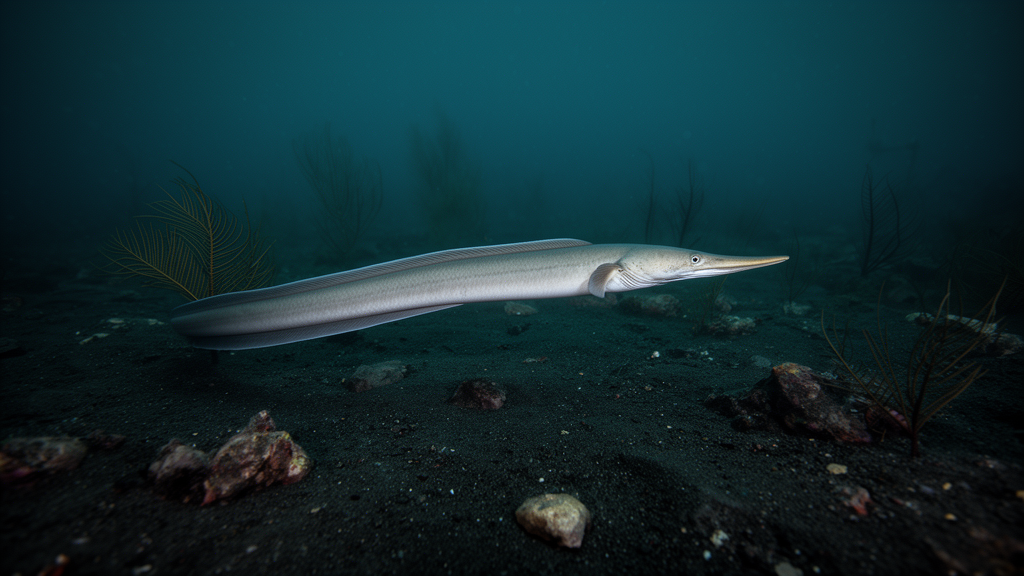
A large individual of the cutthroat eel Meadia roseni has been collected from a fishing port in central Vietnam, marking the first time this deep-water species has been recorded anywhere outside Taiwan, the country where it was originally described more than three decades ago. The specimen, catalogued as NMMB-P39330 and measuring 845 mm in total length, was gathered by the first author of the new study at the Luong Son fishing port in Nha Trang city, at coordinates of approximately 12 degrees 20 minutes north and 109 degrees 12 minutes east, on the western edge of the South China Sea.
Meadia roseni belongs to the family Synaphobranchidae, a group of eels often referred to as cutthroat eels, and to the genus Meadia, commonly known as arrowtooth eels. That genus is a small one, comprising only three nominal species. It was established by Bohlke in 1951 to accommodate the abyssal cutthroat eel, Dysomma abyssale Kamohara, 1938, which had originally been described from Japan. A second species, Meadia roseni itself, was described by Mok, Lee and Chang in 1991 from southern Taiwan, based on material collected off Tongkang, also written Dong-gang, in southwestern Taiwan, at a depth of 1020 meters. The third and most recent member of the genus, Meadia minor, was described from Vietnam by Vo and colleagues in 2021, in a paper that also discussed the identification of closely related genera.
Until now, every confirmed record of Meadia roseni came from Taiwanese waters. The species was originally described from a single specimen, and was later recorded by several authors in checklists and catalogs of the Taiwanese fish fauna, including works published in 2011 and 2015. None of those records came from outside Taiwan, even after many intensive collecting activities in nearby areas over the past 20 years, as the authors of the new study note. That makes the Vietnamese specimen not only a first record for Vietnam but also the only known occurrence of the species beyond its type locality, a significant extension of the documented range of an animal that had previously been known from a single stretch of the northern South China Sea.
The newly collected specimen is a robust, moderately slender eel. Its body depth at the gill opening is 13.1 times in the total length, and the body depth remains relatively uniform along the trunk, narrowing gradually toward the caudal fin. The head and trunk are slightly compressed, becoming more compressed toward the posterior part of the tail. The anal fin is much higher than the dorsal fin, about twice its depth, and its height is about one quarter of the body depth without fins; the anal fin is continuous with a small caudal fin. The pectoral fins are well developed, with the lower end of the fin base at around the upper end of the gill opening, and the pectoral-fin length is 25.0 percent of the head length, or 4.0 times in it.
The head is moderately long and rather robust, with a bump in its dorsal profile, and its length is 15.5 percent of the total length, or 6.5 times in it. The origin of the dorsal fin lies slightly behind the gill opening, above the vertical through the anterior third of the pectoral fin, with a predorsal length of 17.2 percent of the total length. The trunk is short, at 8.3 percent of the total length, and the anus sits well forward, about half a head length behind the pectoral-fin base, giving a preanal length of 23.8 percent of the total length. The tail is very long, accounting for 76.2 percent of the total length. The snout is blunt anteriorly and broad dorsally, densely covered with numerous papillae and fleshy bumps, and its tip projects beyond the lower jaw. The snout length is 27.4 percent of the head length. The eye is moderately small, covered by a thick and semitransparent membrane, with a diameter of 7.7 percent of the head length, or 3.6 times in the snout length, and the interorbital space is very broad, flat or slightly concave, at 18.8 percent of the head length.
The sensory and skeletal details of the specimen are recorded in full in the new description. The anterior nostrils are tubular and directed forward, while the posterior nostril is a small rounded pore with a low rim and an anterior flap, situated in front of the eye and slightly higher than the lower margin of the eye. The lower jaw is shorter than the upper, its tip reaching the first pore of the supraorbital series, and the end of the mouth gape lies well behind the eye, with the upper-jaw length at 31.7 percent of the head length. The gill opening is large and semicircular, its upper end right below the lower end of the pectoral-fin base. The head-pore counts are recorded as four supraorbital pores including the ethmoid, one adnasal pore, six infraorbital pores on one side, and ten preopercular-mandibular pores, with eleven on the left side, and no supratemporal or frontal pores. The lateral line is almost complete, its canal extending to about one eye diameter before the caudal fin base, with nine pores before the dorsal fin, fourteen before the anal fin, thirty-one before the anus, and a total of roughly 195 pores.
The dentition of the specimen is described in detail as well. The teeth on the jaws are blunt to conical and somewhat granular, with the interspaces densely covered with numerous cirri that make the teeth not easily recognized. On the intermaxillary there is an oval patch of moderately large teeth, with about 13 small teeth along the anterior and lateral margins, followed by a long patch of about 12 enlarged and stout teeth arranged in about three rows at the middle, and then small stout teeth posteriorly. The maxilla carries a long band of about four to five rows of slightly pointed teeth, the smallest on the outer row and the larger ones gradually further inward. The lower jaw carries about five to six rows of stout teeth anteriorly, gradually becoming four rows posteriorly, again with the smallest teeth on the outer row. The vertebral counts are 13 pre-dorsal vertebrae, 30 pre-anal vertebrae, 63 pre-caudal vertebrae, and a total of 197 vertebrae, with 41 dorsal-fin rays before the anal-fin origin, 430 total dorsal-fin rays, and 394 total anal-fin rays.
In life, the animal was uniformly grayish brown to dark brown. The anterior two thirds of the dorsal fin were grayish brown with a broad pale margin, gradually becoming darker with the margins narrowing, and darkened at about one head length from the posterior end. The anterior half of the anal fin bore a narrow pale margin that likewise became darker and narrower toward the rear, darkening at about one head length from the posterior end, and the caudal fin was black. The peritoneum was pale with fine black pepper dots, and the stomach and intestines were pale. These fresh color photographs, taken off Nha Trang, accompany the formal description and provide a visual record of the species in its newly documented part of its range.
Compared with the measurements reported by Vo and colleagues in 2021 for Taiwanese material, the Vietnamese specimen shows a slightly longer head, at 15.5 percent of total length against 13.6 to 14.3 percent, a slightly longer predorsal length, at 17.2 percent against 15.4 to 15.9 percent, and a slightly longer preanal length, at 23.8 percent against 22.0 to 23.5 percent. It also has a slightly shorter snout, at 27.4 percent of head length against 28.0 to 31.2 percent, a smaller eye, at 7.7 percent of head length against 8.5 to 9.8 percent, and a broader interorbital space, at 18.8 percent of head length against 16.0 to 17.0 percent. The arrangement of the teeth is also slightly different, and in general the Vietnamese specimen carries more teeth than the specimens from Taiwan. When the authors examined a number of specimens from Taiwan, they found that the number of teeth is lower in smaller specimens, those under 500 mm in total length, and gradually becomes higher in larger specimens, suggesting a growth change in the species.
The study also documents some variation in the head pores of the species. The Vietnamese specimen has two infraorbital pores behind the eye on its right side. Among Taiwanese comparative material, the authors found two pores on the left side of one specimen and two on both sides of another, which suggests that some variation in head pores is present in this species. In addition, the authors counted ten to twelve preopercular-mandibular pores in the Taiwanese specimens, with ten or eleven being the most common counts. Taken together, the authors conclude that the new specimen represents the first record of Meadia roseni for Vietnam and the only record outside Taiwan, and that it may suggest the species has a broader distribution range than previously documented, although compared with other synaphobranchids it may still have a more or less restricted range, found mostly in the northern part of the South China Sea. The authors also note that although intensive samplings have been carried out in past decades, many eel species new to the ichthyofauna of Vietnam continue to be described, which points to a high eel diversity in the country.
Subject of Research: The first record of the cutthroat eel Meadia roseni from Vietnam, based on a single specimen collected at Nha Trang.
Article Title: New record of the cutthroat eel, Meadia roseni ( Actinopterygii : Anguilliformes : Synaphobranchidae ), from Vietnam
Article References: Ho, H.-C., & Vo, Q. V. (2024). New record of the cutthroat eel, Meadia roseni (Actinopterygii: Anguilliformes: Synaphobranchidae), from Vietnam. Acta Ichthyologica et Piscatoria, 54, 209-212. https://doi.org/10.3897/aiep.54.122733
Image Credits: AI Generated
Keywords: Meadia roseni, cutthroat eel, Synaphobranchidae, Vietnam, South China Sea, new record, taxonomy, ichthyology, Nha Trang, eel diversity, Taiwan, morphology
Cite Scienmag News
Margaret Porter. (October 27, 2026). Cutthroat eel Meadia roseni recorded in Vietnam for the first time, far beyond its Taiwanese type locality. Scienmag. https://scienmag.com/cutthroat-eel-meadia-roseni-recorded-in-vietnam-for-the-first-time-far-beyond-its-taiwanese-type-locality/
Margaret Porter. "Cutthroat eel Meadia roseni recorded in Vietnam for the first time, far beyond its Taiwanese type locality." Scienmag, 27 October 2026, https://scienmag.com/cutthroat-eel-meadia-roseni-recorded-in-vietnam-for-the-first-time-far-beyond-its-taiwanese-type-locality/. Accessed 27 October 2026.
Margaret Porter. "Cutthroat eel Meadia roseni recorded in Vietnam for the first time, far beyond its Taiwanese type locality." Scienmag. October 27, 2026. https://scienmag.com/cutthroat-eel-meadia-roseni-recorded-in-vietnam-for-the-first-time-far-beyond-its-taiwanese-type-locality/


